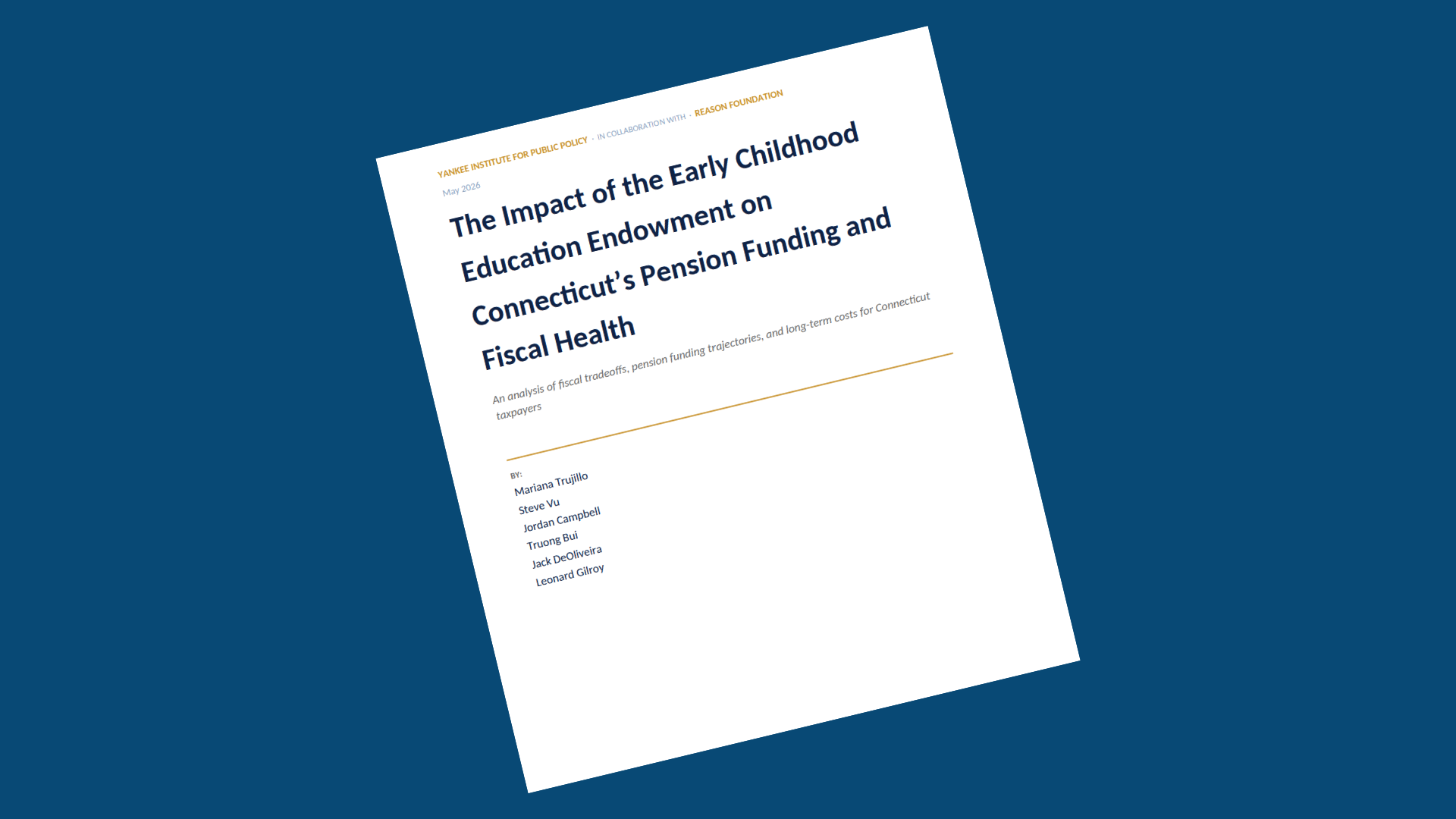
A new analysis from Yankee Institute, in partnership with the Reason Foundation, finds that Connecticut’s Early Childhood Education Endowment (ECEE) diverts surplus revenues away from pension debt reduction, undermining the fiscal guardrails that have helped stabilize the state’s finances.
The study, The Impact of New Initiatives to Divert Funds from Connecticut’s Pensions, examines how redirecting year-end General Fund surpluses from supplemental pension contributions into a new endowment affects the state’s long-term fiscal outlook.
“Connecticut’s fiscal guardrails were designed to correct decades of pension underfunding by prioritizing debt reduction,” said Mariana Trujillo, managing director of government finance at the Reason Foundation and author of the study. “Redirecting surplus revenues from pensions slows that progress, raises long-term costs, and reintroduces fiscal risk—without generating endowment spending at the scale policymakers suggest.”
“The guardrails have worked because they impose discipline and prioritize paying down long-term liabilities,” said Carol Platt Liebau, president of Yankee Institute. “Any changes should preserve these core functions; otherwise, they risk undoing the progress Connecticut has made.”
Key findings include:
- Connecticut ranks as the second most indebted state in the nation, in both total long-term debt and pension debt per capita.
- Under pre-ECEE funding patterns, supplemental contributions were set to accelerate full pension funding by up to 10 years and reduce cumulative pension costs by up to $10 billion over 30 years.
- Redirecting $300 million annually to the endowment would increase inflation-adjusted pension costs by $300–$900 million over 30 years, depending on returns and economic conditions.
- It is unlikely that the ECEE will be enough to cover the program’s promises. Even under optimistic assumptions, the endowment’s inflation-adjusted annual spending reaches only $240 million by 2035 and $369 million by 2045, remaining modest relative to Connecticut’s existing $400+ million annual early childhood education budget.
“The creation of the pre-K endowment sets a precedent for expanding spending outside the budget cap while Connecticut remains one of the most indebted states in the country,” Trujillo added. “That weakens the guardrails that underpinned recent credit upgrades and risks reopening the door to long-term fiscal stress.”
The new report is the second collaboration between Reason Foundation and Yankee Institute. The prior joint study, The Case for CT’s Fiscal Guardrails (2024), found that the reforms have saved Connecticut more than $170 million and, if maintained, could save the state $7 billion over the next 25 years.
TO READ THE FULL REPORT:
- Click beneath report to expand screen for full view.
- Click on side arrows to flip the pages.
- Click on “+” or “-” to zoom in and out on pages.