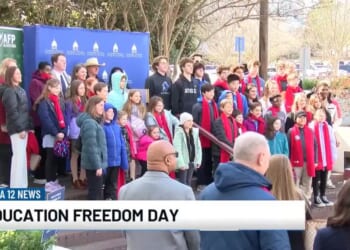
The 2023 ban on suspensions (exclusionary discipline) for K-3 students continues to invite commentary.
Conversation erupted once more last week during the House Education Finance Committee meeting. Rep. Bryan Lawrence brought forth HF 3493, which, among other things, primarily broadened the list of schools available for safe schools funding. An amendment attached to the bill modified current non-exclusionary discipline requirements. It would allow a district to dismiss a student in kindergarten through third grade for up to three school days with the approval of the district superintendent or charter school administrator. It also requires a
safety threat to the child or others for a suspension to occur.
Anoka-Hennepin Superintendent Cory McIntyre, who works for the largest school district in Minnesota, testified in favor of the discipline requirement modification. He said that in the past school year up to Feb. 9, the district had 142 K-3 classroom evacuations due to unsafe and dysregulated student behavior. In that same time, there were 157 staff injuries — 110 of which were caused at the K-3 level. McIntyre asked that lawmakers lift the universal ban on exclusionary discipline and give flexibility to school administrators. He noted that districts need time for a school team to work in partnership with families to create a long-term plan that addresses the child’s behavior and prioritizes their return to school.
Ramsey Elementary School Principal Denise Schnabel also testified in favor of the modification, saying that “we are seeing a rise in high-intensity behavior incidents that exceed the capacity of a traditional tool…there is a misconception that elementary education only involves little people with little problems.” In the past year, her elementary school has faced arson by a 1st grader and a hold-in-place order of an entire wing of her building for almost an hour due to a violent 2nd grader. The elementary school has faced staff absences due to teachers who have suffered concussions, bites breaking the skin, and bone bruises.
(My colleague Catrin Wigfall wrote a report in 2019 detailing Ramsey Elementary’s experiment with nonverbal holistic discipline and how it led to chaotic classrooms.)
Schnabel noted in her testimony, “These are traumatic events, witnessed by many which have shattered the sense of school safety for our entire community.” While Schnabel emphasized that restorative practices are the first choice within the school, she argued that administrative flexibility for student discipline is essential. For Schnabel, suspensions are a necessary tool in unique cases to repair the environment shattered by violence and draft a long-term plan for each child that ensures their success.
Ramsey Elementary isn’t the only school facing the threat of arson from younger learners. In early April, St. Cloud’s Westwood Elementary School experienced a fire that caused more than $2 million in damage and required the school to close for more than a week. The suspected culprit was a 9-year-old student.
Other organizations agreed with the school administrators. A written testimony submitted by the Minnesota Association of School Administrators (MASA), the Association of Metropolitan School Districts (AMSD), the Minnesota School Boards Association (MSBA), the Minnesota Association of School Business Officials (MASBO) and the Minnesota Rural Education Association (MREA) read in part:
[W]e we support allowing dismissals for students in kindergarten through grade 3 for up to three school days under strict conditions to ensure student and staff safety. This provision would provide our educators with the time needed to put appropriate supports in place so students can return to a stable and supportive learning environment.
Testifiers opposing the modification included representatives from Education Minnesota, the Multicultural Autism Action Network, and the Solutions Not Suspensions Coalition. They raised concerns about significant racial disparities in past K-3 suspension rates and argued that suspensions do not benefit students or their community. Erin Sandsmark, executive director of Solutions Not Suspensions, testified in favor of the current protocol. “I ask you, what is the actual educational benefit of a suspension?…It helps no one…Our collective goal must be to address underlying behavior issues by positive and restorative practices.”
HF 3493 failed on a party-line vote, but given that other lawmakers have constructed similar efforts to modify the exclusionary discipline ban during this session, it seems clear that the discussion of Minnesota’s best practices for school discipline are far from over.
Next Steps
While we at American Experiment are deeply supportive of holistic discipline practices that involve collaborative work between a student’s family and school staff, we are also concerned at the rising number of reports related to classroom dysfunction, consistent classroom evacuations, and violent young students.
While the Minnesota Department of Education nominally publishes school violence data, the most updated data is two years out of date. Measuring school violence is always difficult due to the unmeasurable nature of violence itself and the natural incentives for teachers and administrators to underreport or downplay incidents. Unfortunately, the obscuration of the data by the years-long delay in reporting makes a clear assessment of the situation nearly impossible.
Policymakers should consider legislation like Florida’s Teachers’ Bill of Rights, which communicates to teachers and students alike that school violence is unacceptable and that teachers will receive administrative support during disciplinary issues. Additionally, while it’s unlikely to pass in this year’s session, legislators should consider modifying or repealing the K-3 suspension ban. If principals and superintendents are directly informing legislators of a desperate need for local flexibility and control, elected officials should listen to the experts at hand.