
Yesterday, I wrote about Census Bureau data which show that Minnesota’s net loss of residents since 2020 was worse than in 34 other states. Data from the Internal Revenue Service (IRS) allow us to dig into this a little.
A common reply to points such as I made yesterday is to say that our net loss of residents is mostly retirees. I’m not clear why this is supposed to make the phenomenon nothing to worry about, but it isn’t even true, in any case.
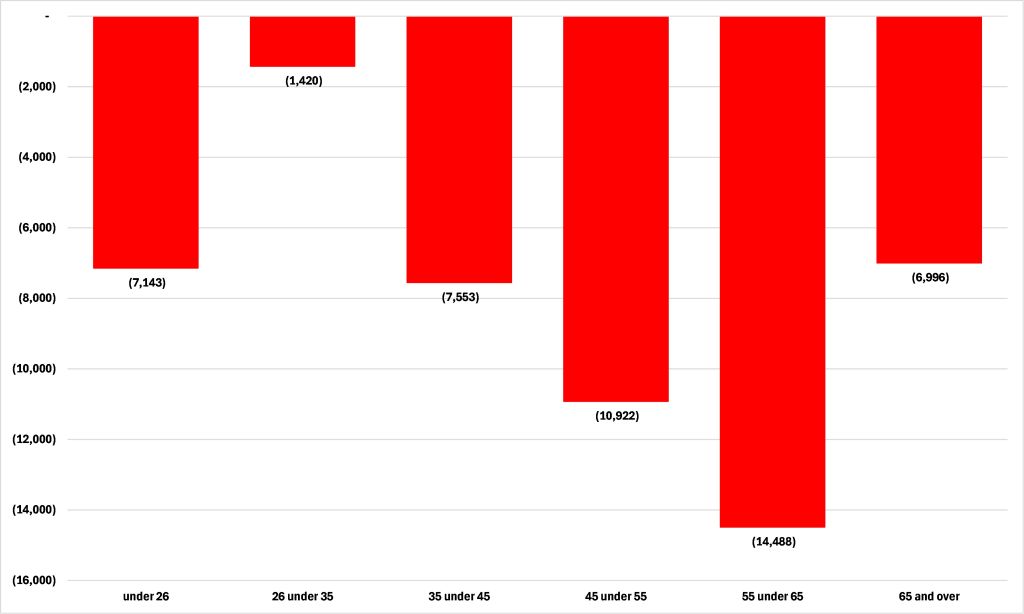
As Figure 1 shows, between 2019-2020 and 2022-2023 — the most recent year for which data are available — Minnesota saw a net loss of residents in each of the six categories the IRS reports; indeed, the net loss among those aged 65 and over was lower than in four other categories. We are, in the main, losing people in the prime of their working lives.
Figure 1: Minnesota’s net loss of residents by age of primary taxpayer, 2019-2020 to 2022-2023
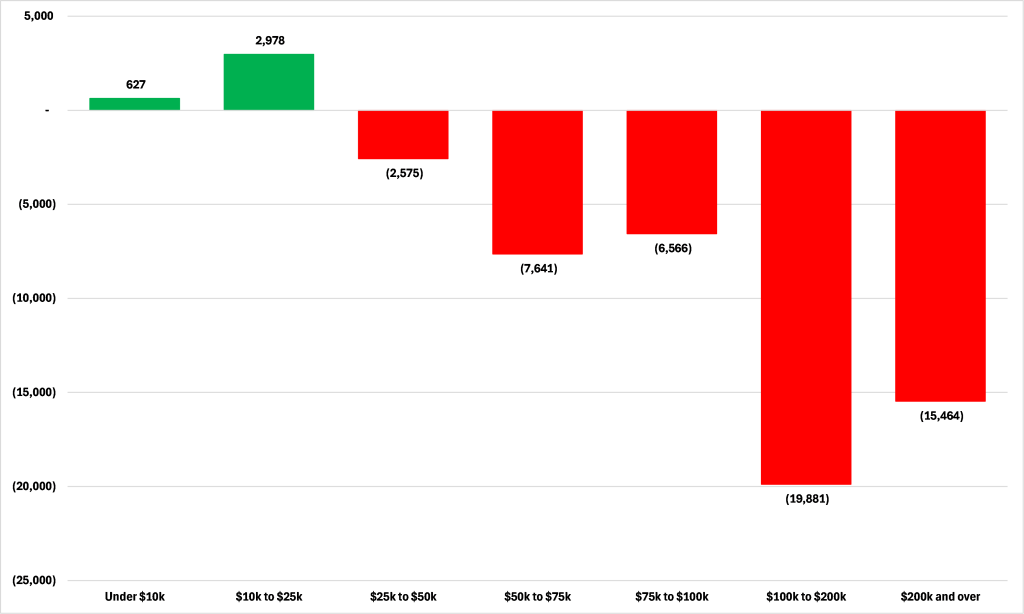
As Figure 2 shows, it is true that, between 2019-2020 and 2022-2023, Minnesota saw its biggest net losses of residents among those with incomes over $100,000 annually, but it is also true that our state has lost residents in every category above an income of $25,000 annually; even middle-class residents are fleeing our state. By contrast, we have seen a net inflow of residents with incomes below $25,000 annually.
Figure 2: Minnesota’s net loss/gain of residents by income of primary taxpayer, 2019-2020 to 2022-2023
When I wrote about the most recent data recently, I concluded:
Taken together, these data show that…Minnesota lost residents and income, on net, to other parts of the United States, generally those with lower taxes. In addition, our state continued to see population loss pretty much across the board in terms of age, with a concerning ongoing loss of young people, and persistent loss of higher income/more skilled workers and gain of lower income/less skilled ones. For the sake of our state’s economic health, we have to work to reverse these trends.
The same is true over the longer horizon.