Being an economist by trade, I am not always the best at applying KISS. Not the kabuki face painted band of rock and roll fame. The common sense principle of “Keep It Simple, Stupid.” In celebration of my 20th article that was posted here yesterday. I will try to do better today.
This article attempts to KISS the key points from what I have written so far this summer about Minnesota energy affordability in terms of the following seven propositions:
- Electricity is increasingly unaffordable due to renewables
- Natural gas is getting unaffordable too due to renewables
- Data centers can afford reliables but not renewables
- Do expand ‘cleaner’ nuclear reliables not renewables
- Do not replace natural gas with pseudo-renewables
- The PUC is no longer affordable and needs to be renewed
- Energy affordability is good policy and winning politics
Electricity is increasingly unaffordable due to renewables
My articles that have addressed electricity affordability are (from newest to oldest):
- New Poll: Energy affordability is a big issue for Minnesota voters
- Electricity is unaffordable; that was the plan, and the numbers confirm it
- Electricity inflation is misery in Minnesota
- CPI + Xcel: The new electricity Misery Index
- Electricity inflation: the forgotten affordability burden
As can easily be seen in the chart below, for all Minnesota electricity customers combined (i.e. residential, commercial and industrial), overall affordability has been shockingly bad in the 21st century, especially since 2002, the first year of the state’s transition to renewables. The lowlights from 2002 to 2025 were as follows:
- electricity price inflation of +118.4%;
- electricity use deflation of -14.6%, noting that less use is not efficiency but poverty;
- electricity bill unaffordability of +86.6%.
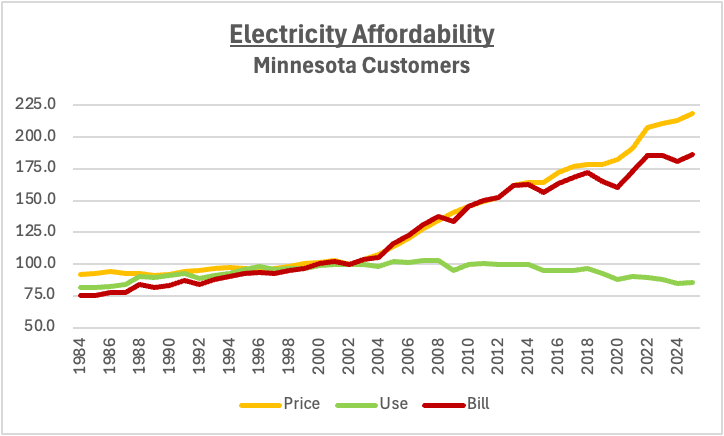
Key: electricity price (¢/kWh), use (kWh/customer) and bill ($/customer)
Index: 2002 = 100.0 Source: Energy Information Administration (EIA)
Natural gas is getting unaffordable too due to renewables
My article that has addressed natural gas affordability is:
Affordability is as much about the quantity or use of energy as it is the price. Both are determined by market demand and supply, subject to government interventions. Regarding the latter, natural gas and electricity markets are intertwined and have both been increasingly impacted by renewable mandates and subsidies. As per the chart below, natural gas electric power use for 1997 to 2025 grew:
- very robustly in the Midwest (MW) region, from 68.3 index points to 567.4, or by 731%;
- relatively modestly in the US nation, from 71.7 index points to 230.2, or by 221%;
- like gangbusters in the state of MN, from 46.4 index points to 745.8, or by 1,507%.
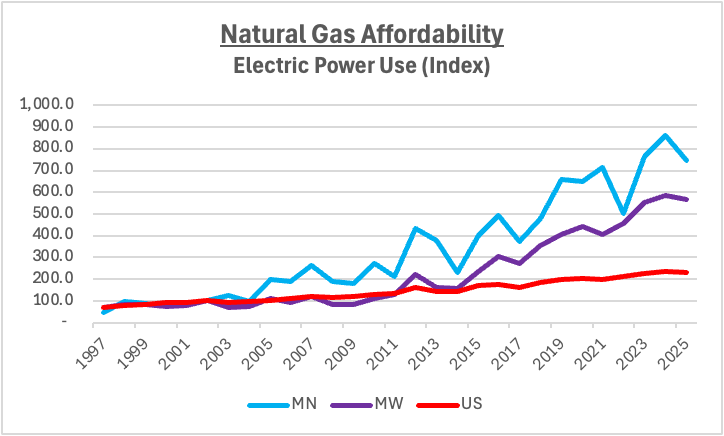
Source: Energy Information Administration (EIA)
Data centers can afford reliables but not renewables
My articles that have addressed data centers are (from newest to oldest):
- Data centers lowered electricity inflation: landmark new study finds
- Love ’em or hate ’em; data centers are not the source of electricity inflation
A landmark study by the Electric Power Research Institute (EPRI), published on June 18, found that data centers modestly reduced US electricity prices between 2015 and 2024. Both a quote and a chart from EPRI follow next:
“We estimate for every 10% increase in data center capacity average residential retail prices fell by approximately 0.4% on average. This is supported by descriptive statistics and a theoretic model that indicate economies of scale of power systems. Our findings are not without caveats, which we place into three categories: (1) supply constraints, (2) durability of demand growth, and (3) fuel costs.“
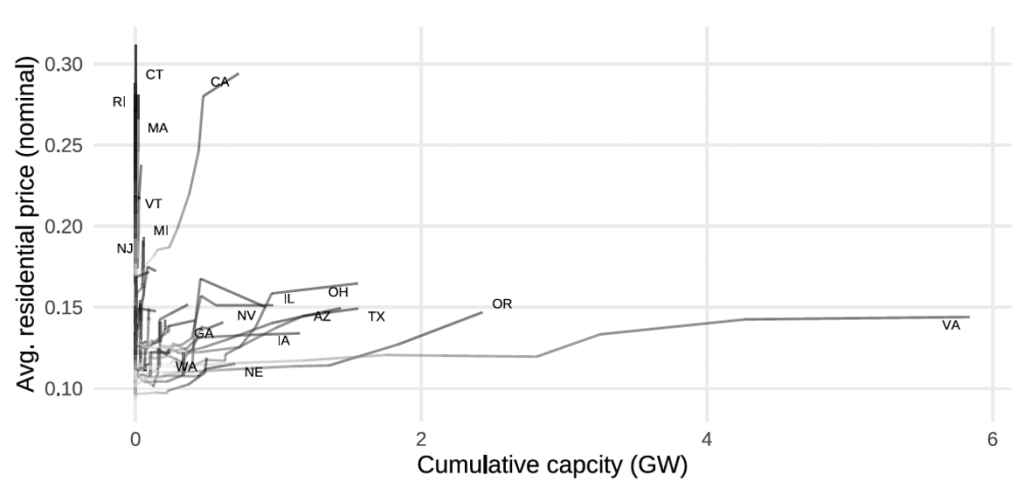
Source: Electric Power Research Institute (EPRI)
Do expand ‘cleaner’ nuclear reliables not renewables
My articles that have addressed nuclear power are (from newest to oldest):
The chart below demonstrates how prices are driven by marginal costs not total costs. Relatively cheaper nuclear, compared to renewables, declines every year from 2006 to 2023, 104.5 to 4.5, thus inflating electricity Harmonized Index of Consumer Prices (HICP) from 129 to 303.
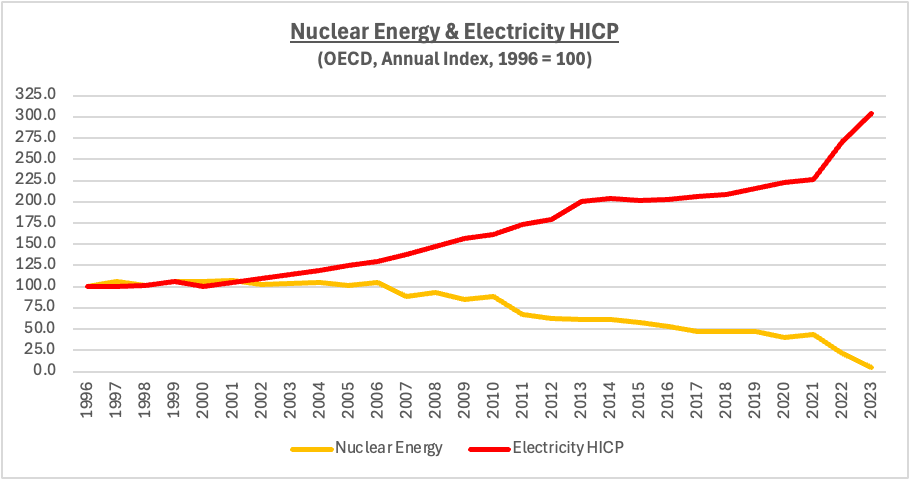
Source: Organisation for Economic Co-operation and Development (OECD)
Do not replace natural gas with pseudo-renewables
My articles that have addressed pseudo-renewables are (from newest to oldest):
The 2021 Natural Gas Innovation Act, or NGIA, is yet another example of Orwellian doublespeak. Rather than being about innovation in natural gas, the NGIA’s provisions are about the replacement of natural gas. And like renewables in electricity, the replacements promise to be unreliable, expensive and mandatory.
The first two quotes below are from Minnesota statute 216B.2427 and the third quote is from the Minnesota Public Utilities Commission (PUC):
“It is the goal of the state of Minnesota that through the Natural Gas Innovation Act, utilities reduce the overall amount of natural gas produced from conventional geologic sources delivered to customers.“
“Innovative resource means biogas, renewable natural gas, power-to-hydrogen, power-to-ammonia, carbon capture, strategic electrification, district energy, and energy efficiency.“
“The NGIA and its innovation plans enable gas utilities to begin testing methods to reduce their emissions, and in some cases, transfer their business away from natural gas entirely.”
The PUC is no longer affordable and needs to be renewed
My articles that have addressed the Minnesota PUC are (from newest to oldest):
- NARUC: the most important energy affordability conference you never heard of
- The PUC: the ‘black box’ of electricity inflation
In their own words, the PUC sets “just and reasonable rates that electric…companies can charge their customers” through “a process called a rate case”. Yet, the PUC has no transparent methodology for either determining electricity rates, in general, nor for Xcel’s rates, in particular. Thus, as can be seen in the chart below, Minneapolis St Paul (MSP) electricity inflation (CPI) starts to take off in the 21st century, as well as diverging upwards from the Midwest (MW) and US. This divergence becomes pronounced from 2008 onwards.
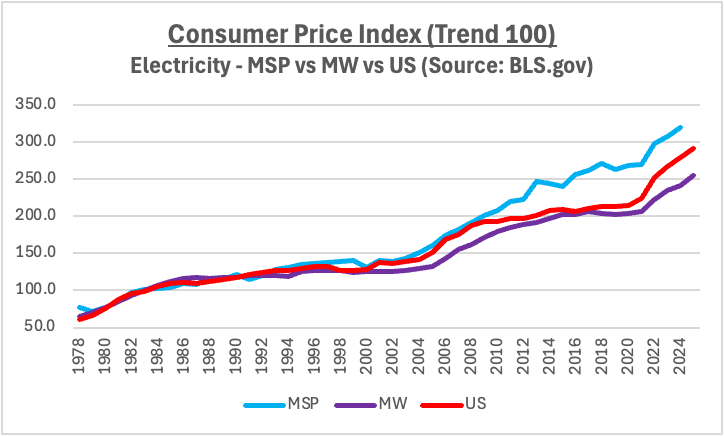
Energy affordability is good policy and winning politics
My articles that have addressed policy and politics are (from newest to oldest):
- New Poll: Energy affordability is a big issue for Minnesota voters
- Ideas have consequences: energy, environment, and natural resources
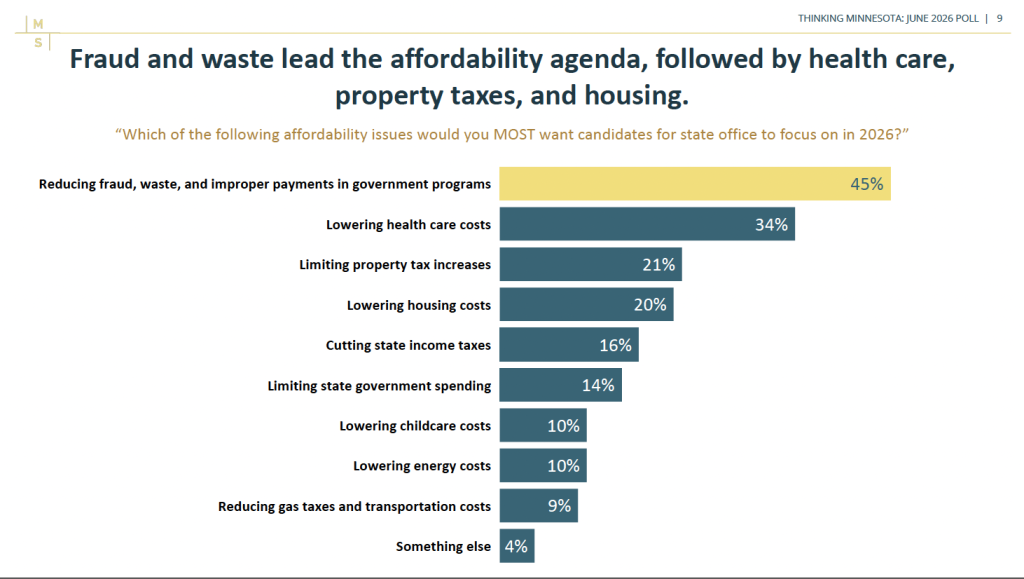
A new Thinking Minnesota poll has recently come out that shows affordability is the top issue for Minnesotans, of all political stripes, in the upcoming 2026 state elections. The poll also shows that energy is a top ten affordability issue, as seen in the graphic below. “Lowering energy costs” is 8th place with 10%. However, energy is more like 5th place, given it is a sixth of both 4th place “lowering housing costs” of 20%, and at least half, and probably more, of “reducing gas taxes and transportation costs” at 9%.
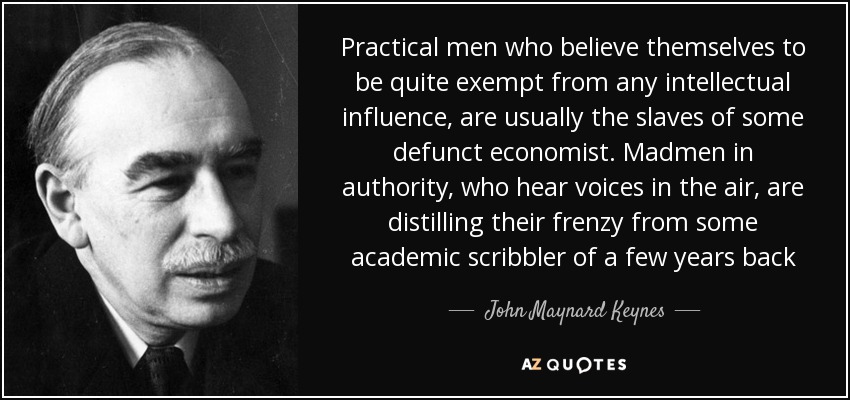
Ideas from left economists are the animating force behind Minnesota’s 21st century policies on energy, environment and natural resources. These include: Galbraith’s discouraging energy use; Pigou’s encouraging renewables growth; and Malthus’s favoring nature over humanity. The consequences include: higher prices; increased scarcity; and more pollution.
Better policies for Minnesotans in energy, environment and natural resources starts with better ideas. These include: Reisman’s encouraging energy growth; Cordato’s discouraging anti-human environmentalism; and Simon’s favoring more population over depopulation. The consequences include: enhanced affordability; greater abundance; and less pollution.
Source: Meeting Street Insights
Source: AZ Quotes
The post Energy talking points: keeping it simple, sort of appeared first on American Experiment.