Earlier this week, the Minneapolis Public Schools (MPS) district school board met to hear three proposals from Superintendent Dr. Lisa Sayles-Adams and her team, each outlining a pathway to right-size the district’s physical footprint.
It’s about time. The district has been in an embarrassing state of chaos for years, affecting countless students and families.
MPS has experienced considerable enrollment decline, both from students leaving the district and fewer student being born. Today, only 53 percent of all resident Minneapolis K-12 students are attending a district school.
The district hasn’t reduced its physical footprint in response. This week’s presentation reported that 61 percent of the 61 buildings in the district are underutilized. There are six sites that are boarded up but not yet demolished. A vacant elementary school costs the district an estimated $50,000 – $80,000 in carrying costs each year per site.
Underutilized school buildings still hold staff and maintenance costs, but don’t have the ability to provide full traditional coursework (like PE, art, music, or world language courses).
Unsurprisingly, Minneapolis has awe-inducing budget woes. The district has not been financially stable since 2017, and currently faces a $39.7 million deficit for the year. The financial department has been so troubled that two outside law firms were hired recently to investigate internal personnel issues connected to vanishing funds, and several top officials were removed from their posts. As my colleague Catrin Wigfall has pointed out, the district has known for over a decade that its finance department lacked enough staff to properly separate accounting duties. Insufficient staffing allowed MPS to racked up more than $5 million in IRS penalties for botched employment tax filings. But help is on the way; financial district oversight was recently outsourced to a private contractor to the tune of almost $70k per month.
For three years, the MPS board has discussed, resolved, or otherwise moved toward creating a building consolidation plan. In October 2025, school board member Sharon El-Amin summed up, in a tone of exhaustion, what remains true nearly a year later. “We started this in 2023…I think we have defined, redefined, went through, and it is time for us to really just get to work.”
This week, a vote to change the trajectory of the district became possible.
The plans
District officials, responding to a formal board request, presented three different options for reimagining the district. All options contained similar base structures, such as a student pathway system from elementary to high school. Officials remarked that the highest prioritization when drawing up the plans was to ensure consistent, high-quality education experiences throughout the district, not to create a balanced budget. Regardless, every potential option would, officials say, give the budget room to create a fully-funded MPS experience for each child.
The pathways system would create a clear roadmap from elementary to middle to high schools, with each school designated as a “feeder school” for particular upper-level buildings. Once students enter a pathway destined for a particular high school, they are guaranteed a seat in all future grades unless they choose to switch pathways.
There would also be seven opt-in magnet program pathways: American Indian Best Practice and Pathway, Montessori, Hmong Heritage Language and Culture, Global Studies and Humanities, STEAM, Spanish Dual Language, and Somali Language Heritage and Culture.
Choice was emphasized as a strength of the proposed system. Transportation to magnet schools and programs would be provided. Students could apply to attend community schools outside of their attendance area, with priority for students living in the walk zone of a different community school. (Acceptance is dependent on space, not grades. Transportation would not be provided for those students.) High school walk zones would be reduced from two miles to one.
Under the current options, several education programs (such as Hmong Language and Culture Academy or Teen Parent Services) would move into different school buildings.
The three proposed plans all require building closures, but differ in the specific schools that would be closed and the particular redistricting lines that would be drawn. Precise information has been published by MPS. District officials were careful to avoid closure language, noting that the buildings would instead be “deprogrammed” and that final decisions connected to building futures could be decided at a later date.
The majority of proposed closures would impact elementary schools. Only one middle school (Anwatin) was listed for closure, and none of the seven community high schools were targeted for closure. Under every proposal, four specialized high school programs would move from their own building into a shared space with another high school.
District officials estimated that 12 to 14 percent of students would be affected by the changes. That would be between 3,610 and 4,212 of the district’s 30,079 students.
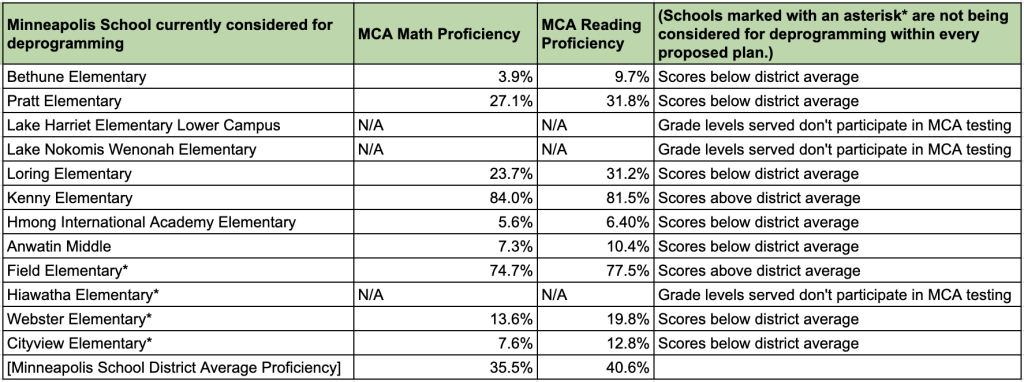
Schools targeted for closure were said to be chosen for low building capacity, not academic achievement concerns. Regardless, many of the schools named were outliers for either very high or very low academic achievement in the district. Kenny Elementary and Field Elementary are strong academic performers, whereas Bethune Elementary had just four students who could do math at grade level last year.
District officials emphasized the need to make changes, pointing out that the new plan would allow for a “consistent MPS experience” throughout the district. In particular, the district noted that the shift would allow each building to have two academic intervention teachers, and every elementary school would hold a full-time art, music and gym teacher. Middle schools would have academic and athletic programs, and high schools would have access to all graduation requirements.

There are several unanswered questions. Despite district officials saying that the changes would create the financial bandwidth to fully fund the desired MPS experience for each student, they did not provide an accounting sheet. Nor did the proposal include a list of how many MPS staff members would be affected. Officials noted that such an analysis would occur after board members decided how to proceed, and that collective bargaining agreements govern and protect job transitions. (In general, they noted, teachers would follow their students.) Additionally, district officials did not elaborate on how the MPS student experience would be made more consistent at the middle and high school level.
One potential item of future tension was the inclusion in every plan to build a brand new, bespoke $105 million school to rehome Anishinabe Academy. The school would serve as the first step in the American Indian Best Practice and Pathway magnet program. Despite some public pushback, the MPS school board formally committed in May to move to Phase Two of the building project. Board members argued that the Anishinabe Academy community had been promised a new building, and that commitment should be honored despite district financial strain.
Will it pass? And will it work?
Community feedback meetings and surveys are currently in process, and suggestions will be presented to the board in October. Board members and administration plan to tweak the plans in response to reflect community concerns.
The clock is ticking. Board members must vote by the scheduled Nov. 10 meeting on any changes for the 2027-2028 school year.
However, the proposal might not make it to a vote. The school board election is on Nov. 3, and there are five board seats up for grabs. Three candidates have already slammed the concept of closing schools at all in a jointly written Star-Tribune op-ed, saying in part that
After a winter of turmoil and disruption for our entire city, our schools need stability now more than ever. Our model of many small neighborhood schools is part of what makes MPS such an incredible school district. It was those neighborhood school communities that supported our city through an attempted fascist takeover.
They’re not the only voices pushing back against school closures. Board member Greta Callahan, former president of the Minneapolis Federation of Teachers, argued that the district should focus their efforts on recruiting and retaining students, not right-sizing the physical footprint. Her remarks drew heavy applause from the packed room, in which many were wearing union shirts.
The next few weeks will surely bring a bitter political fight.
Among board members, Callahan was alone in rejecting school closures as a board tool. While several other board members expressed concern about a hasty timeline, none pushed back on the necessity of changing the district’s physical footprint. Board member Joyner Emerick said that families are “tired of us kicking the can down the road…I don’t think there’s any one person who wants to close schools. If there was a different way to do this, collectively we would have figured it out by now.”
Emerick is correct. The writing has been on the wall for a long time regarding Minneapolis’ desperate need to consolidate schools, streamline student experiences, and raise academic achievement. A new recruiting program is just new paint on a district that requires structural change.
The reason that so many students have left the district can be summarized in two numbers: 35.5 percent of students can do math at grade level, and 40.6 percent can read at grade level.
Parents have voted with their feet. They don’t care about a walkable elementary school. They care about an elementary school that will actually teach their children.
It’s time for change and reform at the district. Sure, these proposals have several unanswered questions attached to them. But the worst decision the board can make here is no decision at all.