Kansas families need lower fuel costs through more supply, less inflation, and fewer government-made costs.
Fuel prices hit families fast. A gallon of gas is not just a number on a sign. It is the cost of getting to work, taking kids to school, delivering goods, that long-planned summer road trip, and keeping rural Kansas connected.
According to AAA’s Kansas gas price data, regular gasoline averaged $3.961 per gallon in Kansas on May 4, compared with a national average of $4.457. Kansas is below the national average, but that is little comfort to families already squeezed by groceries, housing, insurance, utilities, and interest costs. By way of reference, the price one month ago was $3.363 and $2.834 this time last year. Affordability is not judged in Washington talking points. It is judged at the pump.
Start with Econ 101: prices rise when demand increases, supply falls, or both. Gasoline is especially sensitive because oil trades in a global market. A supply shock in the Middle East, including the war with Iran and risks around the Strait of Hormuz, can hit Kansas quickly. On some level, it doesn’t matter if that barrel is pumped in Saudi Arabia, Saskatchewan, or Sumner County, KS, it’s a globally traded commodity and prices are driven by global trends.
My research on oil and gasoline markets has long reinforced this point: retail fuel prices respond to movements in crude and wholesale markets, but not always smoothly or immediately. In other words, pump prices can rise fast when costs jump and fall slowly when costs ease, but not for long.
That is why energy abundance matters. The Energy Information Administration reports that U.S. crude oil production reached a record 13.6 million barrels per day in 2025, up 3% from 2024. More American production does not make Kansas immune from global shocks, but it gives families a buffer. Less production, fewer pipelines, constrained refining, and more regulatory delay do the opposite.
Still, crude oil is only part of the pump price. The EIA’s gasoline price breakdown for January 2026 shows regular gasoline consisted of 51% crude oil, 20% refining, 11% distribution and marketing, and 18% taxes.
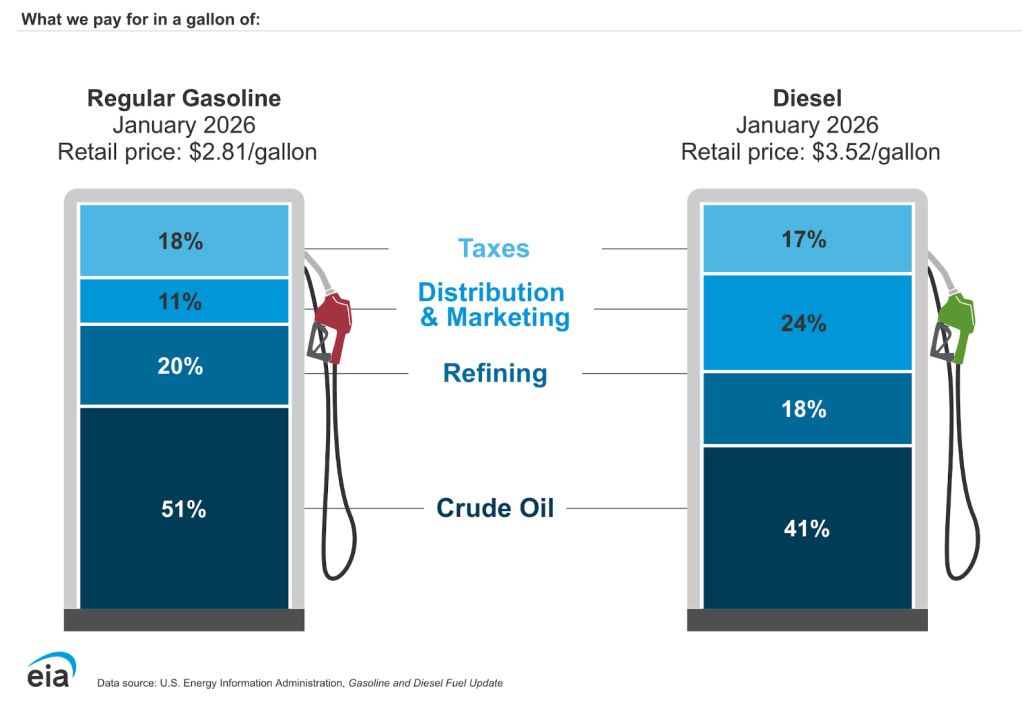
That means policymakers cannot control everything, but they do control some of the costs families face.
Fuel taxes are one of those costs. The EIA reports that state gasoline taxes and fees ranged from 70.9 cents per gallon in California to 9 cents in Alaska as of January 1, 2026, while state gasoline taxes averaged about 33.5 cents per gallon. The federal government adds another 18.4 cents per gallon. Kansas’s gas tax of 25.3 cents per gallon is above the national average and adds real cost to every gallon bought by workers, farmers, truckers, and families.
Some politicians respond to high fuel prices with gas tax holidays. That is political theater. It is the same kind of gimmick as sales tax holidays, temporary payroll tax cuts, homestead exemptions, and other carveouts that complicate tax systems while avoiding the real problem. A Washington Post editorial argued that gas tax holidays are good politics but bad policy because they temporarily subsidize demand during a supply shock and do little to solve the underlying issue.
The economics are straightforward. If a fuel tax is suspended, pump prices may fall a little at first. But because vehicle drivers were already willing to pay the higher tax-inclusive price, part of the benefit can be captured by suppliers or offset by higher market prices, especially when supply is tight. A temporary holiday does not create more fuel, expand refinery capacity, improve logistics, or reduce inflation. It just reshuffles who receives the benefit while politicians claim credit. What they’re typically doing is reshuffling the cost to future generations who cannot vote, hoping today’s voters give them credit for “doing something.”
The better policy is not to suspend fuel taxes. It is to eliminate them over time as part of broader spending restraint and more transparent infrastructure funding. Fuel taxes, which primarily fund road and highway infrastructure, are often sold as user fees, but in practice they are taxes set by politicians, not market prices. Transportation finance is tangled with federal funds, transfers, debt, and political priorities. If lawmakers want users to fund roads, they should be honest, transparent, and disciplined, not hide behind temporary tax gimmicks.
The deeper problem is overspending. When governments spend too much, they must tax more, borrow more, regulate more, or inflate more. That burden shows up everywhere, including fuel prices. In my work on inflation and government spending, I’ve noted that when the money supply expands faster than the supply of goods and services, prices rise over time. Fuel shocks then land on families already weakened by general price inflation.
Kansas cannot control Iran, OPEC, or global crude markets. But it can stop making affordability worse. That means rejecting gas tax holidays, eliminating fuel taxes over time, reducing and capping government spending, removing barriers to energy production and infrastructure, and avoiding regulations that make transportation more expensive.
Fuel prices are shaped by oil markets, refining, distribution, taxes, and inflation. The solution is not gimmicks. It is abundance. More energy. Less spending. Lower taxes. Fewer barriers.
That is how Kansas can help families keep more of what they earn and spend less just to get where they need to go.