During the 2026 legislative session, Connecticut lawmakers backed away from a proposed statewide ban on gas-powered leaf blowers after landscapers warned it could raise costs, slow their work and threaten small businesses.
The subject did not stay dead for long.
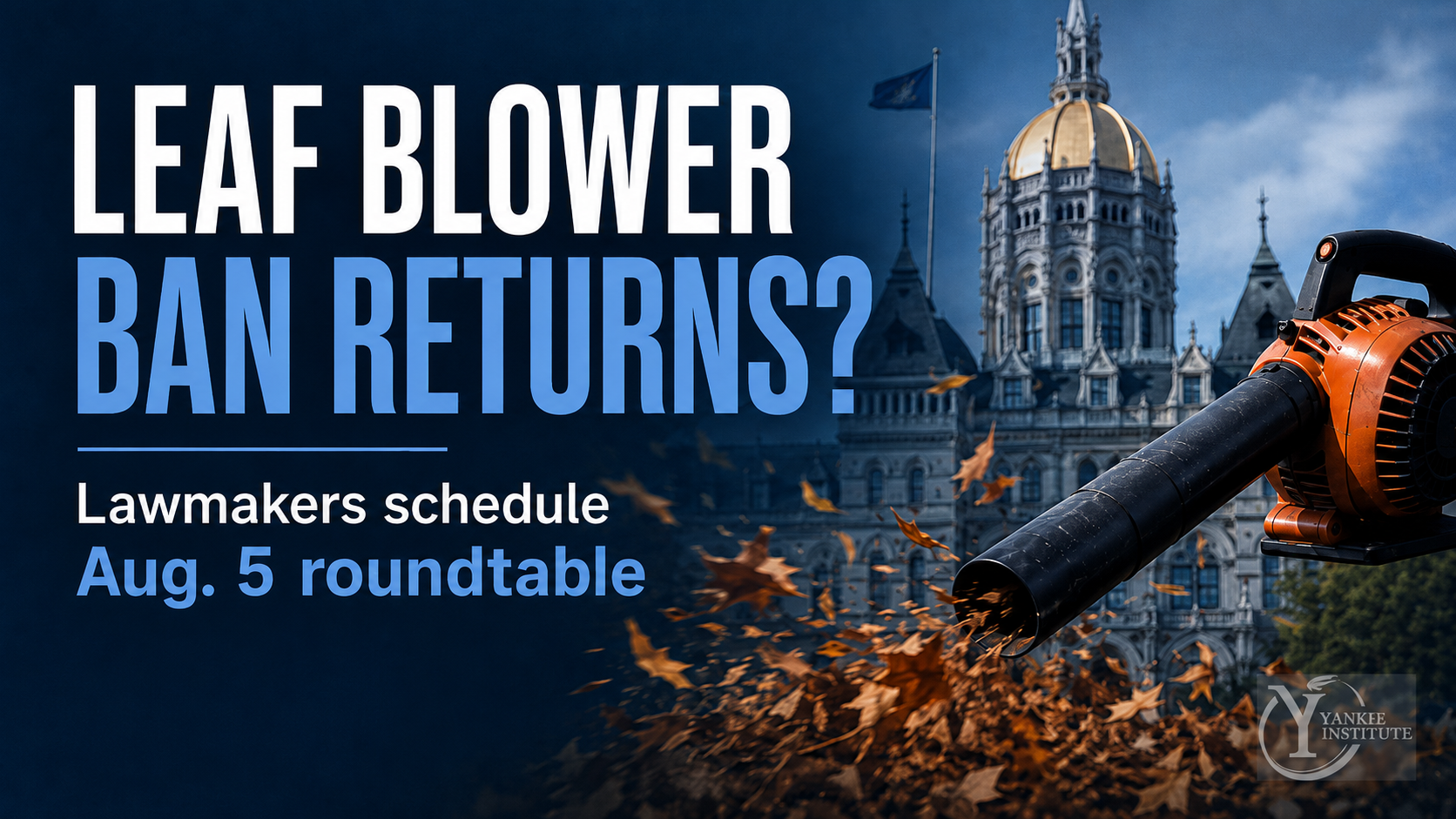
Sen. Rick Lopes (D-New Britain), and chair of the Environment committee, has scheduled an Aug. 4 roundtable at the Legislative Office Building titled simply: “Gas Powered Leaf Blowers Roundtable.”
The General Assembly notice provides no agenda and does not identify who will participate. There is no bill language for the public to review, no list of invited organizations and no indication whether the discussion will focus on voluntary incentives, local restrictions or another version of the statewide policy lawmakers abandoned earlier this year.
A roundtable is not legislation. It does not impose a mandate or automatically produce a new bill. But Connecticut residents have seen this film before, and they have reason to pay attention.
Senate Bill 319 originally would have prohibited the sale of gas-powered handheld and backpack leaf blowers beginning in 2029 and banned their use statewide beginning in 2030. State agencies and contractors working on state property would have been required to begin replacing gas equipment with battery-powered alternatives even sooner.
The proposal also would have used money collected through the Public Benefits Charge on electric bills to help finance the transition.
Put another way, lawmakers proposed restricting gas-powered equipment and then using electricity customers’ money to subsidize the equipment needed to comply.
That was difficult to defend in a state where residents already pay some of the nation’s highest electricity costs.
Landscapers Forced the Issue into the Open
The proposal drew significant opposition during a March public hearing.
Michael Sennello, owner of Western CT Pro Turf, told lawmakers that battery-powered equipment was not yet a practical replacement for commercial landscapers who need consistent power and hours of runtime during fall cleanups.
Sennello estimated that replacing each blower could cost at least $1,300. He said outfitting work trucks with enough battery capacity and charging equipment could cost tens of thousands of dollars.
He also warned that slower equipment would mean longer jobs and higher bills for customers.
“If it’s going to take us two to three times as long to do a leaf pickup … we have to bill our customers for that time,” Sennello testified. “In short, this bill puts me and thousands of hardworking guys like me permanently out of work.”
Lopes responded by calling the testimony “the first time I’ve ever heard a legislative infomercial.”
The exchange helped draw attention to a basic problem with the proposal: lawmakers were discussing a statewide equipment mandate while people who use the equipment for a living were warning that the alternatives could not yet do the same job at the same cost.
Two weeks later, the Environment Committee removed the statewide sales and use bans. It also dropped the plan to finance the transition through the Public Benefits Charge.
“There is no ban. There is no mandate,” Lopes said when the revised bill advanced.
But he also made clear that the underlying goal had not disappeared.
“I don’t think we’re ready yet for a ban, but we do want to keep the needle moving,” Lopes said.
The Aug. 4 roundtable suggests that the needle is still moving.
The Revised Bill Still Expanded Government’s Role
After the ban was removed, SB 319 became a financing and subsidy bill.
The revised legislation directed the Connecticut Green Bank to create a loan program or financing product to help commercial landscapers buy or lease battery-powered lawn equipment. It also required the Department of Energy and Environmental Protection (DEEP) to reactivate a lawn-equipment exchange program for municipalities and regional school districts.
Even that scaled-back version raised unanswered questions.
The Office of Fiscal Analysis (OFA) estimated that the Green Bank would face an “indeterminate cost” because the bill did not specify how much funding would support the new financing program. The bill also ordered DEEP to “reactivate” a 2010 lawn-equipment exchange program, even though fiscal analysts said the account had no money and legislative researchers noted that the original fund no longer exists.
The amended bill passed the Senate on a party-line 26–10 vote May 4. The House placed it on the calendar but never called it for a vote before the General Assembly adjourned May 6, so the bill died without becoming law.
That should have given lawmakers time to consider what they heard from business owners, residents and municipalities.
Instead, the subject is returning through an interim roundtable with almost no publicly available detail.
The Gas Leaf Blower Fight Is Not Over
The statewide ban was removed only after landscapers and small-business owners explained what it would cost them, their customers and municipalities. The revised bill then failed to become law.
Now the issue is back on the General Assembly calendar for an Aug. 4 roundtable. The notice gives the public a time and place, but no agenda and no participant list.
The timing also means less public attention than a hearing scheduled during the regular session would draw. It falls in early August, when many families are on vacation and others are preparing for the new school year — a period when relatively few residents are tracking legislative activity in Hartford.
The question is not whether lawmakers are allowed to keep discussing the issue. It is whether the landscapers and small-business owners who stopped the first mandate will be included in the next discussion.