The premise that higher spending will yield better academic results has, in practice, fallen short. So, too, has the idea that more funding reliably translates into higher teacher salaries.
With teacher shortages consistently topping the list of public school leaders’ concerns, the most common response has been to increase K-12 spending. Common logic would say that higher, more competitive salaries make the teaching profession more attractive. “But for legislators hoping to improve teacher pay and attract more people to the profession, increasing education spending is surprisingly ineffective,” writes Christian Barnard for Education Next.
Many states have lost ground on average teacher salaries over the past two decades despite spending more. Those states that do manage to raise teacher salaries largely do so only after investing exorbitant amounts in public education, with most of those dollars still being diverted to expenditures besides take-home pay for current teachers.
…
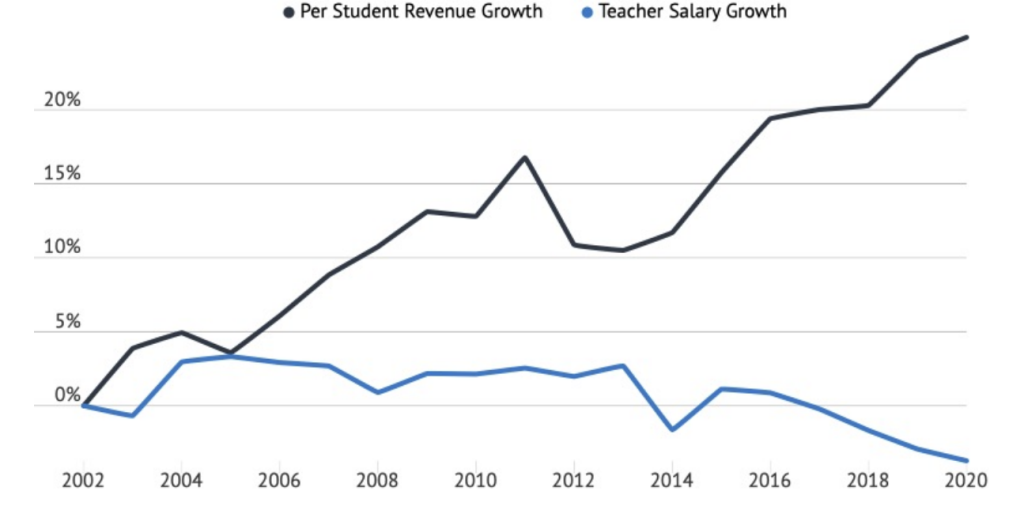
Using data on average teacher salaries from the National Center for Education Statistics, which excludes classroom aides and accounts for new teacher hires, the picture becomes bleaker. Despite education revenues increasing by 25 percent nationally from 2002 to 2020, inflation-adjusted average teacher salaries fell by 0.6 percent, from $64,522 to $64,133.
Minnesota fits this pattern. Despite rising inflation-adjusted revenue per student over the last 20+ years, average teacher salaries have declined. According to U.S. Census Bureau data, only about 25 cents of each new education dollar in the state has gone toward instructional salaries.
By contrast, states with more modest spending growth, like Mississippi, have been “more efficient” at “devoting new funds to instructional pay,” continues Barnard. While the state’s overall pay levels remain low, the state has posted some of the strongest gains in the country on national assessments in recent years.
The disconnect underscores what I often reiterate — that education outcomes are driven less by how much we spend than by how well we spend it.
Mississippi’s lower per-pupil spending paired with smart policy choices is a clear example of this. Minnesota, by contrast, has relied on a funding-first approach, increasing spending without ensuring those dollars are tied to performance or classroom impact. This leaves us with a system where spending grows but outcomes don’t justify the price tag and rigid union compensation structures don’t reward effectiveness.
If policymakers want different results, they will need to move beyond reflexive spending increases. That means greater transparency about where education dollars are actually spent, stricter limits on the growth of non-instructional spending, and a willingness to repeal burdensome mandates that redirect time, resources, and classroom attention away from the core mission of public education. Without these changes, simply adding more money to the system will continue to produce the same disappointing results.
Minnesota Teacher Salary Growth vs. Revenue per Student Growth