The 2023 session
The 2023 legislative session was indeed historic. Raising the budget by over a quarter between 2023 and 2024, the DFL-controlled legislature created several new programs that have now become a permanent fixture of the budget, costing taxpayers billions of dollars.
These new programs, and expansions to several existing programs, are worth re-examining if the state is to find enough savings to plug Minnesota’s budget shortfall. As the newest additions to the budget, they highlight precisely where the state has overcommitted resources beyond its primary purposes. New spending is also less entrenched. So, it would be easier to cut (at least in theory).
What were some of the new programs and changes?
Universal Breakfast and Lunch (over $500 million, 2026-27 Biennium): Before 2023, Minnesota provided free- and reduced-cost lunches to low-income K-12 students. The federally funded National School Lunch Program provided the majority of the money for this program, with the state portion amounting to less than $40 million between 2022 and 2023. Free breakfast and lunch for all students regardless of income — introduced in 2023 — has added over a quarter of a billion dollars to the state budget each year beginning in 2024.
Originally estimated to cost $419 million between 2026 and 2027, the program has now ballooned to $637 million — over 50 percent higher. If the state had stuck to providing free and reduced meals to low-income students, it would be on track to spend $57 million in the 2026-27 biennium, saving over half a billion dollars.
| 2022-23 Biennium | 2024-25 Biennium | 2026-27 Biennium | 2028-29 Biennium | |
| Free and Reduced-Cost Breakfast and Lunch | $36 million (Actual) | $54 million (Estimated) | $55 million (Estimated) | |
| Universal Breakfast and Lunch | $572 million (Actual) | $637 million (Estimated) | $639 million (Estimated) |
Even setting aside the strain on the state budget, universal meals need to be reconsidered for the operational problems it creates for schools. As Education Policy Fellow Catrin Wigfall has pointed out, schools use applications for free and reduced-cost meals to identify low-income students, who are eligible for extra funding. Universal meals make those students harder to identify, resulting in an undercount. Consequently, schools that serve a disproportionate share of needy students are at risk of losing state compensatory aid.
Free college ($99 million per biennium): The “North Star Promise” provides free college for students with family incomes below $80,000. Since 2023, the program has cost the state about $50 million a year.
The legislature could repeal the North Star Promise and still assist low-income students through other existing programs. This includes the much larger and costlier State Grant Program, which, as of May this year, is facing a $131 million deficit partly due to increased enrollment attributed to the North Star Promise.
Automatic inflation to the K-12 funding formula (Over $1.3 billion, 2026-27): Before 2023, any increase in the K-12 per pupil funding formula needed legislative discussion. In the 2023 session, the legislature anchored the K-12 per pupil amount to inflation. Spending automatically increases every year.
For the 2024-25 biennium, the legislature appropriated $705 million for this adjustment. At an expected 2-percent inflation rate each year, the cost could exceed $1.3 billion for the current biennium (2026-27).
Baking inflation into the budget creates the need for more spending even if underlying trends do not change. It also absolves legislators of making the difficult decisions: deciding how much to spend, and on what. If, indeed, these increases are necessary, legislators must explicitly justify them during each budgeting session.
Payments to childcare providers (about $260 million per biennium): The federal government created the Childcare Stabilization Grant program to assist childcare providers affected by rising costs and declining enrollment during the coronavirus pandemic.
The 2023 legislature made these grants permanent through the Great Start Compensation Payments program. In that session, the legislature appropriated $260 million for the program between 2026-27. With the pandemic long gone, this program is worth revisiting.
Rental Assistance ($46 million per biennium): The Bring it Home Rental Assistance program was created in 2023. It costs $23 million a year, or $46 million per biennium.
Formula adjustments in Medicaid (over $1 billion, 2026-27 Biennium): HHS saw the largest permanent spending increase during the 2023 session. Legislators directed a large portion of new funds to the Medicaid program. Home and Community-Based Service (HCBS) waiver programs, which allow individuals with disabilities and the elderly to receive Nursing-home-level care in their homes, saw the largest cash infusions. This was done mainly through formula adjustments that accelerated future growth.
Specifically, in the 2023 session, the legislature appropriated an additional $1.3 billion to the Medicaid budget for the 2026-27 biennium. Over 60 percent ($856 million) of this money went to HCBS waivers, with $548 million going to the Personal Care Assistance (PCA) program alone.
Formula changes in Medicaid have triggered spending growth beyond what legislators envisioned in the 2023 session. The November 2024 forecast by the Department of Human Services (DHS), for instance, noted that HCBS waivers would require an additional $725 million in the 2026-27 biennium. DHS attributed some of this to legislatively mandated rate increases.
Budget estimates released this July by MMB show that HHS programs will cost nearly $26 billion in the 2026-27 biennium. By comparison, post-session estimates from 2023 pegged HHS at $22.3 billion, over $3.5 billion less.
Even after the Legislature instituted a 4 percent annual spending growth cap on disability waivers in 2024, costs have continued to climb. Because Minnesota ranks as the highest-spending state for Medicaid enrollees with disabilities, the structural changes enacted in 2023 are worth reexamining.
Other Medicaid changes:
Cost Sharing: Before the 2023 session, Medicaid enrollees contributed to the cost of healthcare coverage. The legislature repealed cost-sharing, including contributions from high-income parents, shifting the entire cost of Medicaid to taxpayers. Eliminating cost-sharing could cost the state about $40 million in the current biennium (2026-27).
Continuous eligibility: The federal government mandates 12 months of continuous Medicaid eligibility for children. Minnesota, however, extends this provision beyond these requirements. For instance, since 2023, the state has offered 6 years of continuous eligibility for children under 6.
Minnesota’s Medicaid program could be covering children whose parents can afford private insurance, a far cry from what the safety net is supposed to be: a temporary assistance program for those in need.
Relaxed work requirements for Cash Assistance: The 2023 session also relaxed various work requirements for cash assistance programs, making it easier for people to receive benefits for extended periods, sometimes even if they are not working or looking for work. In addition to income reporting changes, this was estimated to cost $99 million in the 2026-27 biennium. Revisiting these changes would encourage self-sufficiency and create fiscal space to address the impending crisis.
Discretionary inflation
Under a law passed in 2023, Minnesota Management and Budget (MMB) must include projected inflation in the budget forecast as a separate line item. By law, legislators must approve funding for inflation before those dollars can materialize. But while inflation is a planning tool, its inclusion in the budget does two things:
(1) it creates a constant pressure for higher spending
(2) it effectively ties up revenue that could be used elsewhere
In the 2025 session, for instance, lawmakers treated discretionary inflation as an automatic part of the budget. Choosing not to spend money on inflation costs was framed as “cutting spending.” The outcome? Despite billions of dollars seemingly being taken off the table, the baseline budget trajectory has barely budged.
Removing discretionary inflation from the budget forecast could slow spending by forcing lawmakers to justify budget increases explicitly. It would also compel them to confront underlying spending drivers, especially in areas like Health and Human Services.
Primary drivers of growth
Legislators could also address the state’s imbalance by specifically addressing primary drivers of growth — HHS and E-12 education. Since 2024, HHS has constituted 49 percent of all general fund spending increases. This year (2026 fiscal year), HHS will cost more than E-12 education for the first time in state history, and will do so again in 2029.
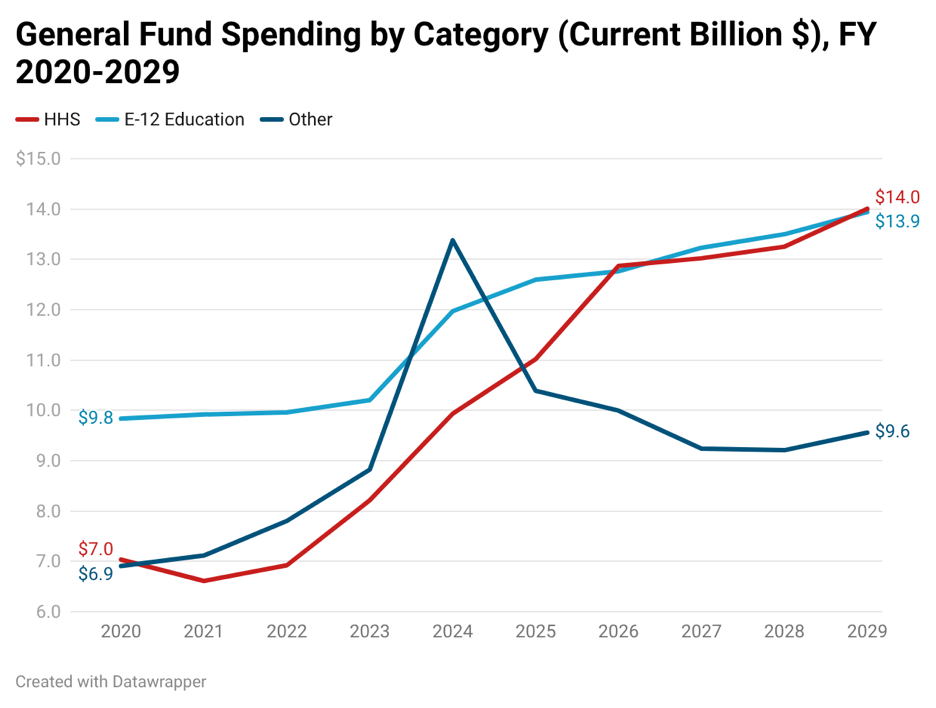
Because a significant portion of new HHS appropriations originates in the 2023 session, it is fairly easy to pinpoint where to trim. Lawmakers can target specific pieces of legislation, like those accelerating growth in HCBS waivers. Other spending increases outside of legislative changes are also easy to trace through DHS publications.
While E-12 education has grown more slowly than HHS, its sheer size means it still drives a massive portion of overall budget growth. Between 2024 and 2029, E-12 education will consume nearly a third of all new money invested in the budget, making it an area worth examining as well.