Anticipating that federal funding cuts could force the state to cover more of its own costs, Gov. Josh Green and some lawmakers earlier this year considered walking back the historic income tax cuts they approved in 2024.
The Grassroot Institute of Hawaii challenged the narrative that the state could no longer afford the promised tax relief, producing a list of $1.4 billion in potential savings in the state budget alone — including repurposing hundreds of millions in funding for vacant positions and languishing special funds.
But were the federal funding cuts ever really a threat? Let’s take a look.
The state of Hawaii appropriated $20.4 billion in its operating budget for the current fiscal year, which started July 1. Of that, $3.97 billion — 19.4% — is federal funding.
Not all state departments are equally dependent on federal dollars. For the previous fiscal year, which ended on June 30, 2026, a few state departments stood out as being most reliant on federal dollars as a percentage of their operating budgets. They are displayed in the graph below.
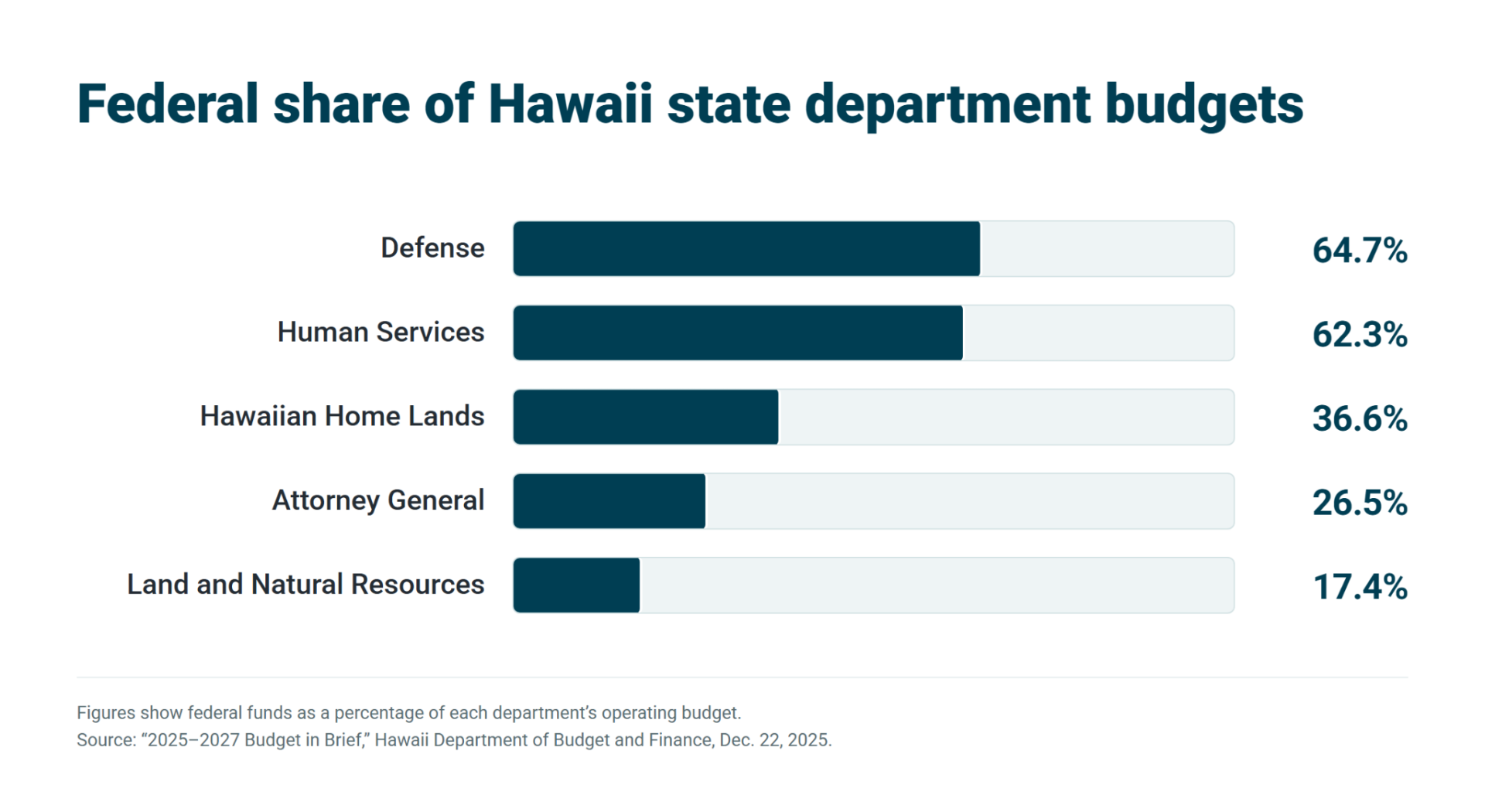
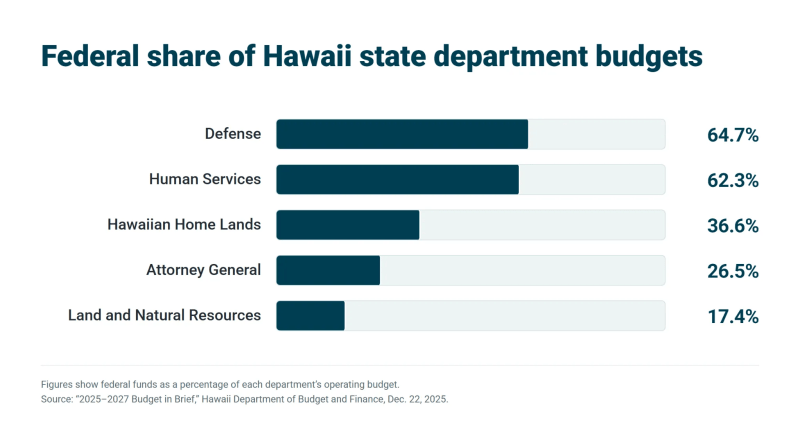
The state Department of Human Services receives more than 70% of Hawaii’s federal dollars because it administers Medicaid, the state’s Supplemental Nutrition Assistance Program and the Temporary Assistance for Needy Families program, all of which rely heavily on federal funding.
Compared to other states, Hawaii is less dependent on federal funding to balance its budget.
A 2025 report from the Center for Practical Federalism used U.S. Census data to show that Hawaii received 26% of its revenue from the federal government in fiscal year 2023, while the average U.S. state received about 37%.
The “One Big Beautiful Big Act” signed by President Donald Trump on July 4, 2025, did pass on some expenses to the states, including greater administrative obligations for SNAP and cost-sharing for the program for states with high error rates.
But Hawaii might be better situated than many other states to handle a drawdown in federal dollars. For instance, the state’s rainy day fund holds $1.6 billion — the largest it has ever been — due to a series of deposits made by Gov. Green and former Gov. David Ige.
For now, Hawaii residents can breathe a sigh of relief as they continue keeping more of their hard-earned money.