Back in February, I warned against the budgetary impact of passing a massive bonding bill. Governor Walz’s bonding budget proposal was then $907 million. But in the 2026 session, the legislature passed a $1.2 billion bonding bill — $300 million above Walz’s proposal.
This has several implications. Most notably, rising debt service costs could further weaken the state’s already deteriorating fiscal outlook.
High borrowing costs put pressure on present and future tax revenues
Every year since 2014, Minnesota has spent over $500 million in general funds to service debt.
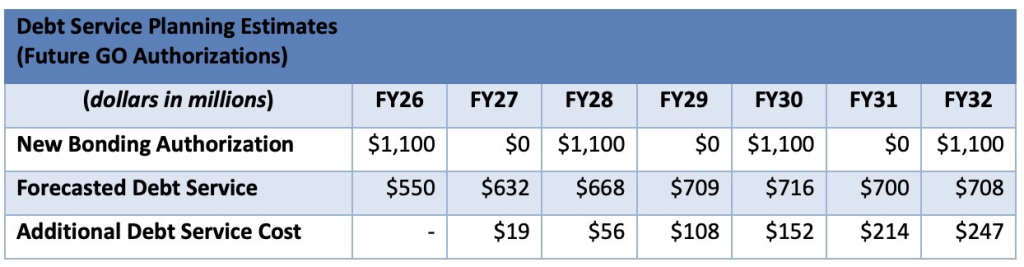
In the February 2026 forecast, Minnesota Management and Budget (MMB) estimated that debt service costs would rise from $559 million in 2025 to $708 million in 2032, assuming the legislature passed a $1.1 billion bonding budget during each even-numbered year between 2026 and 2032. This would mean an additional $796 million in debt service costs during that entire period.
With the legislature passing a $1.2 billion bonding bill, debt service costs will likely outpace MMB’s February forecast. And if lawmakers dont rein in the size of future capital budgets, this temporary bump will become a fixture of the budget.
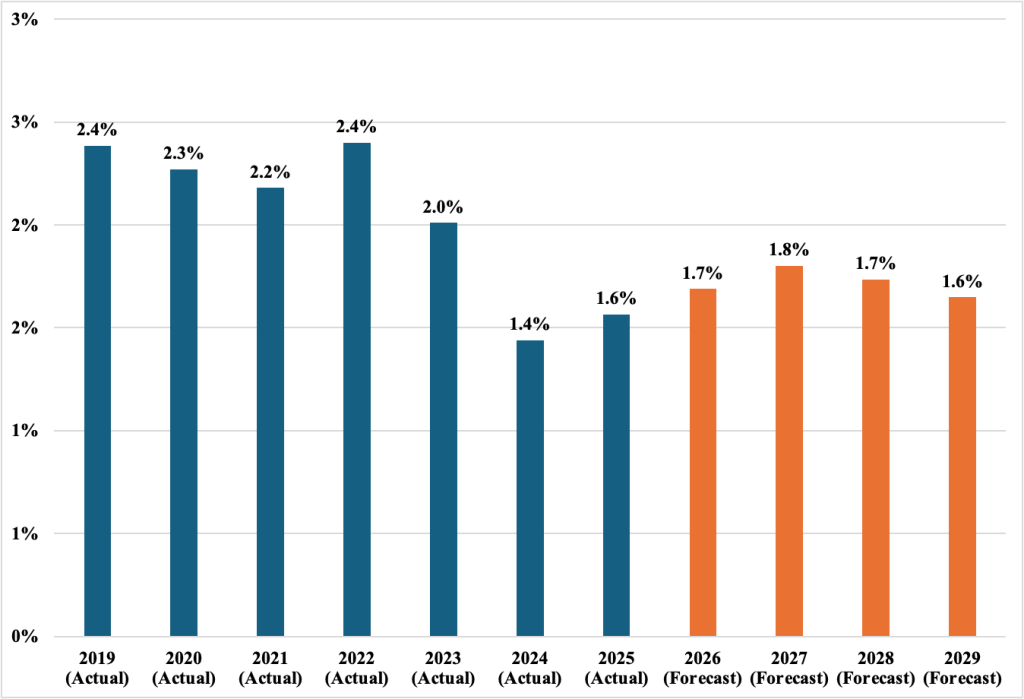
Historically, debt service has averaged 3 percent of general funds between 1990 and 2018. Due to a growing budget, that share declined to 2 percent between 2018 and 2024.
But while still lower than before 2024, debt service rose slightly as a share of the budget in 2025. It will remain elevated between 2026 and 2029 when compared to 2024.
Figure 1: Debt Service as a Share of General Fund Spending, FY2019-2029
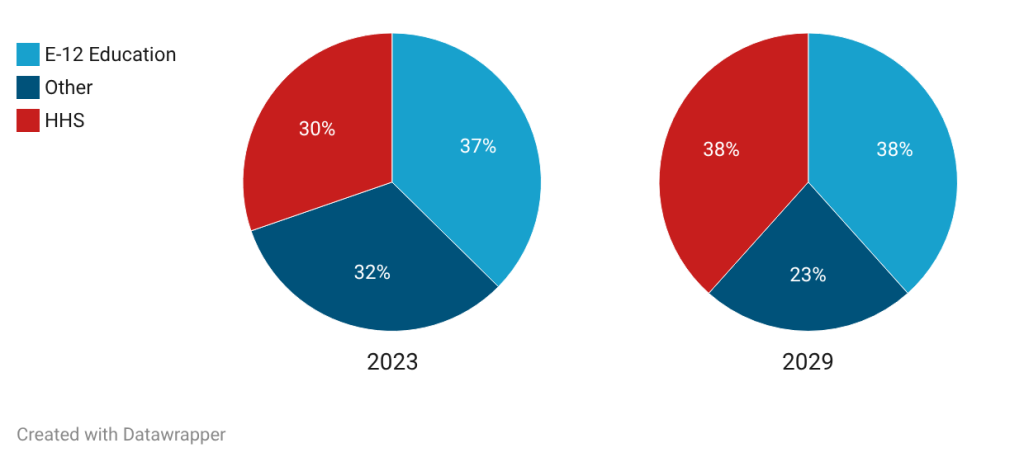
On its own, this increase would not present a significant budgetary hurdle. But with Health and Human Services (HHS) taking up a large and growing share of state resources, there is little to no room for the legislature to expand other areas of the budget.
Without accounting for additional spending enacted in the 2026 session, HHS will account for 38 percent of general funds in 2029, up from 30 percent in 2023. Rising debt service costs will be competing with other public services for a small and shrinking share of available resources — if any.
Figure 2: Share of General Fund Spending, FY2023 vs. FY2029
Certainly, bonds fund infrastructure essential for a well-functioning state. But that cannot be said about every dollar included in the $1.2 billion bonding bill. For instance, does it benefit taxpayers when the state goes into debt to maintain the Minnesota Zoo? Highly unlikely.
And since, by law, the state cannot default on general obligation bonds — which make up the majority of state debt — absent spending cuts, funding for other essential public services could likely suffer as rising borrowing costs, together with an expanding HHS, exert increasing pressure on tax revenues.