
Artificial intelligence (AI) is rapidly expanding and has already entered K-12 schools nationwide. November 2025 data from the Rand Institute show that the majority of teachers and students alike use AI to complete educational tasks. Yet, 80 percent of students do not believe they are adequately trained to use these emerging technologies (Figure 1).
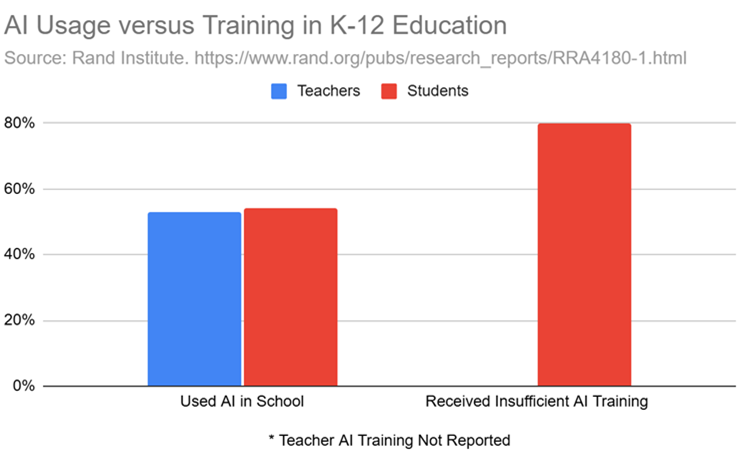
Figure 1. AI Usage versus Training in K-12 Education. Data sourced from the Rand Institute and graphed by Pioneer Institute.
Despite the lack of AI literacy training, the data is clear. Students are using AI in the classroom across subjects, including English, Science, and Math. However, without proper training, they will quickly become victims of AI’s limits. A Stanford Report highlights that while AI use has improved students’ performance, it has also led to greater reliance on technology. The report cited a study that found performance declined when AI was removed, indicating students rely on the technology to do the work rather than learning from it. Many fear that this redirection of thinking skills will cause children’s developing brains to miss out on critical intellectual progression. In addition to cognitive interference, many also worry about AI’s impact on student integrity. This ethical threat extends beyond cheating on assignments; students could believe hallucinations and falsehoods produced by AI.
While these cognitive and ethical concerns are valid, the growing presence of AI makes its usage in education and the workforce inevitable. By prohibiting the use of AI, students will lack the practical knowledge needed to succeed in the real world. AI literacy may solve this problem by teaching students how to use AI to improve their thinking – not think or do the work for them.
Education scholar Amy Eguchi, of the University of California San Diego, has reached concrete conclusions about what needs to be done. She not only believes that thoughtful use of AI can deepen thinking, but also that it will help students be prepared to thrive amid AI’s inevitability. To achieve this goal, Eguchi believes schools should fundamentally adapt their curriculum to incorporate an AI literacy framework.
This long-term goal would also require additional teacher training, as Eguchi notes an extreme shortage of AI literacy among teachers. In fact, many experts argue that teachers should be trained in more than just AI literacy. Julie Young, author of Say Yes! How Virtual Became Reality, explains: “the implications for education are profound” when discussing the AI-driven future. She believes AI has the potential to adapt learning to meet each student’s individual needs. This worthy approach is incredibly challenging for educators, as it is difficult to scale in large classroom settings.

Restructuring is a worthy goal to work towards, but it won’t happen overnight. Realistically, K-12 educators can start by incorporating a more basic form of AI literacy into the school day. Here, AI literacy will teach students to effectively prompt, interpret, and implement the technology into their studies. This would still require some additional teacher training, such as short video modules as featured in Stanford’s CRAFT project, an AI literacy resource for educators, but not at the same scale as the extensive retraining a complete restructuring would require. Since this is an emerging topic, there is little data on whether AI literacy training prevents the skill atrophy Stanford documented. It can be inferred that curricular adaptations could curb the atrophy by teaching students to use AI in ways that further their thinking.
A study from France’s National Institute for Research in Digital Science and Technology found teaching effective prompting can go a long way. 8th- and 9th graders who took a short, two-hour AI literacy course on effective prompting performed 15 percent better on science-based tasks than their peers without the course. While 15 percent is significant for a two-hour course, the study did not measure if those gains persisted in the long term. If AI literacy was continually incorporated into pedagogy, the 15 percent gain may not only persist but grow.
The emerging need to teach AI literacy has reached the nation’s largest colleges. Ohio State University (OSU) has developed an AI Fluency Requirement for all undergraduates. Instead of simply teaching general AI skills, students will learn the foundations of AI literacy and how to apply them effectively to their field of study. OSU’s administration claims that this requirement will equip its students to succeed in the workforce. After all, job listings that prefer or require AI skills have risen over 600 percent across the U.S. in the last decade. While teaching AI literacy at the collegiate level is beneficial, teaching it earlier will better align with helping students apply inevitable real-world AI skills. This will also benefit students who are not seeking a college degree.
It is time America’s K-12 schools incorporate AI literacy into daily education. Since the school day is already packed, experts suggest incorporating AI literacy into existing classes. This incorporation will also ensure AI literacy does not interfere with core aspects of a liberal arts education, such as literature and math. Transforming the K-12 curriculum to incorporate AI literacy may not be easy. To ensure effective implementation, educators must be trained in AI literacy so they are equipped to teach students how to use AI as an effective advisor – not an assistant. Since AI is our future, our youngest generations must be ready to use it effectively.
Samuel Klein is a Roger Perry Education Intern at Pioneer Institute. He is a rising Junior at the University of Rochester, studying Politics, Philosophy, and Economics (PPE).