Common Sense Catches Up
THIRTY YEARS AGO, George Witwer, a founding scholar of the Indiana Policy Review Foundation and now CEO of Cavo Health, won a dark-horse race for the GOP nomination for lieutenant governor at a contested state convention.
He did so campaigning on the floor, delegate-by-delegate, with a simple argument, “Property taxes mean you never really own your property, you merely rent it.” We highlighted it in our book, “Indiana Mandate: An Agenda for the 1990s.”
This week, the GOP wrote Witwer’s principle into its platform, endorsing the elimination of the property tax, albeit timidly: “In the pursuit of eliminating property taxes, we direct the General Assembly to take up the measure in the next general session.”
Should we worry about a leadership — spanning the governorships of Mitch Daniels, Mike Pence and Eric Holcomb, and including 14 years as a legislative supermajority — that takes three decades to recognize such a core principle as the sanctity of property?
Speed (Variance) Kills
THERE’S AN EASY two-step way of determining in real time whether Indiana government is functioning as intended. You will not need a library of economic and public-policy books. You need only take a Sunday drive, preferably after a spring thaw and at a midpoint between elections.
The first step is to note the potholes and the stretches of poorly maintained highway. Please know that ensuring the smooth movement of commerce is one of government’s most fundamental responsibilities.
Leave it to say that the roads should be high on the list of budget priorities. Rough roads tell you that state and local government are fudging that responsibility. While inflation and recent gas-tax suspensions have created funding pressures, nobody has seen fit to tap lower spending priorities to fill the gap. Major road projects are pushed back years.
Relatedly, Indiana constructs its roads mainly with the old design-bid-build approach rather than a “life of the road” approach using long-term contracts as is done in Europe. That can mean more and frequent repairs because contractors spend less on a solid roadbed than if they were going to be held accountable for longterm surface repairs.
Again, the core problem with roads is a political unwillingness to set priorities and pull money necessary for repairs from popular schemes that can be touted at election time. Infrastructure is not politically sexy.
A caveat: Proving categorically that the roads at any given time are worse than they have been all along would require an unprecedented degree of transparency and cooperation from government itself. But like I suggested, just take a Sunday drive.
NOW TO THE SECOND STEP, one that may be difficult for us classical liberals. On your Sunday drive, set the cruise control to the speed limit. Count how many cars pass you and how many you pass. The ratio is 20:1 on my home stretch of I-69 where I see semi trucks routinely barreling through constructions zones at 80 m.p.h.
Where are the police? Well, maintaining the speed limit is hard, expensive work but lets look at the public-policy implications.
High speeds are not the killer in traffic accidents. Indeed, modern roads can safely handle speeds far greater than the posted limits. What kills people is the speed differential, that is, some cars going fast and some going slow.
When budget pressures or just civic laziness relax enforcement, then the speeders are free to go whatever speed they wish, setting up a libertarian ideal but a nightmare accident scenario. My assistant, Grok, tells me that research shows that such varying highway speeds (speed dispersion or variance within the traffic stream) is a stronger indicator of higher crash rates than average or absolute speed alone, particularly for the likelihood of crashes.
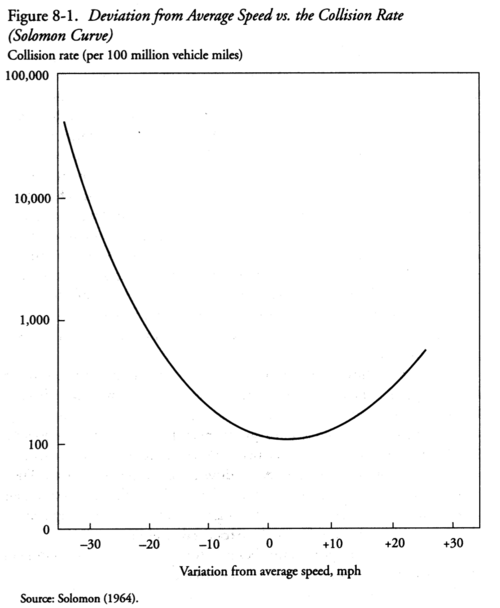
What we may have now with lax enforcement is called the “Solomon Curve.” That is a chart showing risk is lowest for vehicles traveling near the average traffic speed and rises sharply for those deviating significantly faster or slower. This creates a U-shaped curve: both very slow and very fast drivers relative to the flow have elevated involvement rates.
The reason is obvious. Reaction times are constricted when greater speed differences lead to more lane changes, overtaking, merging issues and rear-end or sideswipe risks. Uniform speeds, on the other hand, improve flow predictability and reduce conflicts.
And that, dear friends, is why a civilized society, individual freedom granted, must find the will and the means to enforce speed limits, not that high speeds would be particularly more dangerous but to ensure that traffic is not traveling at random speed which is dangerous, especially on bad roads. — tcl