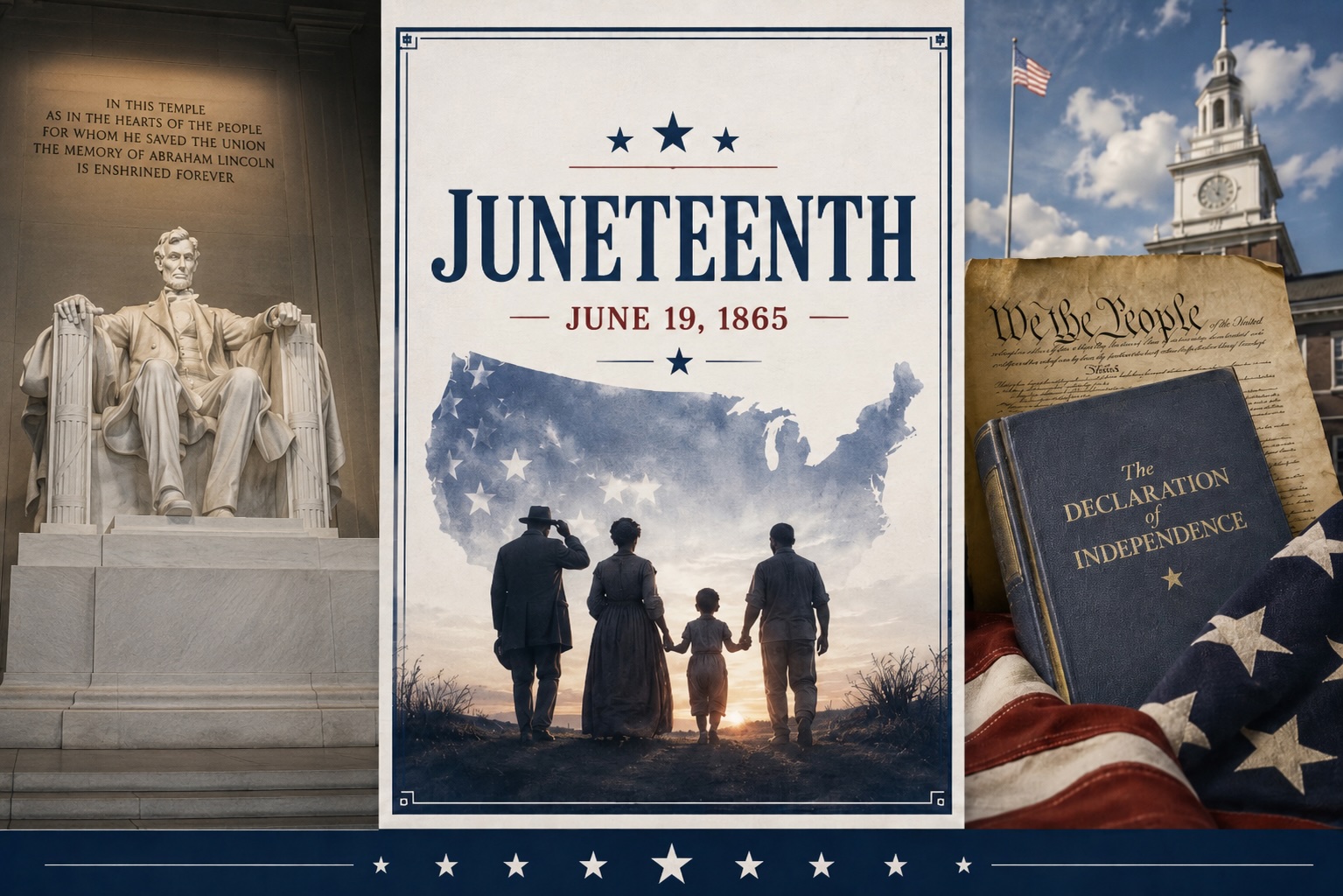
Juneteenth marks one of the great turning points in American history: the day when the promise of 1776 was carried more fully into the lives of those who had too long been denied it.
America was founded on a revolutionary principle: all people are created equal, endowed by their Creator with the rights to life, liberty, and the pursuit of happiness. That principle did not instantly erase the injustice of slavery. But it gave Americans the moral standard by which slavery could be condemned and a guide for future generations seeking to bring the nation’s laws and institutions into closer alignment with its founding ideals.
On June 19, 1865, Union General Gordon Granger arrived in Galveston, Texas, carrying the mandate of emancipation, and with it, the principles of the American Revolution. The Civil War had ended. The Confederacy had fallen. The Emancipation Proclamation had already declared enslaved people in the rebellious states free. But in Texas, that promise had not yet been made real for those still held in bondage. Granger’s order marked the arrival of federal authority and a new birth of freedom. It also defined what that liberty meant. General Order No. 3 declared “an absolute equality of personal rights and rights of property” between former masters and the formerly enslaved. Freedom was understood as self-ownership: a person’s right to his own life, his own labor, and the property earned through that labor.
That is why Juneteenth matters. It reminds us that liberty is more than an idea. Natural rights do not operate like natural laws. They do not assert themselves with the force of gravity. They must be upheld in law and defended in practice so that freedom is not only declared but lived.
America marks the 250th anniversary of the Declaration this year. Juneteenth shows what those founding words demand of every generation, including our own.
The Declaration did not make America perfect. Its truths are not self-preserving and must be taught, defended, renewed, and, when necessary, fought for. That was true for those who endured bondage, for those who took up arms to save the Union and destroy slavery, and for every generation tasked with keeping America faithful to the principle that no person’s life belongs to another. Juneteenth calls us to remember the cost of liberty and to celebrate its victories: the end of slavery, the vindication of human equality, and the enduring charge that America’s ideals must be secured for those who come next.
Carl Paulus is a Senior Writer for the Goldwater Institute.