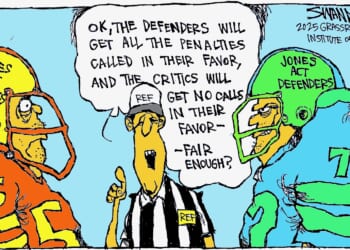
As the temperatures rise, so too does a distinctly anti-innovation, anti-competition sentiment in the United States Congress. Cloaked in the language of “protecting consumers” and “giving the public a role,” recently introduced bills create regulatory regimes that would dismantle consumer choice and cripple American industries.
The American Innovation and Choice Online Act (AICOA) is deceptively named, providing neither innovation nor choice. The bill is a reintroduction, spearheaded by Senate Judiciary Committee Chairman Chuck Grassley (R-Iowa) and Sen. Amy Klobuchar (D-Minn.) It outlines a system of red tape to govern platforms like Amazon, Apple, Google, Meta, and Microsoft not dissimilar to the Digital Markets Act (DMA) of the European Union. In a coalition letter from the Information Technology and Innovation Foundation, signed by the Pelican Institute for Public Policy, the similarities to the DMA are outlined, “AICOA targets a small set of online platforms that meet specific revenue and user thresholds—without requiring any demonstration that they enjoy market power. It places limitations on these firms from undertaking a broad range of business practices that include self-preferencing, product integrations, refusals to deal with competitors, tying, the cross-use of data, and more.”
The AICOA picks winners and losers in an industry that has already demonstrated the ability to generate organic competition simply through the breakneck speed of innovation and without government intervention. Technology companies are constantly vying against each other, with new ones rising up to challenge more established companies as innovation disrupts the status quo.
While different from the AICOA in its stated aims and technical approach, the American AI Sovereign Wealth Fund Act, introduced by Sen. Bernie Sanders (D-Ver) also supplants free market mechanisms in favor of government control. The legislation imposes a tax on AI companies with gross receipts of over $200 million. It also gives the U.S. treasury a 50% stake in all qualifying AI companies and directs payments to every man, woman, and child each fiscal year from the fund. The bill doesn’t stop there, it imposes new restrictions on the business practices of AI companies and establishes a commission to monitor and control their behavior.
Like the AICOA, the American AI Sovereign Wealth Fund Act picks clear winners and losers among American businesses. The Wealth Fund Act forsakes free market principles for the temporary satisfaction of getting back at “big tech,” neglecting to acknowledge the vital need for American AI leadership and the increasingly crucial role of AI innovation to America’s security and economy.
Sanders frames his legislation as an opportunity for the American people to benefit from AI, ignoring the countless ways that people are already benefitting from the technology. Medical breakthroughs, improved educational outcomes, refined procedures around public safety, infrastructure, and emergency response are but a few areas where AI is helping people. Economically, the American people are already benefitting as well; an AI data center in Louisiana’s Richland Parish created the extra funds for some of the teachers in the area to receive bonuses of more than $50,000 and more broadly, the AI industry and the infrastructure surrounding it continue to create jobs and generate investment in towns across the country.
The AICOA and the American AI Sovereign Wealth Fund both make bold promises to do what the free market is already successfully doing. We don’t need the government to cripple certain businesses in the name of competition or to apply a socialist approach in order to help the American people benefit from AI.