The Kansas House and Senate have already passed the FY 2027 budget bill, House Bill 2513, and sent it to Governor Laura Kelly. Aside from some line-item vetoes and (failed) overrides, the topline is essentially the same.
Supporters are calling it responsible because it trims the State General Fund budget by $189.2 million below a roughly $11 billion total from last year while still funding selected priorities.
That sounds nice. It is also not the real test. The real question is whether the budget is actually small enough, disciplined enough, and competitive enough for Kansans. It is not.
The latest March 2026 revenue report makes that plain. Total tax collections came in at $577.1 million last month, which was $68.9 million below the estimate and 9.4 percent below March 2025. Since the November consensus estimate, collections have run more than $175 million below forecast. Corporate income tax receipts were especially ugly, coming in $63.5 million below the estimate for March alone.
That is not a rounding error. That is the kind of softness you see when the budget is still leaning too heavily on wishful thinking.
And that is the problem. Kansas is not budgeting from a position of strength. It is budgeting from a permanently inflated post-pandemic baseline and pretending that a modest trim from last year somehow makes everything fine. It does not.
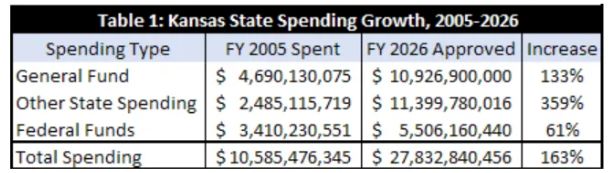
The updated Responsible Kansas Budget shows how far off course Kansas has drifted. From FY 2005 to FY 2026, total state spending rose from $10.6 billion to $27.8 billion, while state funds spending rose from $7.2 billion to $22.3 billion.
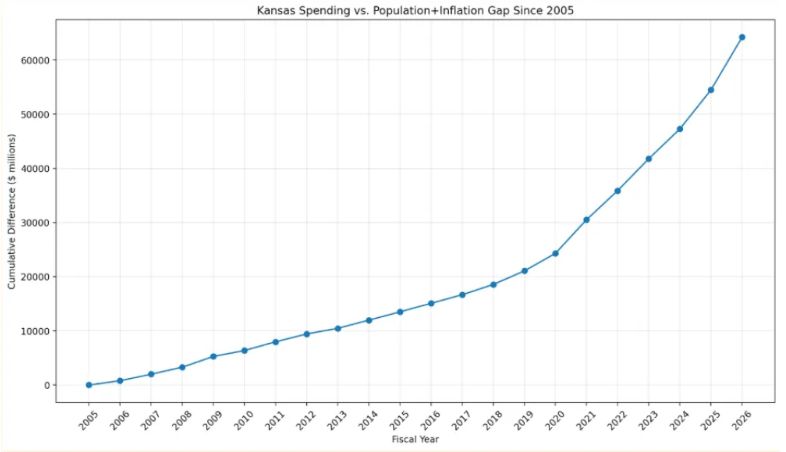
If state funds spending had grown only by population growth plus inflation since 2005, Kansas would be spending about $12.6 billion this year instead of $22.3 billion.
That means the state is spending roughly $10 billion more per year than a responsible path would allow, with cumulative excess spending of more than $64 billion since 2005. That is not prudent budgeting. That is decades of drift.
The Legislature’s FY 2027 budget does not fix that. It barely touches it.
The Responsible Kansas Budget also makes an important point that too many lawmakers still dodge. Limiting future spending growth to population plus inflation is a good rule, but it is not enough when today’s budget is already bloated.
Kansas first needs a reset. Spending should be cut back toward FY 2019 or 2020 levels, before pandemic-era spending spikes and federal cash distorted the baseline. Using 2020 as the base year, the updated RKB estimates a 2027 responsible budget of about $17.2 billion, which is roughly $10 billion less than what Kansas is now planning to appropriate.
That is the debate lawmakers should be having. Instead, they are congratulating themselves for shaving around the edges.
They are also missing the deeper lesson Kansas should have learned from the Brownback years. The failure was never tax relief per se. The failure was trying to cut taxes without first getting spending under control. When revenues tightened, spending stayed protected, and tax reform took the blame.
The wrong lesson got burned into Kansas politics. Today’s lawmakers risk repeating that mistake by protecting an oversized budget and hoping future revenue growth will rescue them. Hope is not a budget strategy.
The broader economic picture should make lawmakers even more uneasy. KPI’s 2025 Green Book shows Kansas government spending at $5,428 per resident and state and local tax collections at $6,326 per person. That is not the profile of a lean, growth-focused state. It is the profile of a state that taxes and spends too much while competitors move faster. When Kansas remains expensive, average, and slow to reform, families and businesses are increasingly moving elsewhere.
And unlike Washington, Kansas cannot print money. If it spends more than it collects, the bill shows up in only two ways: higher taxes now or higher taxes later.
That is why Kansans should not settle for this budget just because both chambers passed it. The House and Senate missed the big issue.
Kansas does not need a slightly smaller version of an oversized budget. It needs a budget reset. Cut back toward a 2019 or 2020 spending base. Cap future growth at population plus inflation, preferably less. Use surpluses for tax relief, not bigger government.
Kansas passed a budget. Kansans still need a better one.