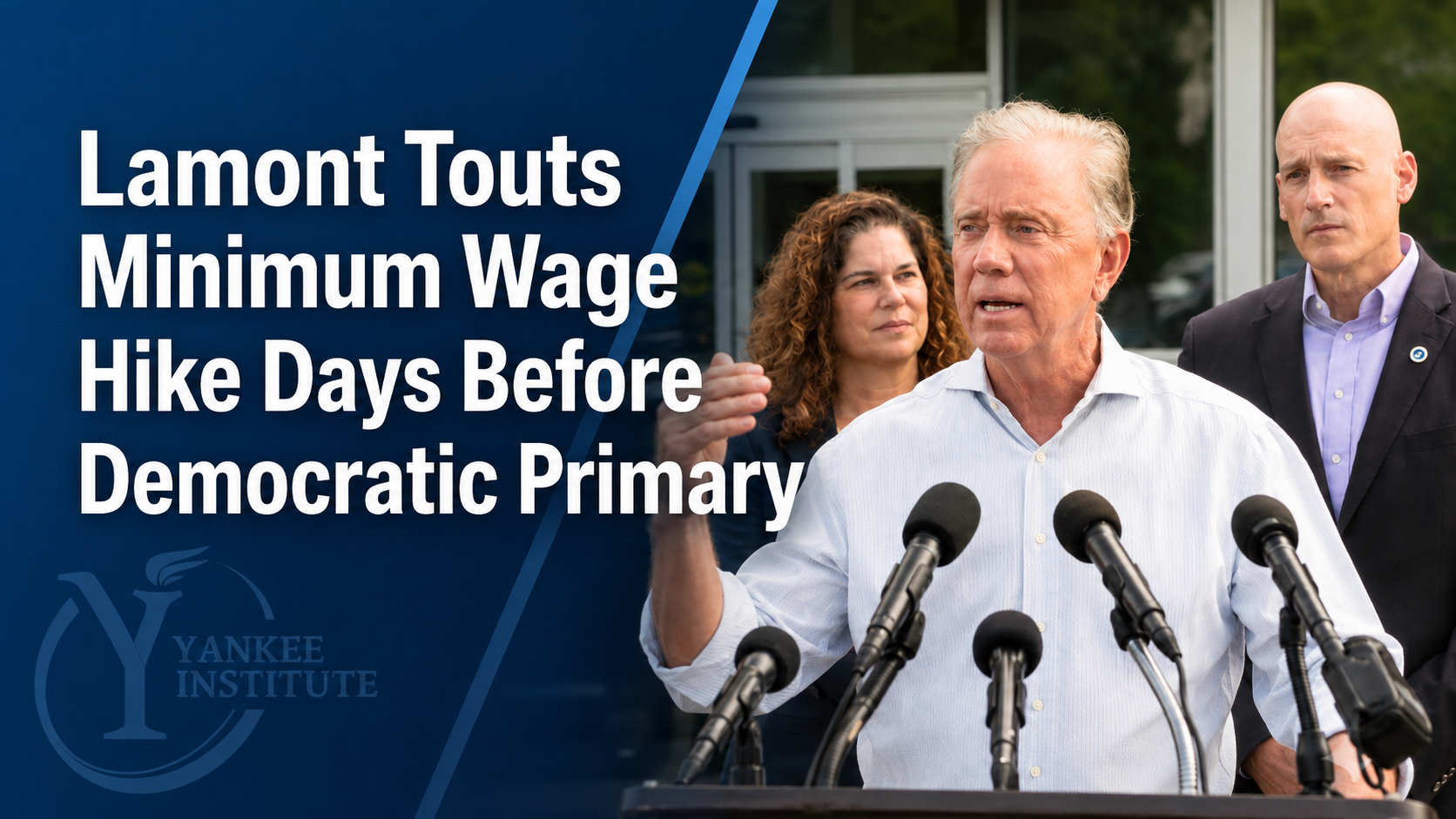
Connecticut’s minimum wage will rise to $17.48 an hour next year, following an announcement the Lamont administration held six days before the governor faces Democratic primary voters.
The 54-cent increase is automatic under a 2019 state law that ties the minimum wage to changes in the federal Employment Cost Index. It will take effect Jan. 1, 2027, increasing the current rate of $16.94 by 3.2%.
For someone working 40 hours a week, the adjustment amounts to an additional $21.60 before taxes.
Lamont faces state Rep. Josh Elliott (D-Hamden) in the Aug. 11 Democratic primary, and a reporter directly questioned whether the announcement’s timing was political.
“Is it just coincidental that it’s prior to August 11th?” the reporter asked.
“It is absolutely coincidental,” Labor Commissioner Danté Bartolomeo answered.
Bartolomeo said the announcement was made to give employers time to prepare for the increase.
“It’s always around the same time every year,” she said. “We want to give businesses an opportunity to adjust and to plan for this. It doesn’t go into effect until January of 2027, so they’ve got five months to adjust.”
There is a reasonable explanation for the timing. The state calculates the new rate using the federal Employment Cost Index for the 12-month period ending June 30. The June figures were released July 31, giving the state the information it needed to announce the adjustment. State law requires the labor commissioner to announce the following year’s rate by Oct. 15, but does not require the state to wait until September.
Still, the announcement came earlier than it did during the first three years of Connecticut’s indexed minimum-wage system.
The increase taking effect in 2024 was announced Sept. 18, 2023. The 2025 rate was announced Sept. 27, 2024, while the increase taking effect this year was announced Sept. 3, 2025.
Before annual indexing began, the 2019 law set a series of specific minimum-wage increases and the dates they would take effect. In 2022, for example, the administration issued a reminder on June 27 that the wage would rise from $13 to $14 on July 1, just four days later.
Beginning with the rate that took effect Jan. 1, 2024, the wage was no longer set at a predetermined amount. Instead, the Labor Department began calculating a new rate annually using the federal Employment Cost Index.
That makes this year’s early-August announcement unusual, although not necessarily improper. The federal figures needed to calculate the rate had become available, and nothing in the law required the administration to wait until September.
Wednesday’s event also went beyond a technical announcement from the Department of Labor.
Lamont was joined by Lt. Gov. Susan Bysiewicz, Sens. Julie Kushner (D-Danbury) and Derek Slap (D-West Hartford), and Connecticut AFL-CIO Vice President Shellye Davis. Speakers used the event to promote the administration’s record on wages, taxes, paid family leave and assistance for lower-income residents.
Kushner pointed to Democrats’ control of state government when the law passed.
“We had a trifecta,” she said. “We knew we could get this done.”
Slap connected the minimum-wage increase to the state earned income tax credit, income-tax reductions and the gradual elimination of state taxes on Social Security income.
Bysiewicz called the adjustment “a really important pay raise” and argued that Connecticut’s economy has continued to grow despite predictions that higher wage mandates would cost jobs.
Lamont spoke about rising gasoline and food costs, SNAP benefits and the economic pressures facing lower-paid workers.
“Pay the essential workers a little more,” Lamont said. “They deserve it.”
The administration estimates that between 160,000 and 200,000 Connecticut workers will benefit from the increase. Bartolomeo acknowledged that employers will face additional costs but argued that Connecticut should not leave its lowest-paid workers to absorb rising prices without a corresponding wage increase.
The increase itself was automatic. What stood out was the timing: after three September announcements, this one came six days before the primary.