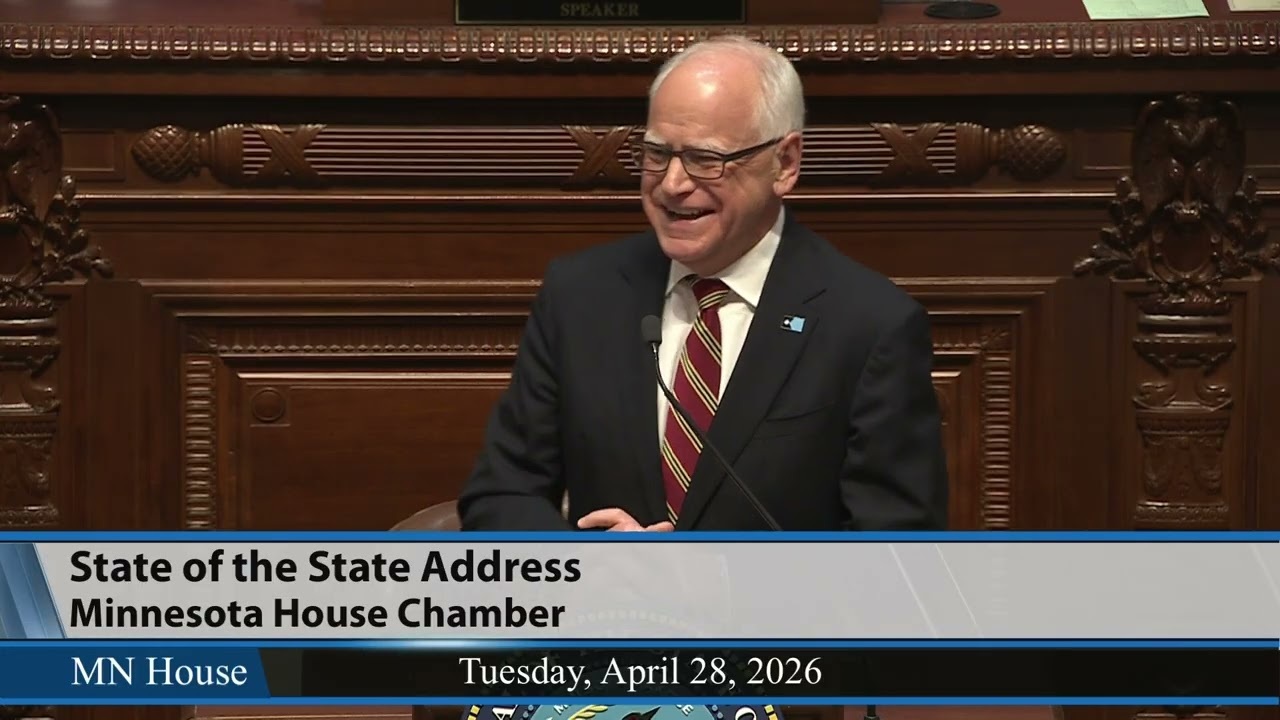
On Tuesday night, Gov. Walz gave his final State of the State speech. Implausibly, but unsurprisingly, after seven years in the governor’s mansion, he claimed that “the state of our state remains strong.”
All bucks, no bang
It was an occasion for the governor to list his achievements, but there aren’t many achievements to list. What we got instead was a list of things he had spent more money on, but spending isn’t an achievement if you don’t get anything in return.
On education, for example, Gov. Walz said:
I’ve had the privilege of signing into law the most consequential education budgets in our state’s history.
From cradle to career, we’re preparing our kids for life in the 21st century better than anyone else.
We’ve invested more than $1 billion in child care and early learning opportunities.
We’ve added thousands of new pre-K seats.
Made significant investments to improve child literacy.
Expanded access to mental health resources for students at every level.
Made college free for students with a family income under $80,000.
All these things are inputs, spending, and not outputs, like results.
When he did try to show what bang Minnesotans have got for their bucks, he was forced to rely on bogus statistics. “[O]ur schools have never been in better shape—as evidenced by our record-high graduation rates,” he said. But, as my colleague Catrin Wigfall noted recently, “Even as graduation rates climb, academic performance is moving in the opposite direction. In math and reading, Minnesota high school students are performing at the lowest levels ever recorded for a graduating class.”
The governor said that he had “invested” – notice how, to politicians, every cent of spending is “investment,” whether it is or not – “millions in workforce development to connect Minnesotans of every age with high-growth, high-demand career fields like manufacturing, education, and public safety.”
And what have Minnesotans got for that? An unemployment rate above the national rate for the first time since November 2007.
It is the same story across a range of issues. “Meanwhile, we’ve invested $1 billion in housing,” the governor claimed, “a historic investment in making housing more affordable and our economic foundation more secure in communities across the state.” But has housing become more affordable in Minnesota?
Some of this spending has simply backfired. The governor noted:
And because we instituted free breakfast and lunch in our public schools, we can say we’re a state where no student goes hungry—in Minnesota, we feed our kids.
During the first two years of the Minnesota Free School Meals Program, schools served more than 300 million free meals, saving Minnesota families an average of $1,000 per student per year.
But, as the Star Tribune reported in a recent article on school budgets which are being squeezed even after those “consequential” budgets:
At the Capitol, the Association of Metropolitan School Districts and other school advocacy groups are fighting to retain funding targeted at low-income students — some of which now is in peril due to the state’s adoption in 2023 of universal free school meals.
Previously, families filled out forms to qualify for free or reduced-price lunches, and the numbers were used to determine how much a district receives in so-called compensatory revenue. Now, the state relies largely on SNAP and Medicaid enrollment to determine aid, leaving many low-income students unaccounted for.
The key question is whether this spending produces a result, so keep a watch on data for food security.
Making things worse
“The cost of everything—from groceries to gas to housing—is simply too high,” the governor commented, blaming “bad economic policies coming from D.C.” Thankfully, inflation is down from its year-on-year peak of 9.0% in June 2022.
But then he went on to take credit for state policies which have made energy more expensive. “We’ve also worked together to get Minnesota on a path to 100 percent clean energy by 2040 while creating green jobs in every corner of the state,” he claimed. “And I’ve had the privilege of signing into law more than 40 different climate initiatives, including expanding our electric vehicle infrastructure, making our homes and buildings more resilient and efficient, and cutting red tape for clean energy projects.”
All of these measures have helped push your energy bills up and squeezed affordability.
Misspeaking
Some of the governor’s claims were simply false.
“I’m proud to say that I’ve cut taxes in nearly every single budget I’ve proposed and signed,” he claimed. But, as I noted recently, the Minnesota Department of Revenue’s own analyses show that taxes on every income decile from the fourth up increased as a result of the budgets the governor signed in 2019 and 2023, and that is without taking into account the new payroll tax which funds the Paid Family and Medical Leave scheme. Indeed, for 2025, the average earner will pay more state income tax in Minnesota than in 43 other states and our state is one of just 16 where the share of the average earner’s wages swallowed up by the state government in income tax has increased over the last decade.
“We’ve delivered rebate checks of up to $1,300, putting money directly into the pockets of students, seniors, workers, and middle-class families,” the governor claimed, but handing out cash is not a tax cut, certainly not when, thanks to his own party’s blunders, it landed recipients with a higher federal tax bill.
“I’m proud that we’ve been able to invest so much in our schools and in housing even as we cut taxes nearly every year,” the governor claimed, “and, thanks to the work we did last year, maintained a fiscally responsible budget.” But Minnesota’s state government has, in fact, spent more than it has collected in revenues in every year since 2024 and is forecast to continue doing so in every year until at least 2029. This isn’t fiscal responsibility.
An infuriatingly large amount of this tax revenue, hard earned by Minnesotans, has been stolen under Gov. Walz’ watch. Indeed, the miserable failure of his administration to look after its citizen’s cash with state government programs becoming an ATM for fraudsters from all over is the main reason he exited the race for a third term.
On Tuesday, he conceded that “we’ve seen in recent months—and just today—the more generous your support system, the more oversight you need to make sure people aren’t taking unfair advantage.” But when he lists all the measures he has taken to combat fraud, not one of them dates from before February this year, seven years into his term and with many billions of dollars out the door.
Getting worse
More broadly, the governor claimed that:
Together, we’ve made Minnesota one of the most economically secure, prosperous, forward-thinking states in the nation.
Just look at the rankings.
No, let’s look at the data.
Gross Domestic Product per capita has grown at slower rate in Minnesota than for the United States generally in every single year of the governor’s tenure and in 2025 we became a below average state for the first time on record. This underperformance dates to 2014, in fairness to him, but on his watch our state’s economic growth has slowed sharply.
If GDP per capita seems too esoteric a measure, note that Minnesota’s real median household income is down 6.4% from its 2019 peak, a worse record than in 44 other states. That above average unemployment rate we now have is the result of the job growth in Minnesota being half the national rate on his watch with the result that, last September, there were fewer people employed in Minnesota than there were in 2018.
One thing that has increased is SNAP issuance in the state: since 2018, we have seen the biggest expansion in the United States, hardly a sign of a thriving economy.
So long, it’s been good to know yuh
The governor is done, and with his record Minnesotans can, perhaps, be grateful for that. The key question for any candidate of any party seeking to replace him is: “What would you do differently?”