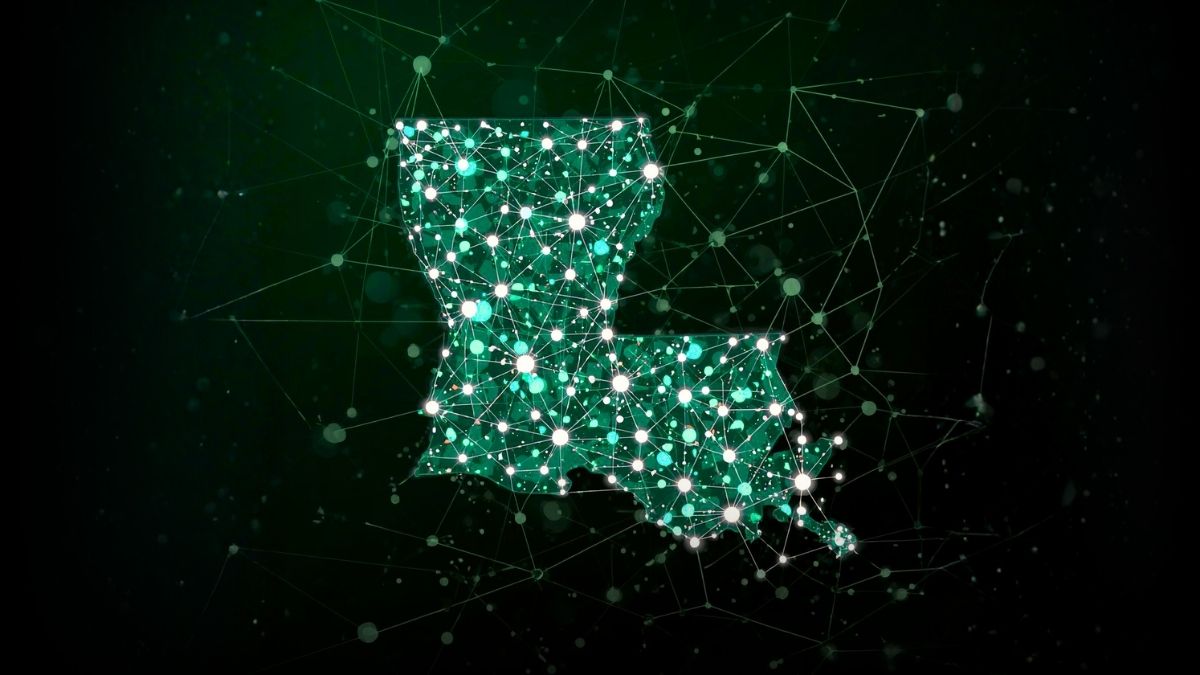
Louisiana regulators have officially opened the door to one of the most consequential energy policy debates in decades.
At the April meeting of the Louisiana Public Service Commission, Commissioner JP Coussan directed staff to open a rulemaking docket evaluating “private use electrical networks” — a move that could fundamentally reshape how large-scale energy projects are powered in Louisiana.
The directive comes at a pivotal moment for the state. Louisiana is rapidly emerging as a national hub for artificial intelligence infrastructure, hyperscale data centers, advanced manufacturing, and industrial expansion. But meeting that demand will require something the current regulatory structure struggles to deliver: dramatically more electricity production at market speed.
The timing also aligns with a growing national conversation led by U.S. Energy Secretary Chris Wright, who recently warned during a fireside chat with the Cato Institute that America’s electricity system is falling dangerously behind its broader energy success story.
“In the last 20 years,” Wright said, “the United States has tripled our oil production. We’ve doubled our natural gas production. And we’ve grown our electricity production by just 10 percent. What’s wrong with that picture?”
For Louisiana, that question is no longer theoretical.
The state sits atop one of the most powerful energy economies in the world. Louisiana produces oil and natural gas at massive scale, exports liquefied natural gas to global markets, and hosts one of the world’s largest petrochemical corridors. Louisiana knows how to produce energy.
But when it comes to electricity, the state still largely operates under a monopoly utility structure designed for a very different era.
That matters because electricity demand is now surging after decades of stagnation. U.S. net electricity generation hit a record 4.43 thousand terawatt-hours in 2025, while analysts at S&P Global project demand could rise another 50 percent by 2040. Artificial intelligence, data centers, reshored manufacturing, and electrification are all pulling from the same constrained grid.
Louisiana is squarely in the path of that growth wave — and that is good news.
In March 2026, Amazon announced plans for two large-scale data center campuses in Caddo and Bossier Parishes representing more than $12 billion in private investment, the largest single economic commitment in the region’s history. That same month, Meta unveiled a major expansion of its Hyperion campus in Richland Parish, growing the project from an already massive $10 billion investment into a roughly $27 billion commitment.
Meta’s facility alone could require as much as 5 gigawatts of power — roughly enough electricity to serve more than five million homes.
These projects are not just warehouses filled with servers. They are the backbone of artificial intelligence, cloud computing, digital commerce, and next-generation technologies that will shape the global economy for decades. Landing those investments in Louisiana means more jobs, more industrial growth, stronger domestic supply chains, and a larger tax base.
Critics often argue that these large new energy users will drive up electricity prices for everyone else. But Secretary Wright argues the opposite.
“The reshoring of manufacturing and the building of data centers,” Wright said, “they are the answer to drive down electricity prices. They are not the problem, they are the answer.”
The data supports that argument. States with the fastest-growing electricity demand over the last five years have generally experienced price increases below the rate of inflation. Meanwhile, states that have constrained electricity production — including California, New York, and Massachusetts — have seen some of the steepest electricity price increases in the country.
The larger problem is structural.
In most of the United States, including Louisiana, electricity is provided through regulated monopoly utilities operating under exclusive government-granted service territories. Under this “cost-of-service” model, utilities recover approved expenses and earn guaranteed returns based on the amount of capital invested into infrastructure projects.
That system creates incentives that often reward larger capital expenditures rather than lower-cost or more innovative solutions. Utility profits increase as the regulated “rate base” grows, regardless of whether those investments represent the most efficient option for consumers.
As Wright put it: “We can massively grow our rate of electricity production, but the system we have today is not conducive to it. We need larger wholesale reform so that capital can come in and invest in it.”
Louisiana policymakers have already begun exploring what that reform could look like.
During the 2026 Regular Session, Senator Bob Hensgens introduced Senate Bill 490, legislation designed to create a parallel market-based pathway for large industrial users to directly develop or procure power generation outside the traditional monopoly utility structure.
The proposal would not dismantle the regulated utility system that serves residential and small business customers. Instead, it would create an additional lane allowing private capital to finance and build generation for new large-load projects without placing additional pressure on the existing grid.
Although the legislative clock may run out on SB 490 this session, the debate is clearly moving forward.
That is why the Public Service Commission’s decision to open a formal docket evaluating private use electrical networks is so significant. It signals that Louisiana regulators understand the scale of the opportunity — and the risks of standing still.
Louisiana already knows how to produce abundant energy safely, efficiently, and competitively. The challenge now is whether the state will modernize its electricity framework quickly enough to support the next generation of economic growth.
Secretary Chris Wright has issued a direct challenge to states across the country: embrace targeted reforms that unlock private capital, competition, and electricity abundance — or fall behind.
Louisiana now has an opportunity to lead.