
Since 2005, Massachusetts has achieved the top ranking in the biannual National Assessment of Educational Progress’s (NAEP) fourth-grade reading assessment. However, the Commonwealth’s lower quality Common Core-based English Language Arts (ELA) standards and lack of quality of reading pedagogy and curriculum at the local level are coming back to haunt it.
Massachusetts currently delegates curriculum authority, allowing local school districts to adopt their own reading pedagogy. Teachers’ unions, including the Massachusetts Teachers Association, praise this local flexibility, arguing that it allows for trust in front-line educators to determine classroom needs. Despite its popularity among unions, this decentralized approach is becoming increasingly unsustainable, especially with lower state standards. Reading scores across the Commonwealth have been plummeting since 2018, currently sitting lower than they were in the early 2000s (Figure 1).
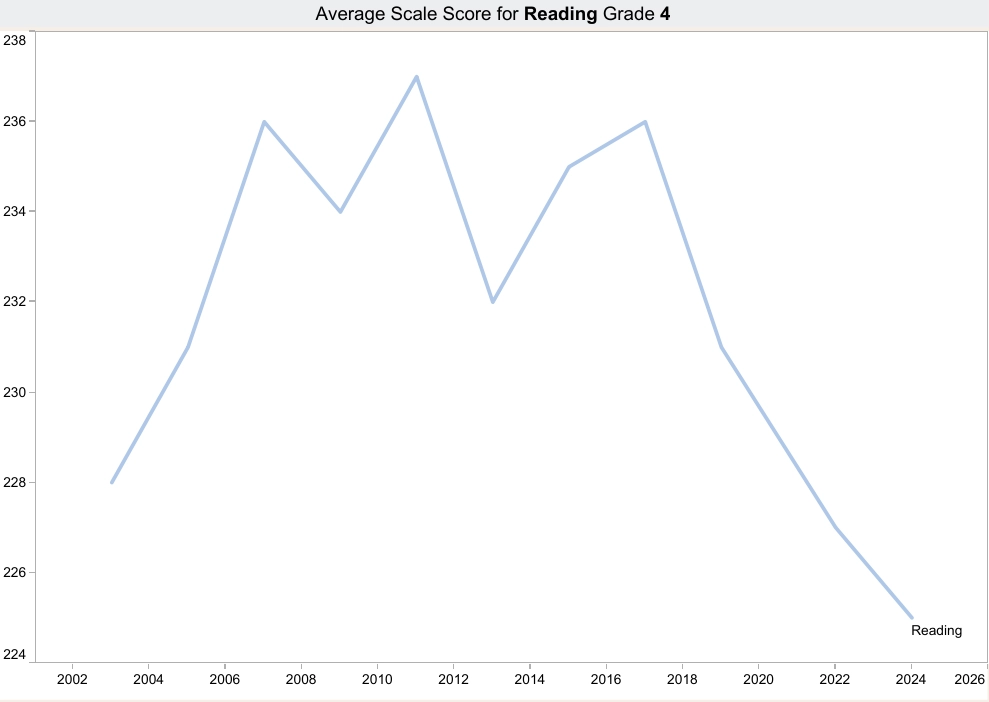
Figure 1. NAEP Reading Score Among Fourth Graders in Massachusetts from Pioneer’s US DataLabs.
While Massachusetts policymakers may attempt to hide behind a broader national decline in reading scores, there are several states making notable progress on NAEP reading. These states have mandated a structured curriculum framework and instruction known as the science of reading. Rooted in cognitive science, this decades old, research-based approach emphasizes phonics and language comprehension over the whole language pedagogy that’s dominated K-12 education for 35-40 years. Mississippi, for instance, mandated the science of reading curriculum and witnessed notable progress climbing from the third lowest fourth grade reading score in 2003 to above the national average in 2024 (Figure 2).
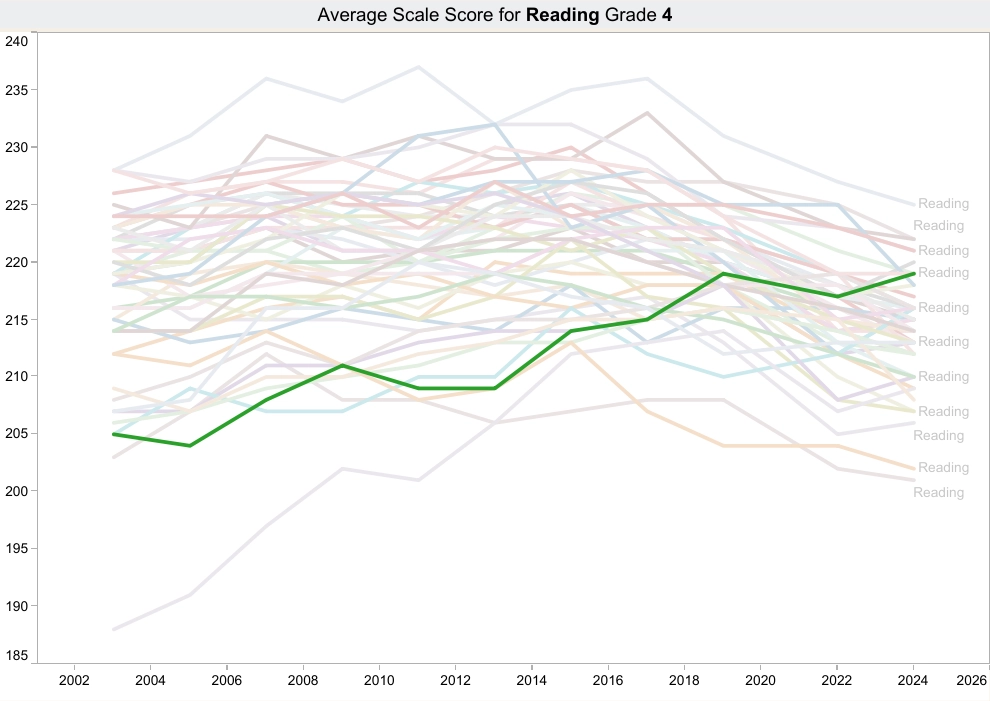
Figure 2. NAEP Reading Score Among Fourth Graders in Mississippi (dark green) contrasted with all states from Pioneer’s US DataLabs.
Mississippi is a success story. Yet, critics of science of reading point out that even though more than 40 states have adopted these frameworks, national literacy scores continue to slide. While their criticism has merit, it fails to recognize that the vast majority of science of reading states fail to effectively implement this curriculum. In fact, Florida is a prime example of a state with a nuanced implementation. When they originally adopted their curriculum to science of reading in the early 2000s, they had remarkable success but have since struggled to maintain their results.
Today, Florida’s fourth-grade reading score has nearly returned to pre-reform levels. While science of reading’s failure in Florida is still being researched, some school officials are pointing to overreliance on technology, unstructured teacher training, and chronic absenteeism as potential reasons for the program’s recent struggles. While all states may face confounding implementation difficulties, one of the most common ones is a lack of teacher training in the science of reading pedagogy. In Florida alone, 40 percent of teacher education programs fail to adequately train incoming educators in all five types of basic reading pedagogy.

Massachusetts State House
Massachusetts plans to update its literacy curriculum for the 2027-28 school year. The new curriculum will provide school districts with a menu of pedagogies to choose from,likely including science of reading. However, the Commonwealth’s proposal not only fails to provide an outright mandate but takes zero initiative in ensuring a successful implementation. Given that a staggering 84 percent of the Commonwealth’s teacher education programs fail to train adequately across all five core components of literacy instruction (Figure 3), Massachusetts should feel an obligation to aid in implementation.
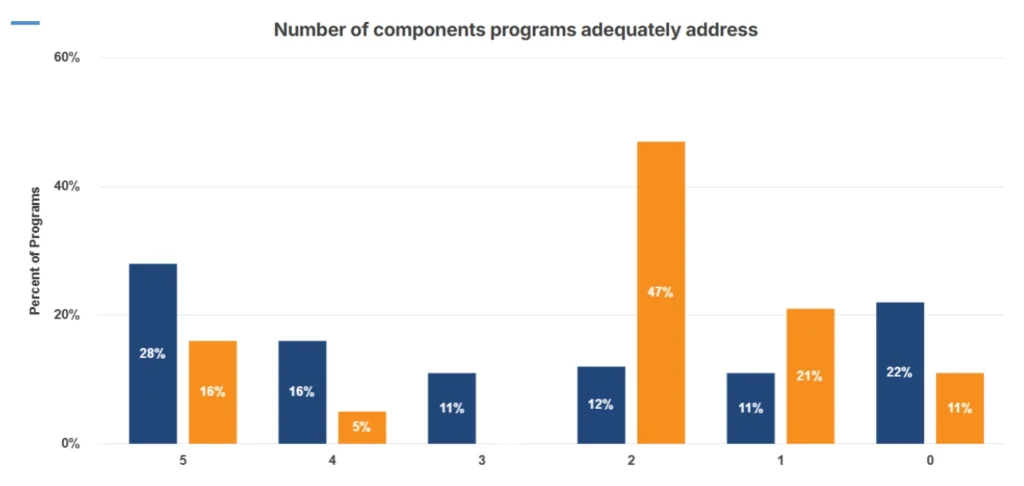
Figure 3. National Council on Teacher Quality’s Review of Percent of Massachusetts Teacher Training Programs Based on Number of Reading Methodology Components. Blue graph is percent nationally; orange is percent in Massachusetts.
If Massachusetts wants to remain number one in education, it must enact more sweeping reforms than are currently planned for the 2027-28 school year. The Commonwealth is no stranger to the benefits of educational reform. The Commonwealth’s landmark 1993 Massachusetts Education Reform Act transformed Massachusetts into the nation’s highest performing public education system because it established high-quality academic standards; teacher testing, and norm-referenced student tests aligned with the state standards and teacher tests. Recent dismantling of this coherent system has damaged academic quality, contributing to the state’s drop in student literacy. To turn this trend around, the state should mandate the science of reading pedagogy and ensure it is properly implemented and evaluated. These changes will help Massachusetts continue to be the best state for K-12 education.
Samuel Klein is the Roger Perry Intern with PioneerEducation. He is a rising Junior at the University of Rochester, studying Politics, Philosophy, and Economics (PPE).