
Today, the majority of Minnesota students cannot read or do math at grade level. One strong contributor is the fact that many students don’t attend class.
In Minnesota, there’s been a significant decline in actual school attendance. In 2024, about one in four Minnesota students were chronically absent. Unfortunately, Minnesota’s school system is not designed to address chronic absenteeism.
The first obstacle for systems change is that it’s far too easy for chronic absenteeism to go unnoticed. The Minnesota Department of Education (MDE) releases chronic absentee data on a one-year lag for each release. (2025 chronic absentee data is expected in August 2026.) The delay in the release of chronic absentee numbers does nothing but obscure the problem, allowing thousands of Minnesota children to slip through the cracks.
Chronic absenteeism (when a student misses 10 percent or more of the academic year) has predictably unfortunate effects on academic performance. An absent student does not learn the material, and when she returns, she spends her time on makeup work. As teachers spend their time constructing makeup packets and alternative assignments for absent pupils, they are unable to devote their energy to the classroom, leading to decreased learning for the entire room. In turn, frustrated classmates of chronically absent students are more likely to become chronically absent themselves.
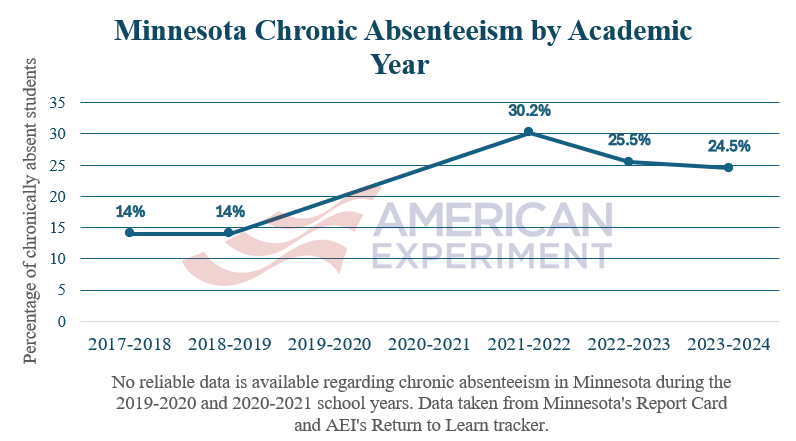
The issue hasn’t prompted urgent legislative action, even after COVID-19 saw absentee rates skyrocket from about 14 percent to over 30 percent. Rates declined in the 2023 and 2024 school years to an apparent new norm of about 25 percent.
There are many organizational challenges to be met before policymakers can determine a successful plan to lower chronic absenteeism. The most prominent issue is the outdated way in which MDE collects and publishes information. Districts are free to choose their own internal codes for tracking chronic absenteeism, making it difficult to make standardized comparisons. The data itself is released on a one-year delay, rendering it functionally useless as a policy guide. This information exists and is used regularly within funding formulas to determine state financial disbursements.
Minnesota is one of the only states in the nation that releases chronic absentee rates with such a long delay. Several states, like Ohio, have clear chronic absenteeism dashboards to promote quality student retention policies.
The desperate need for Minnesota’s data reform isn’t a secret. Minnesota Legislature’s Student Attendance and Truancy Legislative Study Group, released a report in 2024 arguing for change. That report primarily emphasized the importance of creating up-to-date, granular data systems that shared data sets quickly across school districts, county governments, and state agencies.
Legislators haven’t been fully on board with data modernization, but they have asked school districts to weigh in. One state-funded $4.7 million three-year pilot program, which began in 2024, gave 12 school districts funds to spend however they saw fit to combat chronic absenteeism. The program released a new legislatively mandated report July 2026.
Within the report, MDE revealed that it will soon be publishing a chronic absenteeism dashboard that will break down chronic absenteeism data in more granular detail. This is a significant accomplishment. Researchers and policymakers will be able to see what percentage of chronically absent students are extremely chronically absent. If certain demographics are more likely to be chronically absent, specialized, targeted programs can be created to address their needs and progress can be tracked in real time.
The report noted that in the 23-24 academic year, “84% [of chronically absent students] had between 71% and 90% attendance rates, with smaller proportions having attendance rates between 50% and 71% (11% of students) and less than 50% attendance rate (5% of students).” If the dashboard contains district-level breakdowns like this, it will be worth every penny.
But the report didn’t say the most important detail: will MDE begin to publish accurate chronic absentee data promptly enough for the dashboard to matter?
Transparency about this data is the first step toward a plan to mitigate chronic absenteeism. If MDE does not have the capacity to release absentee data in a timely way, they should alert the legislature and request extra hands. But MDE does a stellar job releasing other types of data in a short timeframe, making it more likely that modernizing the publication of this data simply needs to be made a higher priority.
As the majority of Minnesota students are below grade level for math and reading, policymakers should push for smart changes to the education system. It’s time for Minnesota’s school system to take itself seriously and get the students back on track—by letting policymakers know who has fallen off of it.