Here’s the bad news: Minnesota is still nowhere close to pre-COVID student achievement in either math or reading.
Now, here’s the silver lining. Minnesota is (barely) on the road to recovery in both mathematics and reading.
The newly released 2025 Education Scorecard, a product of Harvard, Stanford, and Dartmouth researchers, measures academic growth across states through an analysis of 3-8 grade state testing scores and national tests. A recent press release announced that Minnesota ranks 17th in mathematics recovery and 8th in reading recovery among states.
Minnesota still remains below prior achievements in both categories, with students remaining nearly .75 grade equivalents below 2019 levels in math. However, most states in the nation (particularly states that did not pass early literacy reforms) have seen continued declines from 2022-2025. Minnesota is in the rare category of states that have begun to reverse the downward slide.
Minnesota squeaked into the group of 8 states that have seen recovery growth in reading achievement, with statewide cohorts gaining .006 grade equivalent levels of reading ability compared to 2022 scores. (Scores are still around around .57 grade equivalents below 2019 levels.)
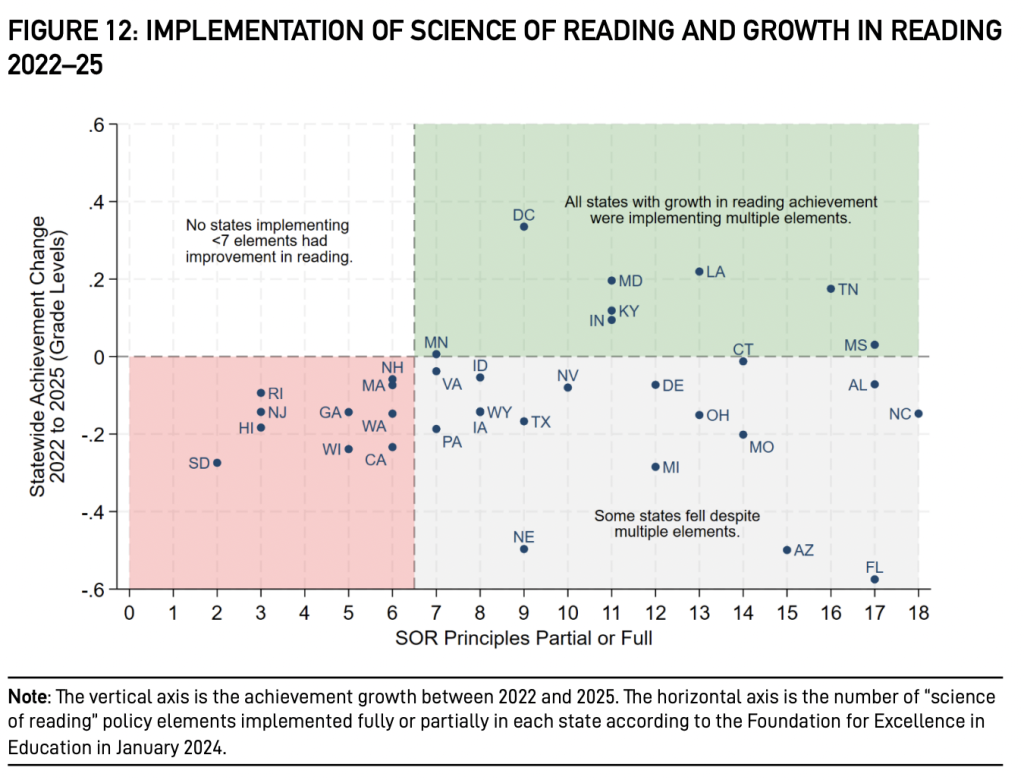
Researchers found that all states that had grown in reading achievement had implemented multiple “science of reading” policy elements. Minnesota’s READ Act, it seems, has had some positive effects. Policymakers should push further to strengthen the READ Act and continue Minnesota’s recovery trajectory.
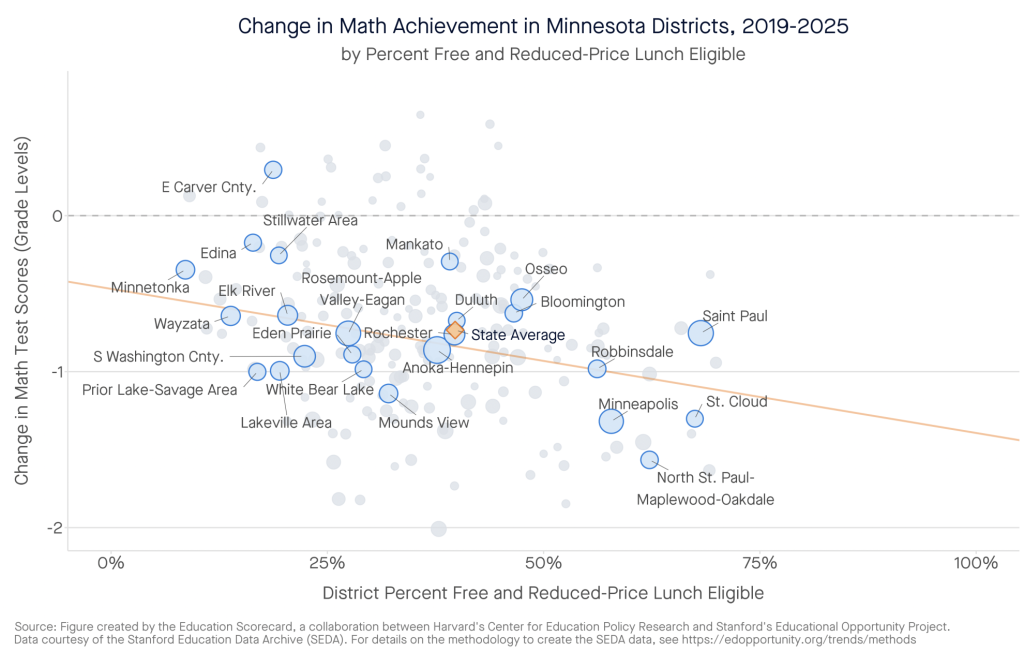
The Education Scorecard highlighted several Minnesota districts that warrant concern. In mathematics, North St. Paul–Maplewood Oakdale, Minneapolis, and Mounds View continue to lag over a full grade equivalent behind 2019 levels. In reading, North St. Paul–Maplewood Oakdale, Minneapolis, and South Washington County are also significantly behind their 2019 levels.
However, there are districts that are standouts. Chisago Lakes and Edina Public are outperforming similar districts in both mathematics and reading recovery. Several other districts are rising in comparison to similar districts in either mathematics or reading. The Scorecard noted that “Sartell-St. Stephen, Mankato Public, and Owatonna are leading the way in math performance, while Richfield Public, Saint Paul Public, and St. Francis Area are leading the way in reading.”
The Scorecard’s superstar district, however, was Eastern Carver County Public Schools. The district has a universal expectation of grade-level proficiency, and has put significant manpower behind data-driven personalized learning. The hard work has paid off. ECCC has mathematics achievement higher than 2019 levels, and reading achievement is higher than equivalent districts by almost half a grade year’s worth of learning.
ECCC is an outlier for Minnesota’s mathematics achievement. The district is the only large district in Minnesota that has surpassed the state average of remaining almost .75 grade levels behind in mathematics. Districts should consider sending representatives to East Carver County Schools in order to learn from their strategies.
It’s always good to hear that Minnesota is on a trajectory towards recovery. Policymakers and school officials should use this positive momentum (however small) to push for a systems-wide refresh, prioritizing more early literacy and mathematics reforms and putting administrative effort into combatting chronic absenteeism. Education Scorecard researchers also argue that, as federal aid dollars expire, Minnesota should focus school improvement dollars on the middle and higher poverty districts that remain behind their pre-pandemic levels. Tightly targeted interventions, whether in the form of student improvement dollars or in the form of an invested Minnesota Department of Education, can work wonders.
The Education Scorecard has published district-level recovery fact sheets for every Minnesota district, available here.