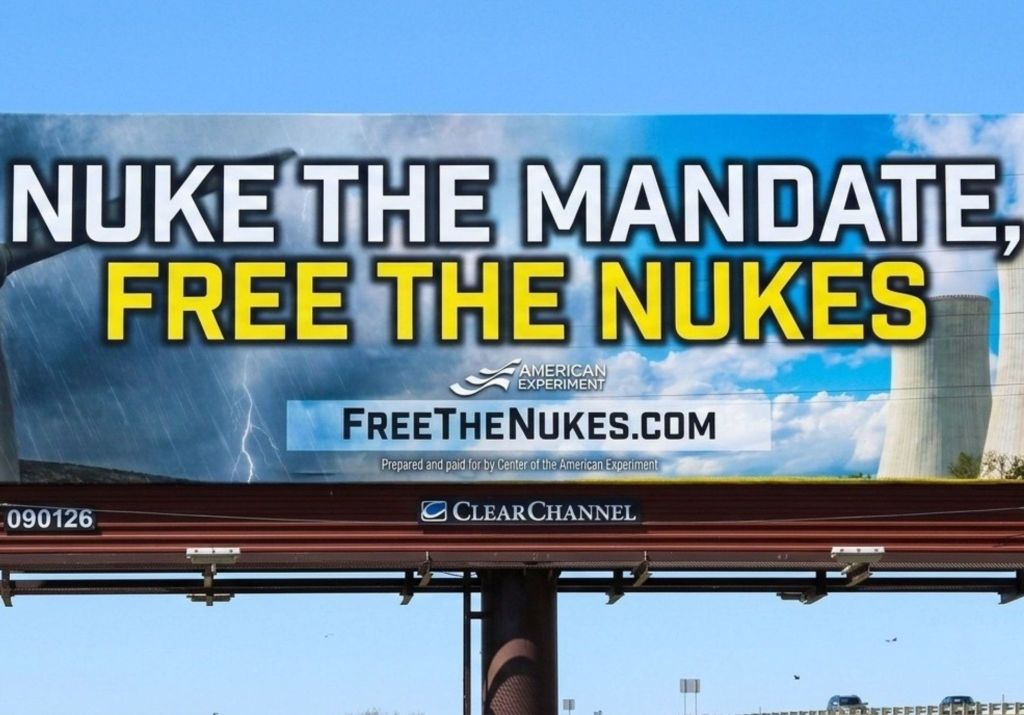
This is a copy of my response to the Request for Information (RFI) from the public by the Great Plains Institute (GPI) regarding the Minnesota Nuclear Energy Study (MNES). The study began on July 1, 2026 and ends by January 30, 2027.
GPI has a website devoted to the RFI. One can either upload a response document or enter responses by topic area in the online form. GPI also has a website with further information on the MNES. Questions may be submitted at [email protected].
The deadline for responses are by 11:59 pm on September 14, 2026. Respond to the RFI here.
Request for information
About You
Name: Darren Nelson
Organization or affiliation, if applicable: Center of the American Experiment
Title or role, if applicable: Policy Fellow, Energy & Natural Resources
Email address: [email protected]
Where are you or your organization located?
City: Minnetonka
County: Hennepin
State: Minnesota
Which of the following best describes you or the perspective you represent? (Select all that apply).
☐ Academic, research, or technical institution
☐ Business customer
☒ Energy policy or professional organization
☐ Environmental, public interest, or community-based organization
☐ Host community or community near an existing energy facility
☐ Indigenous-led or Indigenous-serving organization
☐ Labor organization or workforce representative
☐ Large electricity customer
☐ Local government
☐ Nuclear technology developer, vendor, or industry representative
☐ Public health or emergency response organization
☐ State government
☐ Tribal Nation citizen or member responding as an individual
☐ Tribal Nation official, staff member, department, or council representative providing information that is not an official Tribal Nation response
☐ Tribal Nation government or authorized representative submitting an official Tribal Nation responser
☐ Utility or energy provide
☐ Other: __________
Are you submitting a response:
☐ As an individual
☐ In an official capacity on behalf of an organization or government
☒ Both as an individual and in an official capacity
Federal licensing
1. How might recent or anticipated changes in federal regulations governing the licensing of nuclear-powered facilities affect the review and approval of such facilities? Please identify any specific regulatory changes, expected effects on licensing timelines, and any supporting sources.
According to the Office of Nuclear Energy (ONE) within the US Department of Energy (DOE) on June 10, 2025 regarding 9 Key Takeaways from President Trump’s Executive Orders on Nuclear Energy:
President Trump announced four executive orders aimed at reinvigorating America’s nuclear energy industry. The orders lay out a plan to: 1. Speed up Nuclear Reactor Licensing; 2. Add 300 Gigawatts of New US Nuclear Capacity by 2050; 3. Lay the Groundwork for Faster Reactor Testing; 4. Deploy US Reactors for AI and Military Bases; 5. Explore Fuel Recycling and Reprocessing; 6. Amp up Domestic Nuclear Fuel Production; 7. Bolster the American Nuclear Workforce; 8. Assess Spent Nuclear Fuel Management; 9. Expand US Nuclear Energy Exports.
According to the Federal Energy Regulatory Commission (FERC) on June 18, 2026 regarding FERC Launches Aggressive Targeted Action to Speed Large Load Integration:
FERC today issued tailored show cause orders under section 206 of the Federal Power Act to each of the six regional grid operators under its jurisdiction, directing them to justify or reform the rules that govern how data centers, manufacturing facilities, and other large energy users connect to the electric grid. FERC’s action focuses on the unique operational profiles of large energy users, including those co-located with their own generation, recogniz[ing] that a one-size-fits-all solution is not the current most efficient solution for integrating large, energy-intensive loads onto the electric grid.
Technology and costs
2. What technological advances have been made with respect to conventional nuclear-powered facilities that affect safety and cost? Please identify specific technology advances and how they impact safety and/or cost.
According to ONE on September 9, 2026 regarding More than a Decade of Data to Ensure a Lifetime of Reactor Safety:
Researchers at Argonne National Laboratory in Illinois completed a 14-year campaign to help inform the safety features of new advanced reactor designs. Next-generation nuclear reactor designs are being developed with enhanced safety features. Described as being “walk away safe,” these new designs leverage basic physics principles to maintain reactors in a safe shutdown condition without the need for human intervention, electrical power, or additional water.
3. What information should the study consider when evaluating the full lifecycle costs of nuclear generation compared with alternative baseload resource options? Please identify any relevant information regarding capital costs, financing costs, construction risks, cost and schedule overruns, operating and maintenance costs, decommissioning costs, waste management costs, long-term liability exposure, historical experience from comparable projects in the United States or internationally, and other relevant costs or risks.
As I wrote on September 2, 2026 regarding Nuke the Mandate, Free the Nukes! Minnesota’s time is nigh:
The Levelized Cost of Energy (LCOE) [shows] nuclear at $37.18 per MWh is: 1.3x less expensive than combined cycle at $50.03; 2.4x less expensive than coal at $89.79; 3.1x less expensive than natural gas at $115.83; 7.9x less expensive than wind at $296.97; and 13.3x less expensive than solar at $496.16. [And] the Levelized Cost of Blackouts (LCOB) [shows] for new wind and solar sources, as … $24.56 per MWh.
4. What information should the study consider when evaluating the full life costs of alternative baseload resource options, and why? Please identify relevant technologies and information regarding capital costs, financing costs, construction risks, cost and schedule overruns, operating and maintenance costs, decommissioning costs, waste management costs, long-term liability exposure, historical experience from comparable projects in the United States or internationally, and other relevant costs or risks.
As I also wrote on September 2, 2026 regarding Nuke the Mandate, Free the Nukes! Minnesota’s time is nigh:
Debates about the feasibility and desirability of an “energy transition” should include the negative impacts of wind and solar. A wide variety and large quantity of minerals are used in solar panels, wind turbines, battery storage, transmission lines, and more. The low electricity density of wind and solar generation means that they require at least 10 times as much land per unit of power produced as coal or natural gas-fired power plants. Some components in wind turbines and solar panels are hazardous. Decommissioning and repowering wind and solar energy is required more often than other forms of electricity generation, compounding costs.
5. What evidence from nuclear projects developed in the United States or internationally should inform the study’s analysis of costs, construction risks, and project performance? Please provide project names, data, reports, or other sources when possible.
According to the National Association of Regulatory Utility Commissioners (NARUC) on November 8, 2023 regarding New Report Reviews Nuclear Energy in Long-Term Utility Resource Planning:
[This report] analyzes 17 utility integrated resource plan (IRP) filings to identify important trends regarding nuclear energy for consideration by state utility regulators. These findings will help state regulators consider the current and future role of nuclear energy in generation portfolios for utilities across the United States. Advanced nuclear reactors not only share beneficial characteristics with the current nuclear fleet but also offer distinct advantages including improved load-following capability, modularity, a smaller land-use footprint, new safety features and low operating costs.
According to the website of the Nuclear Energy Agency (NEA) of the Economic Co-operation and Development (OECD) regarding Nuclear economics:
NEA’s Country-Specific System Cost Modelling initiative uses electricity market scenarios to identify optimal generation mixes and CO₂ targets. Unlike traditional cost comparisons, which often stop at the plant level (such as the levelised cost of electricity, LCOE), [this] approach accounts for the real costs of operating an entire power system under stringent carbon constraints. These include not only generation costs, but also the additional costs of balancing variability, reinforcing grids, ensuring flexibility, and maintaining security of supply.
6. What information should the study consider when evaluating how the development of new nuclear generation could affect Minnesota ratepayers and electricity rates? You may address effects on electricity rates, construction cost and schedule overruns unrelated to unique events, such as the COVID-19 pandemic, how financial risks could be allocated between ratepayers, utilities, developers, investors, or other parties, and approaches that could protect ratepayers from financial risk.
As I wrote on August 18, 2026 regarding Nuke the Mandate, Free the Nukes! Have your say by September 14:
Price information should be the prime focus, as it is the key affordability metric. The two best sources for that are the: 1.) Energy Information Administration (EIA), for prices, quantities and bills, at state and national levels; and 2.) Bureau of Labor Statistics (BLS), for energy-related Consumer Price Index (CPI), at urban and regional levels.
As I wrote on September 8, 2026 regarding Renewables raise electricity prices, University of Chicago economists find:
The authors … findings that renewables caused not just 11% electricity price increases 7 years later, but also 17% after 12 years. These increases were driven by unreliability, distance and displacement. They rightly focus on prices over costs, as ratepayers pay prices in their bills. The authors observe that there were no significant policy differences on electricity prior to RPS, and that prices only started to consistently rise after RPS “by roughly 0.17 cents each year.”
As I wrote on September 10, 2026 regarding Renewables raise electricity prices, official federal statistics corroborate:
MSP Electricity Consumer Price Index (CPI): inflation of 131% for 2002-2024; volatility of 23% for 2002-2024; and misery (inflation plus volatility) of 154% for 2002-2024. MN Average Electricity Prices (AEP): inflation of 113% for 2002-2024; volatility of 22% for 2002-2024; and misery of 135% for 2002-2024.
As I wrote on September 12, 2026 regarding Minnesota’s meteoric rise in renewables, drove up electricity prices:
Minnesota’s wind and solar renewables, or unreliables, “grew like Topsy” by a staggering 1,784% from 2002 to 2024, going from 2% of total generation to 29%. In contrast, the Midwest and US went from under 1% in 2002 to 19% and 16% respectively by 2024. In Minnesota, nuclear decreased 13% from 2002 to 2024, whilst it remained largely the same over that period for the Midwest (i.e. 0.2% decline) and US (i.e. 0.2% growth). The nuclear ratio for MN also decreased from 26% to 20%.
7. What public subsidies, tax expenditures, financial incentives, or financing mechanisms could apply to new nuclear investments in Minnesota?
As I wrote on August 18, 2026 regarding Nuke the Mandate, Free the Nukes! Have your say by September 14:
The first best policy should be to remove mandates, subsidies and tax breaks for wind and solar power, so that nuclear and all other energy sources can compete on a level playing field. If that cannot be done, in the meantime, the second best policy is to offer nuclear power the equivalent mandates, subsidies and tax breaks.
According to MasterResource on March 3, 2026 regarding Nuclear at 70: Federal Subsidies and Regulation Did Not Work:
What US industry is at once the most subsidized and regulated by the federal government? The answer is commercial nuclear power. A free-market approach to nuclear policy would entail the following: Abolishing public grants and tax preferences for the industry. Repealing the Price-Anderson Act in order to privatize safety and insurance regulation. Making waste storage the responsibility of waste owners.
According to the World Nuclear Association on July 30, 2026 regarding Roadmap to Mainstream Finance as First Module of World Nuclear Investment Guide:
The Roadmap sets out how nuclear can evolve from a bespoke, government-led financing proposition into a mainstream infrastructure asset class capable of attracting broad institutional investment. Quantifies investment requirements across the nuclear value chain and key regions. Provides practical frameworks and tools to support transactions and accelerate decision-making.
8. How might these measures affect project feasibility, ratepayers, taxpayers, developers, or other parties?
As I wrote on June 10, 2026 regarding Germany’s nuclear energy regrets:
Mainstream static economics teaches that taxpayer subsidies, such as to German renewables, will increase supply and lower prices. It also teaches that rising input costs, say in such renewables, will decrease supply and escalate prices. Dynamic incentives are the missing link.
Free market economics, like in Murray Rothbard’s Power and Market, argue that subsidies will cause both effects, of increasing supply and rising input costs. But the latter effect will tend to overpower the former. Thus, prices will tend to be high and rising as time goes by.
The reasons for this are: 1.) inefficient businesses are the ones who are incentivized to seek subsidies or rent seek; 2.) these subsidies incentivize such businesses to stay inefficient or worsen; 3.) more resources are diverted into #1, leading to more #2. Rinse and repeat.
As I also wrote on June 10, 2026 regarding Germany’s nuclear energy regrets:
“It was a serious strategic mistake to exit nuclear energy,” admitted Friedrich Merz, the Chancellor of Germany, on January 15 of this year. He added that: “We set ourselves a goal that we now have to correct, but we simply don’t have enough energy generation capacity.”
“We’re now making the most expensive energy transition in the entire world,” said Chancellor Merz. “I don’t know of a second country that makes it as difficult and as expensive for itself as Germany does.” The last three of Germany’s nuclear reactors were shut down in April 2023.
Small modular reactors and other advanced technologies
9. What should the study consider when evaluating the prospects for small modular reactors and factory-built portable modules with a capacity of up to 300 megawatts? Please address any of the following: technologies that are currently available or under development; current federal licensing status; estimated capital, operating, and lifecycle costs; commercial readiness, potential applications in Minnesota; key uncertainties or barriers; relevant projects, studies, or data.
According to NARUC on October 7, 2024 regarding New Report Explores Innovative Use Cases for Advanced Nuclear Energy, Offering Key Insights for State Regulators and Energy Offices:
This new report is a timely resource as we explore how these reactors can be utilized not only for generating electricity but also for various industrial applications. By providing a detailed analysis of potential use cases, the report equips state officials with the knowledge needed to support and guide the integration of advanced nuclear energy into our broader energy strategies.
Siting and infrastructure
10. How could the need for water resources for cooling affect where new nuclear facilities could be located in Minnesota? Please identify the cooling needs of different nuclear technologies; the extent to which water requirements could restrict possible locations; potentially suitable locations or types of locations in Minnesota; and the environmental, ecological, climate, or competing-use considerations associated with water use.
According to Membracon on May 4, 2022 regarding Nuclear power and water consumption:
BWR (Boiling Water Reactor) and PWR (Pressurised Water Reactor) nuclear plants need lots of water. In BWR and PWR nuclear power plants, cooling water is reused by purifying it. The water recycling systems used in the nuclear industry are among the most efficient, capable of recirculating water indefinitely, topped up with new water. We can recommend water treatment technologies for nuclear power.
11. What is the potential for colocating new nuclear facilities with businesses or facilities that use very large amounts of electricity?
As I wrote on August 18, 2026 regarding Nuke the Mandate, Free the Nukes! Have your say by September 14:
Colocating has, not only been often feasible in recent times, but increasingly preferable. This is called Consumer Regulated Electricity (CRE) or Bring Your Own Power(BYOP). It is consistent with both the President’s executive order on Ratepayer Protection Pledge and FERC’s show cause order to Speed Large Load Integration.
12. What are the environmental and public health impacts of new nuclear facilities? Please identify impacts during construction, operation, decommissioning, and waste management, including potential effects on nearby residents.
According to the Competitive Enterprise Institute (CEI) on May 15, 2024 regarding The Scandalous Science Behind Nuclear Regulation:
Nuclear power could be a game-changer for energy affordability, grid reliability, and carbon reduction. However, it’s been stifled for decades based on one deeply flawed scientific model: the linear no-threshold (LNT) model. The theory underlying this model suggests that any exposure to ionizing radiation, no matter how small, increases cancer risks and that risks rise in a linear way with exposure levels. It’s not true. The roots of LNT’s dominance are more political than scientific.
13. What information should the study consider that would inform the prospects for acceptance of new nuclear facilities by host communities?
According to the Pew Research Center on October 16, 2025 regarding Support for expanding nuclear power is up in both parties since 2020:
About six-in-ten U.S. adults now say they favor more nuclear power plants to generate electricity. That’s up from 43% in 2020, driven by increasing support among both Republicans and Democrats. Americans remain more likely to favor expanding solar (77%) and wind power (68%) than nuclear power (59%).
14. What factors could affect whether a host community would support or oppose a new nuclear facility?
According to Pew regarding Support for expanding nuclear power is up in both parties since 2020:
Among those who favor more nuclear power, the most common reason why is that it is a clean or low-carbon way of producing energy (40%). Some of those who favor more nuclear power also say this because it is efficient (20%) or safe (13%). Other reasons highlighted include economic benefits (13%), reliability (10%) and the need for more varied energy sources (9%) as reasons they support nuclear power.
Among those who oppose more nuclear power, safety concerns are the most common reason (44%). This includes respondents who say nuclear power is generally not safe, mention risks of catastrophe and risks to human health. Other reasons for opposing nuclear power include general concerns about its environmental impact (14%) and specific concerns about toxic waste (14%).
According to Newsweek on June 28, 2023 regarding Pregnant Woman Poses With ‘Nuclear Waste’ To Prove Point About Radiation:
A pregnant woman has used a photoshoot to prove that she has no concerns about nuclear power. Nuclear advocate Madison Hilly is 27 and lives in Chicago with her husband. She has been working to advocate for nuclear power for the last six years and is the founder of Campaign for a Green Nuclear Deal. In a series of pictures, a heavily pregnant Hilly poses alongside dry casks that store nuclear waste.
15. What best practices should be used to engage potential host communities and nearby residents regarding new nuclear facilities? Please consider when engagement should begin, who should be included, what information should be available, and how community input should inform decisions.
As I wrote on August 18, 2026 regarding Nuke the Mandate, Free the Nukes! Have your say by September 14:
The best guide to understanding special interest and community support or opposition (including NIMBY) to nuclear power, data centers or anything else is through the economic lens of Public Choice Theory especially that of “Bootleggers and Baptists.”
According to the Journal of Theoretical Politics on November 4, 2022 regarding The NIMBY Problem:
Nimbyism is widely thought to arise from an inherent tradeoff between localism and efficiency in government: because many development projects have spatially concentrated costs and diffuse benefits, local residents naturally oppose proposed projects. But why cannot project developers (with large potential profits) compensate local residents? Not being compensated for local costs, residents therefore oppose development. We conclude that nimbyism arises from a bargaining problem between developers and local residents, not the relationship between local decision-making and the spatial structure of costs and benefits. We suggest policy reforms implied by this.
16. How could electric transmission capacity, grid interconnection requirements, or related infrastructure affect potential locations and development timelines for new nuclear facilities?
According to Marginal Revolution on March 8, 2024 regarding A different perspective on power grid YIMBY and NIMBY:
A major cause of the decline in transmission miles built is that transmission owners (typically incumbent utilities often with some amount of government granted monopoly power) have chosen not to build the kind of high voltage transmission lines that bring power from generation, largely in an effort to avoid competition and construction risk. In short, they make more money building smaller projects that maintain reliability but don’t increase the transmission capacity of the system because those smaller projects are immune from planning scrutiny and competition.
Nuclear waste
17. What information should the study consider regarding the amount and toxicity of radioactive waste produced by conventional nuclear technologies and small modular reactors? Please identify differences among technologies and provide supporting evidence or sources when available.
According to the Institute of Public Affairs on March 21, 2024 regarding Nuclear Push Triggers Usual Anti-science Fallout:
We live in a world full of radiation. Embrace it. Actually, you are embracing it. Your body generates its own radiation from elements such as potassium-40 that you acquire from foods such as bananas. Annual self-generated radiation is about a third of the maximum dose one could have received from being next to the Three Mile Island nuclear “disaster”.
Most of the calculations of long-term deaths from accidents such as Chernobyl and Fukushima are far higher than reality. These risk calculations use the linear no-threshold hypothesis, which assumes a tiny dose of radiation gives a risk in direct proportion to a fatal dose. But this is known to be wrong; small doses are effectively risk-free. If we used the LNT hypothesis in medicine, most pharmaceutical drugs would be banned. The LNT hypothesis also leads to the conclusion that giving a half-litre of blood to the Red Cross must kill about 25 per cent of donors because losing 2 litres is lethal.
18. What should the study consider when evaluating the costs, risks, and long-term requirements of storing nuclear waste on-site?
According to the Mackinac Center for Public Policy on June 17, 2022 regarding Nuclear Defense: Why Nuclear Energy is Safer Than You Think:
Currently, nuclear power plants in the US store their spent fuel on site in what are called dry-cask storage facilities— massive concrete and steel storage casks. The compact nature of the limited waste produced by nuclear energy makes it uniquely attractive. In fact, all of the waste produced in the United States since the 1950s could be stored on a single football field at a depth of less than 10 yards.
All forms of energy make waste, even renewables. Solar panels, for example, create 300 times more waste than a nuclear reactor does per unit of energy produced. Yet unlike other forms of electricity generation, which also produce spent fuel, emissions, or waste products, nuclear energy production accounts for its byproducts and handles them with unparalleled scrutiny.
19. What are the prospects for developing a permanent, federally or privately owned repository to which nuclear waste from Minnesota could be transported? Please address relevant technical, regulatory, legal, financial, political, transportation, or timing considerations.
According to MasterResource on September 10, 2026 regarding US Nuclear Waste: History of a Failed Endeavor:
The Obama administration in 2009 opposed going with Yucca Mountain, urged on by [then] Senate Majority Leader Harry Reid (D-Nevada). Industry interests tried to revive it over the years, including in the first Trump administration. In 2020, the Trump White House abandoned Yucca Mountain.
According to Politico on July 27, 2026 regarding Leaked document reveals White House nuclear waste plan:
The Trump administration is seeking to move past Yucca Mountain as the nation’s sole repository and … is seeking changes to federal law to allow the Department of Energy to partner with states willing to store waste generated at the nation’s nuclear reactors. In exchange for bolstering nuclear fuel production and storing waste, the White House indicated states could see a surge of new business, including nuclear power plants and energy-intensive data centers. Bipartisan support for reprocessing of spent nuclear fuel has grown in recent years.
20. What should the study consider when evaluating the feasibility and cost of reprocessing nuclear waste? Please identify potential benefits, risks, limitations, or relevant examples.
According to the Mackinac Center on June 17, 2022 regarding Nuclear Defense: Why Nuclear Energy is Safer Than You Think:
While “waste” is a popular way to refer to it, “spent fuel” is more accurate. The uranium removed from reactors still contains as much as 90% of its potential energy and can be recycled many times over.
According to the Institute for Energy Research (IER) on June 22, 2021 regarding Why Won’t the US Reprocess Spent Nuclear Fuel?:
The reprocessing of spent nuclear fuel allows more energy to be gained from the same amount of fissile material, produces less waste, and causes the waste that is generated to be less radioactive than when spent fuel is stored without being reprocessed.
France has one of the most standardized and streamlined procedures for nuclear fuel reprocessing in the world and has seen great success in the closing of its nuclear fuel cycle. According to the IAEA in France, “Through recycling, up to 96% of the reusable material in spent fuel can be recovered.” Additionally, “France states that the national policy of recycling spent fuel has meant that it needs 17% less natural uranium to operate its plants than it would without recycling.” France, in this fashion, gets the most energy possible out of its uranium inputs while also minimizing the need to store nuclear waste.
21. What economic impacts could different nuclear technologies have on a host community? Please consider employment during construction, long-term employment during operations, local purchases by a nuclear facility and its employees, effects on local businesses and economic activity, tax revenue for local governments and schools, state tax revenue, potential costs to the host community, differences among conventional reactors, small modular reactors, and other advanced technologies.
As I wrote on August 18, 2026 regarding Nuke the Mandate, Free the Nukes! Have your say by September 14:
Economic impacts should be assessed in a balanced way using sound Cost Benefit Analysis (CBA). This includes not using Keynesian Multipliers nor the Precautionary Principle in a one-sided manner. Better yet, CBA usually precludes both. The ‘gold standard’ of guides is the Australian Government’s 2006 Handbook of CBA.
According to the Commonwealth of Australia in January 2006 regarding the Handbook of Cost Benefit Analysis:
The Handbook provides guidance in the use of cost-benefit analysis for evaluation and decision-making. It is aimed at enhancing capacities and fostering good practices in the use of cost-benefi t analysis. The Handbook also covers two alternative methodologies – financial evaluation and cost-effectiveness analysis – for the evaluation of projects and programmes.
Reliable evidence is needed to quantify costs and benefi ts. In practice quantification often depends on detailed technical studies – for example, the electricity output expected from a new power plant. In these circumstances, careful attention is needed to the pricing assumptions which underlie the studies: demand may increase if prices are lower than has been assumed, but decrease if they are higher than has been assumed.
Market prices, where they exist, provide a great deal of information concerning the magnitude of costs and benefits. In most markets, consumers at the margin are willing to pay no more or no less than the actual price in the market. Accordingly, that price can generally be taken as a measure of the value placed by society on the good or service. Similarly, prices of inputs usually reflect the value which alternative users of these inputs place upon them.
Public safety and emergency planning
22. How could a new nuclear generating facility affect public safety officials and emergency responders in the host community and surrounding areas? You may consider emergency planning and response responsibilities, staffing and training needs, equipment and infrastructure needs, coordination among local, state, Tribal, federal, and facility personnel, potential costs, and how those costs should be allocated.
According to the Heritage Foundation on September 9, 2026 regarding America’s Nuclear Revolution Is Here—and It Won’t Look Like the Last One:
The government’s role should be to protect public health and safety. The private sector’s role should be to operate a competitive commercial nuclear sector. For example, states should be authorized to take a larger role in nuclear power plant regulation. The Atomic Energy Act of 1954 already allows states to regulate some nuclear materials. That should be expanded. If a state can demonstrate the technical know-how to oversee commercial nuclear operations within its borders, it should be free to do so. This should not only be allowed but encouraged by Washington, especially for advanced reactor designs, which tend to be much smaller and have very different safety profiles than large light water reactors.
According to the World Nuclear Association (WNA) on May 27, 2026 regarding Safety of Nuclear Power Reactors:
In the 70-year history of civil nuclear power generation, with over 20,000 cumulative reactor-years across 36 countries, there have been only three significant accidents at nuclear power plants [including Three Mile Island]. Of all the accidents and incidents, only the Chernobyl and Fukushima accidents resulted in radiation doses to the public greater than those resulting from the exposure to natural sources. It should be emphasized that a commercial-type power reactor simply cannot under any circumstances explode like a nuclear bomb – the fuel is not enriched beyond about 5%, and much higher enrichment is needed for explosives.
According to the Nuclear Energy Institute (NEI) in November 2021 regarding Safety: The Nuclear Energy Industry’s Highest Priority:
The performance of US nuclear power plants is assessed against standards established by the World Association of Nuclear Operators (WANO) and the Institute of Nuclear Power Operations (INPO). These organizations have created indicators that continuously monitor plant performance and 10 key safety and reliability areas, as well as set goals for attaining operational excellence. A review of the most current data shows that US nuclear power plants are either near or exceeding those goals.
Minnesota energy and climate goals
23. How would new nuclear generation affect Minnesota’s statutory greenhouse gas reduction and carbon-free electricity goals? Please consider potential contributions, limitations, timelines, lifecycle emissions, and interactions with other electricity resources.
As I wrote on August 18, 2026 regarding Nuke the Mandate, Free the Nukes! Have your say by September 14:
It has been reasonable to question, for at least 35 years, that the greenhouse gas (GHG) of CO2 drives climate change, is largely human in origin, and is net catastrophic. Even the UN recently backed away from the latter. However, be that as it may, and given current MN law, nuclear power is superior to wind and solar from a GHG perspective.
According to NEI on September 10, 2026 regarding Nuclear’s Place in the Climate Movement:
Our Clean Energy page lays out how nuclear hits many criteria that help the environment and lessen our environmental impact. A big part of that is that nuclear doesn’t cause air pollution like some other energy sources do—it doesn’t produce nitrogen oxide, sulfur dioxide, particulate matter (like smoke and dust), mercury, or carbon dioxide. Thanks to nuclear, the total emissions avoided in 2025 in the United States was the equivalent of: 2.4 million railcars’ worth of coal burned; 70% of the annual carbon emissions from the agriculture sector; or the annual transportation sector emissions for California, New York, and Texas combined. The current fleet generates about 17% of US energy while only using 0.003% of land!
Development timelines
24. What timelines should Minnesota anticipate for new nuclear projects, from initial planning and permitting through construction and operation? You may identify timelines for different nuclear technologies, historical averages for comparable projects, common causes of delay, opportunities to shorten timelines, and remaining uncertainties.
According to the Nuclear Regulatory Commission (NRC) on September 8, 2026 regarding NEIMA Milestone Schedules and Fixed Fee Caps for Requested Activities of the Commission:
The NRC has taken key actions to drive increased efficiency and accountability in the NRC’s licensing and other requested activities and provide cost predictability to applicants and licensees, as part of its implementation of Executive Order (EO) 14300, “Ordering the Reform of the Nuclear Regulatory Commission”; the Accelerating Deployment of Versatile, Advanced Nuclear for Clean Energy Act of 2024 (ADVANCE Act); and the Nuclear Energy Innovation and Modernization Act (NEIMA). In 2025, the NRC updated the NEIMA milestone schedules for issuance of the final safety evaluation to align with the 12- and 18-month periods cited in EO 14300, as indicated in the table below. These revised milestones took effect on May 23, 2025.
According to the Energy Information Administration (EIA) on April 27, 2026 regarding Small modular reactors and microreactors under development in the United States:
Several companies are developing new small modular reactor (SMR) designs aimed at reducing capital costs and increasing siting flexibility, challenges associated with traditional nuclear power. The main components of SMRs are modular, factory-assembled parts shipped to the plant construction site for installation, which could reduce construction times. Aside from providing electricity to a power grid, SMRs and microreactors could provide power for applications where large plants are not needed or for sites that lack the infrastructure to support a large unit. SMRs are under consideration for powering AI, data centers, or other industrial activities where developers may not want or need to connect to the grid. SMRs could also service remote areas and communities that have high transmission and distribution costs. We reviewed specifications for commercial SMR and microreactor designs under development in the United States as of February 2026 and have compiled the following tables.
Minnesota laws and regulations
25. Which current Minnesota statutes or administrative rules would need to be modified to enable the construction and operation of new nuclear reactors? Please identify specific provisions when possible and explain why a change may or may not be appropriate.
According to the Minnesota Legislative Reference Library in July 2026 regarding Nuclear Waste Storage in Minnesota:
The [Nuclear Energy Moratorium of 1994] forbade the construction of any additional nuclear-powered electrical generating plants in the state (Minnesota Statutes 216B.243, subdivision 3b). Since then, there have been numerous bills introduced seeking to repeal the construction prohibition.
The 2026 Legislature authorized a $500,000 appropriation to the Minnesota Department of Commerce to contract for a study, due January 2027, to lift the moratorium on new nuclear energy plants in the state (Laws of Minnesota 2026, chapter 128 article 8, section 11).
According to the Minnesota Office of the Revisor of Statutes regarding Minnesota Statutes 216B.243:
Subd. 3b. Nuclear power plant; new construction prohibited; relicensing. (a) The commission may not issue a certificate of need for the construction of a new nuclear-powered electric generating plant. (b) Any certificate of need for additional storage of spent nuclear fuel for a facility seeking a license extension shall address the impacts of continued operations over the period for which approval is sought.
Subd. 3a. Use of renewable resource. The commission may not issue a certificate of need under this section for a large energy facility that generates electric power by means of a nonrenewable energy source, unless the applicant for the certificate has demonstrated to the commission’s satisfaction that it has explored the possibility of generating power by means of renewable energy sources and has demonstrated that the alternative selected is less expensive, including environmental costs, than power generated by a renewable energy source. For purposes of this subdivision, “renewable energy source” includes hydro, wind, solar, and geothermal energy and the use of trees or other vegetation as fuel.
The American Legislative Exchange Council (ALEC) has model state legislation cited as the “OPEN Act — Overturn Prohibitions & Establish a Nuclear Coordinator Act,” which was introduced on December 4, 2025 and finalized on January 6, 2026.
The goal of the bill is to lay the groundwork for states to permit and begin construction on new nuclear facilities within 180 days. States across the country have bans on nuclear energy. These vary in type and extent. This bill removes bans, prohibits bans at local levels, and establishes a state official to work with nuclear companies to be the internal advocate within the state government to assist with permitting, siting, and other duties.
Replacement of retiring generation
26. How feasible would it be to replace retiring electricity generation facilities in Minnesota with advanced nuclear reactors? Please consider potential locations or types of retiring facilities; existing transmission and interconnection infrastructure; site characteristics and infrastructure that could be reused; workforce requirements; differences in generation capacity and operating characteristics; community interest; environmental remediation; cost; and project timing.
According to World Nuclear News (WNN) on July 10, 2024 regarding US study examines feasibility of coal-to-nuclear conversion:
A study by researchers at the University of Michigan ranks the feasibility of converting 245 operational coal power plants in the USA into advanced nuclear reactors, providing valuable insights for policymakers and utilities to meet decarbonisation goals. Rather than establishing new sites, transitioning operational CPPs to nuclear plants can save time and money by using existing equipment like transmission lines and power system components. Surrounding communities also stand to benefit from the transition, retaining jobs and tax bases as coal plants are phased out.
According to GatesNotes (i.e. Bill Gates) on June 10, 2024 regarding We just broke ground on America’s first next-gen nuclear facility:
Kemmerer, Wyoming will soon be home to the most advanced nuclear facility in the world. I just left the groundbreaking ceremony for the first-ever Natrium plant, which will bring safe, next-generation nuclear technology to life right here in Wyoming. The [former coal] plant was designed by TerraPower, a company I started in 2008. The design was far safer than any existing plant, with the temperatures held under control by the laws of physics instead of human operators who can make mistakes. It would have a shorter construction timeline and be cheaper to operate. For a project this big and this important to work, it takes private companies partnering with public leaders and governments. Today couldn’t have happened without the Department of Energy’s Advanced Reactor Demonstration Program, which is supporting the project with the largest single contribution the federal government has ever committed to a private project.
Workforce and training
27. What workforce would be needed to construct and operate new nuclear reactors in Minnesota? Please address the types of occupations, skills, and credentials, as well as the approximate workforce needs, associated with different technologies and project phases.
According to DOE’s ONE on December 17, 2025 regarding 3 Workforce Trends in Nuclear Energy in 2025:
The 2025 U.S. Energy & Employment Report (USEER), an annual report published by the US Department of Energy (DOE) breaks down statistics across the energy industry including employment numbers, workforce demographics, and salary data for all fuel sources and electric power generation sectors. Read the full report for more insights into the US energy workforce.
The USEER report surveyed salaries and benefits across the U.S. energy sector, and several nuclear careers came out near the top. Of 101 surveyed occupations in electric power generation, three of the top five careers by median salary were in nuclear energy: nuclear engineer ($127,520), nuclear power reactor operator ($122,610), and nuclear technician ($104,240). Many of these jobs don’t require a four-year advanced STEM degree.
28. To what extent is the necessary workforce currently available?
According to ONE on December 17, 2025 regarding 3 Workforce Trends in Nuclear Energy in 2025:
A pipeline of young talent will be essential as the US nuclear sector seeks to commercialize and deploy next-generation advanced reactors in the coming decades. All industries of the US nuclear sector experienced difficulties finding enough qualified workers in 2024, with 63% of manufacturing employers in nuclear power generation reporting that hiring was “very difficult” — more than any other single electric power generation sector. Over 80% of employers across nuclear construction, manufacturing, wholesale trade, professional & business services, and utilities said they experienced at least “some” hiring difficulty.
According to Catrin Wigfall of American Experiment on October 12, 2022 regarding Minnesota misses the mark with state labor laws:
Minnesota’s state labor policies continue to undermine worker and taxpayer rights, according to a recent report on public-sector labor laws by the Commonwealth Foundation. The report gave Minnesota a “D” grade. The report’s grading system considered state laws, administrative codes, and regulations related to public-sector collective bargaining, thus going beyond simply whether or not a state has right-to-work status. Minnesota’s neighboring states received higher grades, with Wisconsin and Iowa setting the bar high. Minnesota policymakers would do well to learn from other states who are making freedom of association a reality for more of their workers.
29. What education, apprenticeship, training, recruitment, or workforce development capacity would be needed to support new nuclear construction and operation? Please identify specific training and capacity needs as well as potential roles for labor organizations, educational institutions, employers, government agencies, or other partners.
According to ONE on December 17, 2025 regarding 3 Workforce Trends in Nuclear Energy in 2025:
Our University Nuclear Leadership Program seeks to bolster our nuclear workforce by offering fellowships and scholarships to students studying in nuclear energy related fields. Additionally, the Nuclear Energy University Program funds nuclear energy research and equipment upgrades at U.S. colleges and universities and provides students with training and mentorship in preparation for nuclear careers. President Trump’s executive order on Reinvigorating the Nuclear Industrial Base aims to go even further, bringing more Americans into the nuclear energy workforce through expanded technical education and apprenticeship programs.
According to Catrin Wigfall of American Experiment on February 23, 2018 regarding Minnesota Apprenticeship Summit: “Build Your Workforce Through Apprenticeship”:
Apprenticeship Minnesota, part of the state’s Department of Labor and Industry, is hosting a free, one-day apprenticeship summit. The Minnesota Apprenticeship Summit…will showcase best practices and explore strategies to expand apprenticeship to build Minnesota’s 21st century workforce. A variety of industries benefit greatly from apprenticeship programs and will be highlighted at the Summit. Target audiences include: Employer associations; Educators—all levels; Apprenticeship sponsors; Employers interested in developing an apprenticeship program; Community-based organizations; Workforce investment boards.
According to The Hechinger Report on November 29, 2017 regarding Apprenticeships could provide a path to the middle class for millions of workers, new study says:
A new analysis from Harvard Business School’s Project on Managing the Future of Work and Burning Glass Technologies, a software company that studies labor-market data, … examined more than 23 million job postings and found that 74 occupations could be filled by apprentices who forgo pricey college degrees to earn a salary as they take courses and get on-the-job training. These occupations offer job stability, require a skillset easily obtained through specialized training and eschew hefty licensing requirements. The study also found that the number of jobs filled by apprentices could be expanded eightfold, from 410,000 today to approximately 3.3 million. More organizations have begun to adopt this logic. IBM, Amazon and Microsoft have all started apprenticeship programs to train people for hard-to-fill jobs.
Additional Information
30. Are there additional studies, datasets, models, projects, experts, or other sources relevant to the questions above that GPI should consider? Please provide links or citations and briefly explain their relevance.
As I wrote on August 18, 2026 regarding Nuke the Mandate, Free the Nukes! Have your say by September 14:
I particularly recommend NARUC‘s Advanced Nuclear Resource Library, including their Nuclear Reactor Cost Estimations report, and the Productivity Commission, including their Cutting Red Tape report. I also recommend the following websites: aei.org; aoenergy.org; cei.org; co2coalition.org; heartland.org; ipa.org.au; and nei.org.
I recommend GPI request to attend, or even speak at, the following meeting, that I will be speaking at as will be David T. Stevenson from the Mackinac Center for Public Policy:
The 2026 Annual Fall Meeting of the Midwestern Radioactive Materials Transportation Committee (MRMTC) [of the Council of State Governments Midwest] will be held in Minneapolis, MN on 29 & 30 September 2026. The meeting portfolio and agenda can be found here in the coming weeks. All attendees must register. Please contact Melissa Shahzadeh, project director, at [email protected] if you have not received the invitation to register.
I also recommend the following publications by me and American Experiment:
31. Would you like to upload documents or other materials supporting your response? Please use the file upload option at the bottom of the form linked in the instructions above.
I intend to upload a PDF version of the Commonwealth of Australia’s Handbook of Cost Benefit Analysis from January 2006. In my decades of international experience, including in the US, UK, NZ, Canada and Australia, this the best government produced and published step-by-step guide to CBA on the planet.
I have built nine energy models, using data from BLS, EIA and OECD, since joining American Experiment on June 1, 2026. I am happy to share any or all of these upon request from GPI, subject to them not being used beyond the current MNES. These models are:
- German Electricity Generation, HICP, EPUI & GINI (OECD);
- Minnesota (MN), Midwest (MW) & US Electricity CPI (BLS);
- MN, MW & US Electricity Misery Index (BLS);
- MN, MW & US Electricity PURCB (Prices, Uses, Revenues, Customers & Bills) (EIA);
- MN, MW & US Natural Gas PURCB (EIA);
- MN, MW & US Natural Gas CPI (BLS);
- MN, MW & US Electricity & Gas CPI (BLS);
- MN, MW & US Electricity & Gas PURCB & BTU (EIA);
- MN, MW & US Electricity Generation (EIA).
32. Is there anything else GPI should consider when evaluating the potential impacts of new nuclear generation on the public interest in Minnesota?
I quoted the legendary economist Julian Simon as follows on September 2, 2026 in Nuke the Mandate, Free the Nukes! Minnesota’s time is nigh:
Nuclear power is fundamental to a discussion of energy because it establishes the long-run ceiling to [efficient and reliable] energy costs. No matter how much any other source of energy costs us, we can turn to nuclear power at any time to supply virtually all our energy needs for a very long time.”
“The opposition to it is mainly ideological and political. … The aim of [which] is not increasing the availability of energy and consumer benefits, but decreasing the use of energy for supposed environmental gains and beliefs about the morality of simple living.”
As I wrote on August 18, 2026 regarding Nuke the Mandate, Free the Nukes! Have your say by September 14:
Support for new nuclear power, almost overnight, went from coming almost exclusively from the right, to including many in the center and on the left too. What changed? Big Tech needed and want cheap, reliable and ‘clean’ electricity for hyperscale data centers. Wind and solar cannot provide all three. Nuclear can and will.
As I wrote on July 16, 2026 regarding Ideas have consequences: energy, environment, and natural resources:
Ideas from the left are the animating force behind Minnesota’s 21st century policies on energy, environment and natural resources. These include: Galbraith’s discouraging energy use; Pigou’s encouraging renewables growth; and Malthus’s favoring nature over humanity. The consequences include: higher prices; increased scarcity; and more pollution.
Better policies for Minnesotans in energy, environment and natural resources starts with better ideas. These include: Reisman’s encouraging energy growth; Cordato’s discouraging anti-human environmentalism; and Simon’s favoring more population over depopulation. The consequences include: enhanced affordability; greater abundance; and less pollution.
In conclusion, and to paraphrase center-left economist John Maynard Keynes: “The difficulty lies, not in the new [right] ideas, but in escaping from the old [left] ones, which ramify, for those brought up as most of us have been, into every corner of our minds [and policies].” – John Maynard Keynes (1936)