How Weiser endorsed a now-defunct Montana effort to silence people.
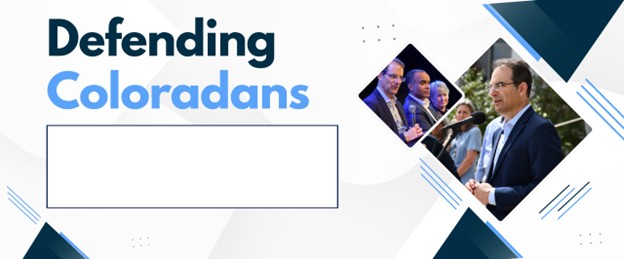
Above: Weiser has turned his taxpayer-funded state website into a campaign poster, complete with pictures of himself.
A version of this article first appeared in Complete Colorado on January 16, 2026.
As part of his campaign for governor, Colorado Attorney General Phil Weiser has endorsed a since-withdrawn, unconstitutional, state effort to muzzle free speech.
In a December 10 Denver Post op-ed, Weiser endorsed a Montana proposal to deny “limited liability” status to targeted groups that engage in political expression. Both the Montana attorney general and the state supreme court have ruled that the measure violates the state constitution. The U.S. Supreme Court almost certainly would hold that it violates the United States Constitution as well.
Doubling down on dubious
The Colorado attorney general is the chief legal counsel and chief law officer for the state. His is a constitutionally-created office with wide responsibilities.
But as I noted in an earlier column, Weiser seems to have diverted his taxpayer-funded office away from its primary responsibilities and toward his campaign for governor.
As reported in that column, Weiser is forcing state taxpayers to pay for over 40 lawsuits against President Trump, many on flimsy grounds.
Supposedly, this is to “defend Coloradans” against illegal and unconstitutional actions. But the lawsuits are not directed against Congress for exceeding the powers the Constitution gives it or for congressional invasion of state powers reserved by the Tenth Amendment. Rather, they are targeted almost exclusively against President Trump.
Since that column, Weiser has doubled-down on dubious. His official, publicly-funded website now features a landing page with a headline screaming “Defending Coloradans” in huge, bicolor type. Below is a subheading that reads as follows:
“Attorney General Phil Weiser is defending Coloradans against harmful and illegal actions from the federal government. Sign up for updates. Learn more.”
If you click on “learn more,” you find his endless lawfare against Trump and his administration. Below that is an advertisement for a “Community Impact Hearing” featuring Weiser and three other leftist state attorneys general.
Only if you scroll below “learn more” can you find links to the legitimate operations of Weiser’s office.
Weiser endorses unconstitutional Montana proposal
The Weiser-endorsed Montana proposal would have denied state “limited liability” protection to certain groups that engage in political speech. It was advertised as removing corporate money from election activity. But it extended far beyond corporations, defining “election activity” so broadly that it would chill discussion even of political issues not on the ballot.
And, conveniently, it exempted the mass media.
The net effect would be to further empower (1) establishment media and (2) billionaires (such as Colorado’s infamous gang of four) who spend personal funds on political causes.
By contrast, the measure would have disempowered most committees supported with small donations.
Citizens United
An announced purpose of the defunct Montana proposal was to evade the U.S. Supreme Court’s 2010 decision in Citizens United v. Federal Election Commission. In that case, the justices upheld the right of a small, non-profit incorporated group to speak out about politics.
Because the ruling in Citizens United protects groups without ties to the media or government, the left has long demonized it. For example, in his Denver Post piece, Weiser claimed the decision “overruled decades of precedent.”
The truth, however, is that Citizens United was within the tradition of Supreme Court cases dating back to 1958, in which the justices have protected the right of citizens to form incorporated political associations. (The 1958 case shielded the NAACP, which is incorporated, from state persecution.) Moreover, as I have explained elsewhere, the Citizens United decision was mandated by the Founders’ understanding of “freedom of the press.”
Weiser’s op-ed also failed to mention some recent history. In 2012, another left-leading attorney general—this one in Montana—persuaded his state supreme court to evade Citizens United and uphold a similarly-unconstitutional state statute. The U.S. Supreme Court summarily reversed.
The fate of the Montana proposal
Both the Montana Supreme Court (which leans far left) and the Montana attorney general (who is conservative) ruled that the Weiser-endorsed proposal violated the state constitution on grounds unrelated to free expression. While I’m not sure that their conclusion is correct, the Weiser-endorsed proposal almost certainly ran afoul of the U.S. Constitution’s First Amendment. Here’s why:
Under established constitutional law, neither the federal government nor a state may condition government benefits on giving up First Amendment rights. In other words, the state may not say, “Here is a benefit that we generally offer (in this case, limited liability), but you can have it only if you promise not to say anything about politics.” The rule protecting us against that kind of government extortion is called the “unconstitutional conditions doctrine.”
The Weiser-endorsed proposal directly breached the unconstitutional conditions doctrine by saying to citizens, “Like anyone else, you may organize as a corporation or limited liability company. But we’ll deny you that benefit if you exercise your First Amendment rights.”
In recognition of such problems, the group supporting the Weiser-endorsed measure has amended it into a much-more limited proposal, one far more likely to survive constitutional review.
Parthian shot
In 2000, I was a leading candidate for governor of Montana, emerging second in an open primary field of five. So I fully understand the pressures of a statewide campaign.
On the other hand, I also fully understand that government officials are subject to public trust, and part of their duties is to prevent taxpayer money from being diverted to campaign purposes. I find Weiser’s breach of that trust—his use of taxpayer facilities for campaign purposes and his dismissive attitude toward First Amendment rights—to be inexcusable.