Three published polls by the Pew Research Center, two in 2026 and one in 2025, show that: renewables popularity is waning (April 3, 2026); nuclear power support is expanding (October 16, 2025); and public utilities are mainly to blame for energy inflation (May 6, 2026).
The key results from Pew’s renewables polling are highlighted next in terms of:
- Renewables Supply
- Renewables Sustainability
- Renewables Affordability
- Renewables Reliability
Renewables Supply
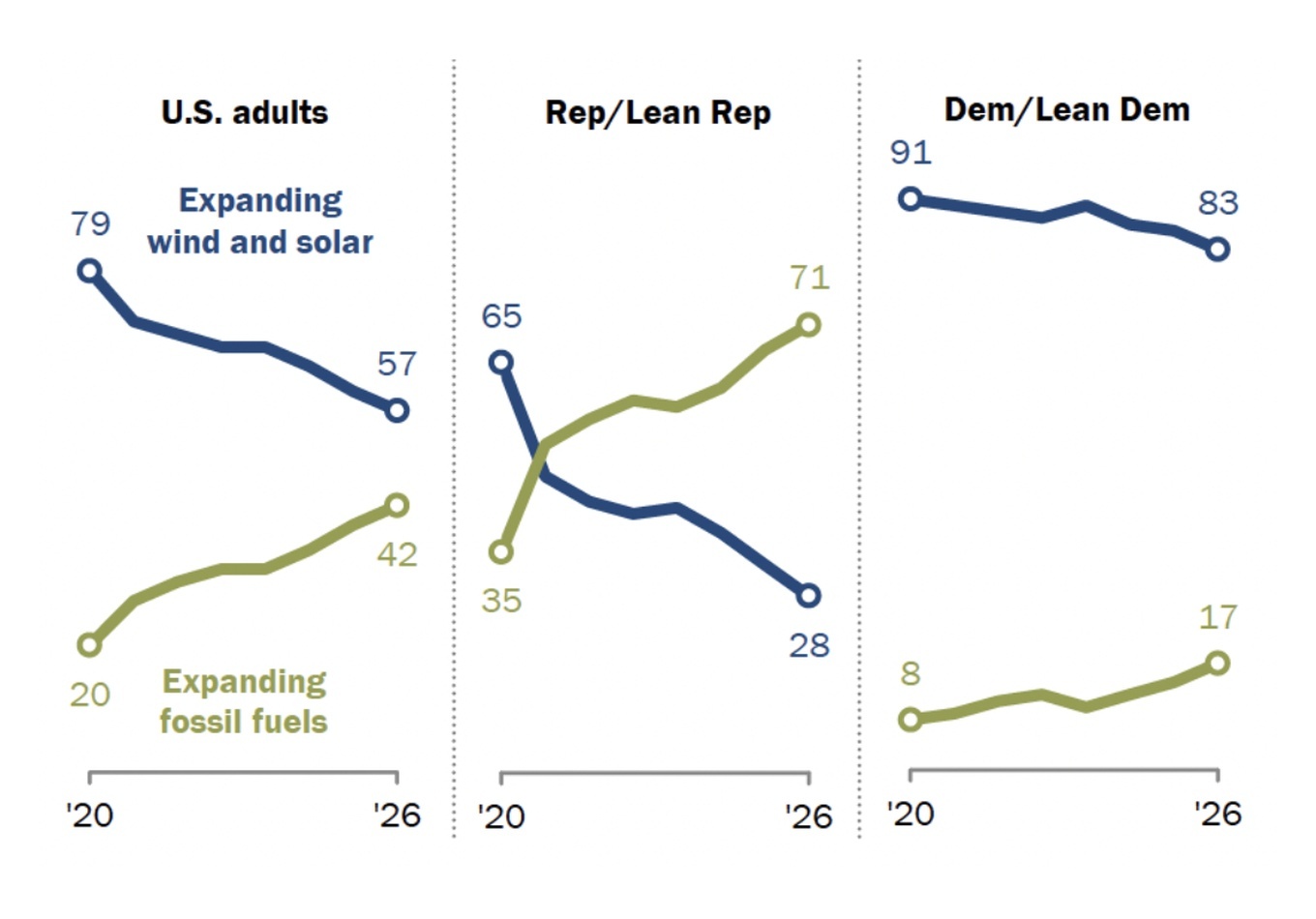
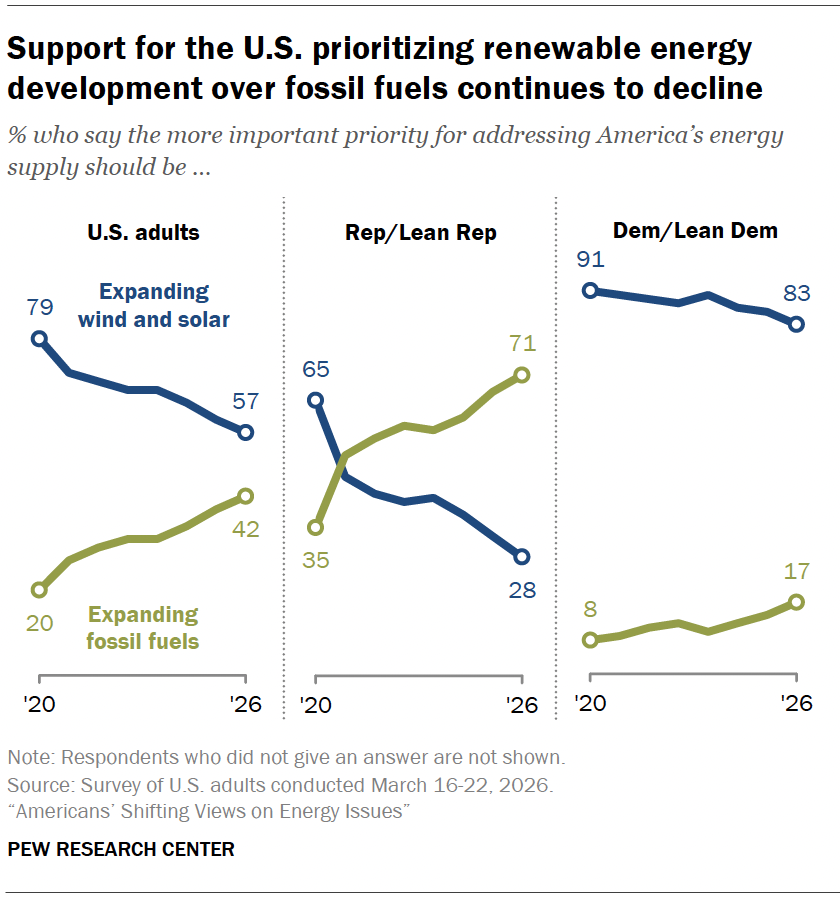
As per Chart 1 below, wind and solar renewables popularity amongst:
- Americans sunk 22% from 79% in 2020 to 57% in 2026.
- Republicans plummeted 37% from 65% in 2020 to 28% in 2026.
- Democrats went down 8% from 91% in 2020 to 83% in 2026.
Chart 1
Renewables Sustainability
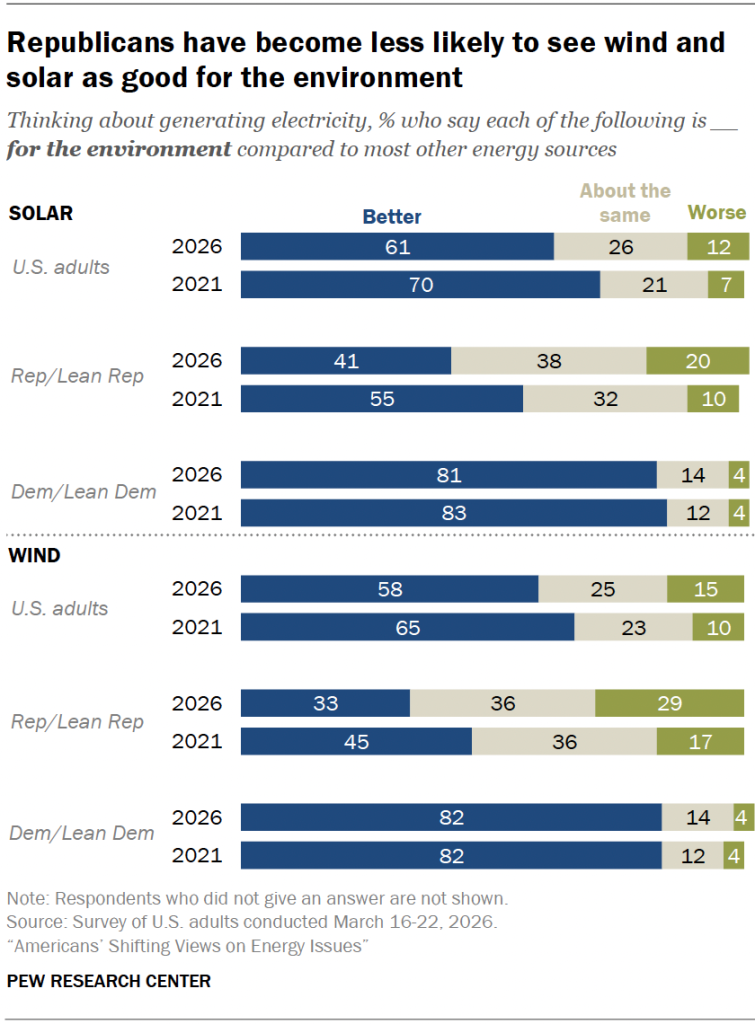
As per Chart 2 below, solar’s environmental credentials from 2021 to 2026 amongst:
- Americans declined 19%, given 9% less said “Better”, 5% more said “About the same” and 5% more said “Worse.”
- Republicans dropped 30%, given 14% less said “Better”, 6% more said “About the same” and 10% more said “Worse.”
- Democrats slipped 4%, given 2% less said “Better”, 2% more said “About the same” and 0% more said “Worse.”
Also as per Chart 2 below, wind’s environmental credentials from 2021 to 2026 amongst:
- Americans decreased 14%, given 7% less said “Better”, 2% more said “About the same” and 5% more said “Worse.”
- Republicans decayed 24%, given 12% less said “Better”, 0% more said “About the same” and 12% more said “Worse.”
- Democrats edged lower 2%, given 0% less said “Better”, 2% more said “About the same” and 0% more said “Worse.”
Chart 2
Renewables Affordability
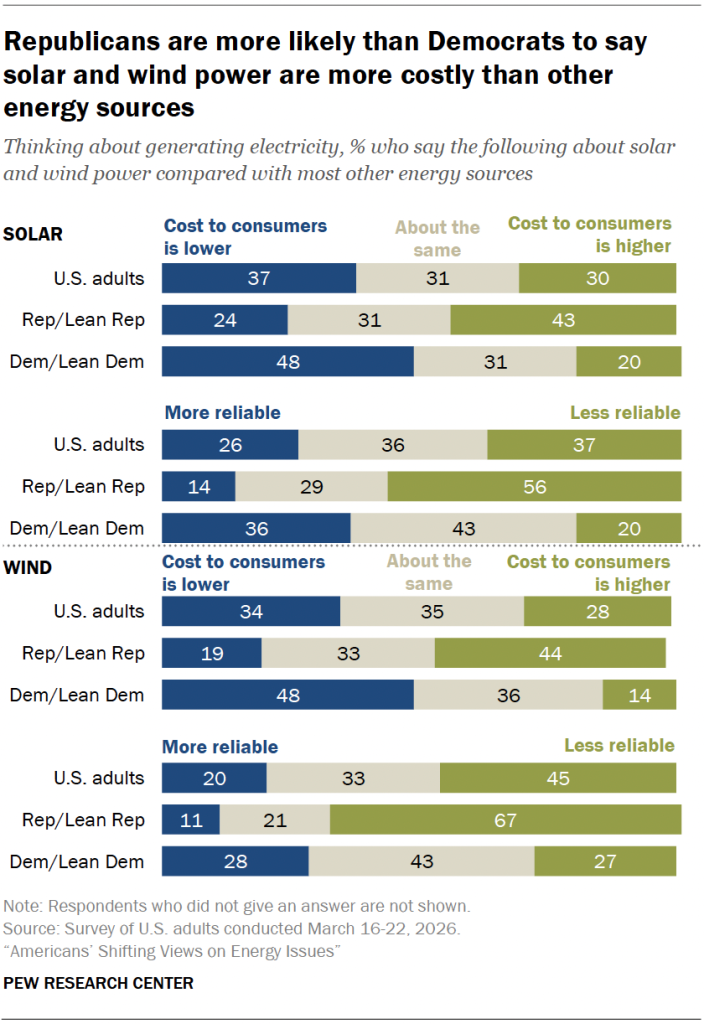
As per Chart 3 below, solar unaffordability in 2026 amongst:
- Americans is considered higher for 30%, same for 31% and lower for 37%.
- Republicans is considered higher for 43%, same for 31% and lower for 24%.
- Democrats is considered higher for 20%, same for 31% and lower for 48%.
Also as per Chart 3 below, wind unaffordability in 2026 amongst:
- Americans is considered higher for 28%, same for 35% and lower for 34%.
- Republicans is considered higher for 44%, same for 33% and lower for 19%.
- Democrats is considered higher for 14%, same for 36% and lower for 48%.
Chart 3
Renewables Reliability
As per Chart 3 above, solar unreliability in 2026 amongst:
- Americans is considered higher for 37%, same for 36% and lower for 26%.
- Republicans is considered higher for 56%, same for 29% and lower for 14%.
- Democrats is considered higher for 20%, same for 43% and lower for 36%.
Also as per Chart 3 above, wind unreliability in 2026 amongst:
- Americans is considered higher for 45%, same for 33% and lower for 20%.
- Republicans is considered higher for 67%, same for 21% and lower for 11%.
- Democrats is considered higher for 27%, same for 43% and lower for 28%.
Conclusion
Americans of all political stripes have been falling out of love with wind and solar renewables during the course of the 2020s. Popularity sunk 22% from 79% in 2020 to 57% in 2026, for reasons of environmental unsustainability, financial unaffordability and service unreliability.
Minnesotans of all political stripes should also be losing their love affair with wind and solar, as the Center of the American Experiment has also shown that the supply of renewables is unsustainable, unaffordable and unreliable: