Once again, not much happening at the Capitol this week, so we’ll focus on an important debate in the Senate over welfare and health care spending. To set the stage for the debate, here are some facts:
- Medicaid is the federal program, administered by states, to provide health care for the poor
- There are 1.2 million people on Medicaid in Minnesota, representing one out of every five Minnesotans
- Medicaid is the program producing most of the fraud in our state
- Minnesota is the second most generous state in the nation, spending $46,000 on public welfare per person in poverty in 2023
- For the next two budget cycles, Minnesota will take in $2 billion less than we will spend
- Most of Minnesota’s budget deficit is caused by growth in Human Services spending, especially Medicaid
- The federal government is $39 trillion in debt
- The One Big Beautiful Bill required states to rein in Medicaid and SNAP spending by adding work requirements and more frequent eligibility checks, removing coverage to able-bodied Medicaid recipients temporarily added during COVID, and stopping coverage for illegal immigrants
- Minnesotans overwhelmingly support these reforms to Medicaid spending, according to the Thinking Minnesota Poll.
Instead of using the federal Medicaid reforms as a framework to slow down the growth in state spending, Democrats in the Minnesota Senate this week passed a bill that spends $700 million to backfill the lost revenue from the feds. In a press conferencebefore the vote, they rolled out all the usual talking points portraying their opponents as mean-spirited and pitting Minnesotans in need against billionaires while predicting the sky will fall without immediate state funding.
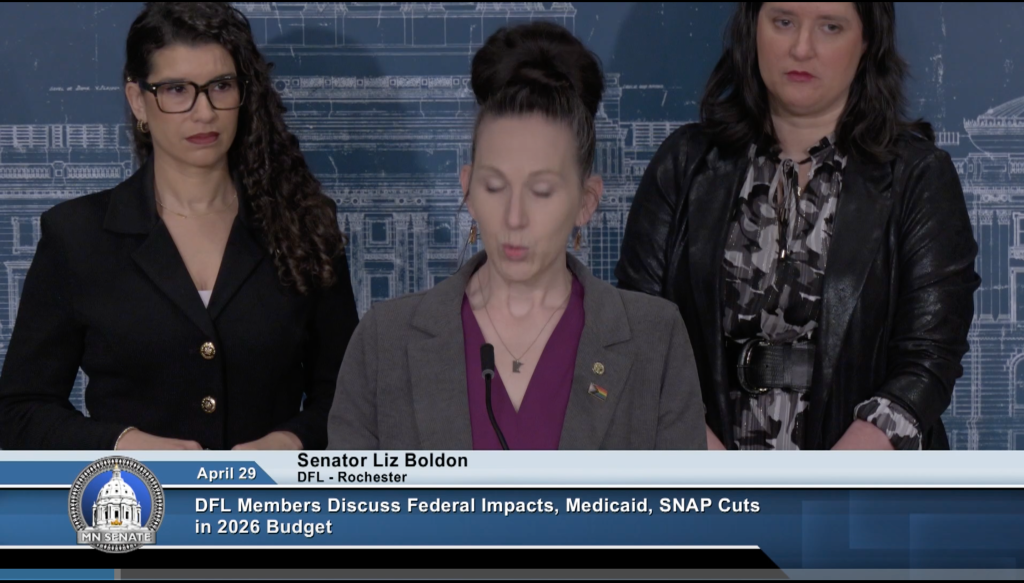
Sen. Alice Mann of Edina said, “The single purpose of this is to kick people off of their health insurance.”
Sen. Erin Maye Quade of Apple Valley said, “Work requirements don’t work. The Trump administration and Republicans in Congress are forcing states to adopt these work-reporting requirements so they can kick enough people off Medicaid to justify the tax cuts they gave to billionaires.”
Sen. Lindsay Port of Burnsville said, “Corporations and super-rich donors are the only people who stand to gain from this deal.”
Sen. Port also offered the coup de grace talking point: “If we don’t spend this money, our health care system will collapse, and Minnesotans will die.”
There you have it. People will die if we try to control federal and state spending on health care and welfare programs. The policy position of Minnesota Democrats remains that no one can ever be removed from a government program once they are enrolled; every removal will be portrayed as mean and cruel; the goal of government programs is to enroll more people, not help them temporarily during a crisis; programs will be judged by the number of enrollees, not beneficial outcomes for Minnesotans; raising taxes on the “rich” is the perpetual funding source for these programs.
The bill passed the Senate 34-32 after four hours of debate. Without a budget agreement with the House, the proposal isn’t likely to move forward.
Senators still voting remotely
A reminder for Capitol Watch readers that the Minnesota Senate is still operating under COVID-era rules allowing members to vote remotely. On this day, 11 Democrats and two Republicans voted for the $700 million Health and Human Services bill by texting a fellow Senator on the floor so their vote could be announced. This included every amendment and every procedural vote. We are to believe they are all glued to a screen somewhere in America watching the floor debate, ready to register their votes via phone or text. I find this practice outrageous. Attending floor sessions and voting in person is the minimal requirement for serving in the Minnesota Senate.
As I wrote here back in 2023, I believe remote voting on the floor of the House or Senate is unconstitutional.
Two weeks left
If anything is going to happen in the 2026 session, it will have to happen soon as the May 18 adjournment date approaches. Look for the House to pass the Inspector General bill this week. We will also be watching for any leadership meetings that might produce an agreement on a supplemental budget and bonding bill.