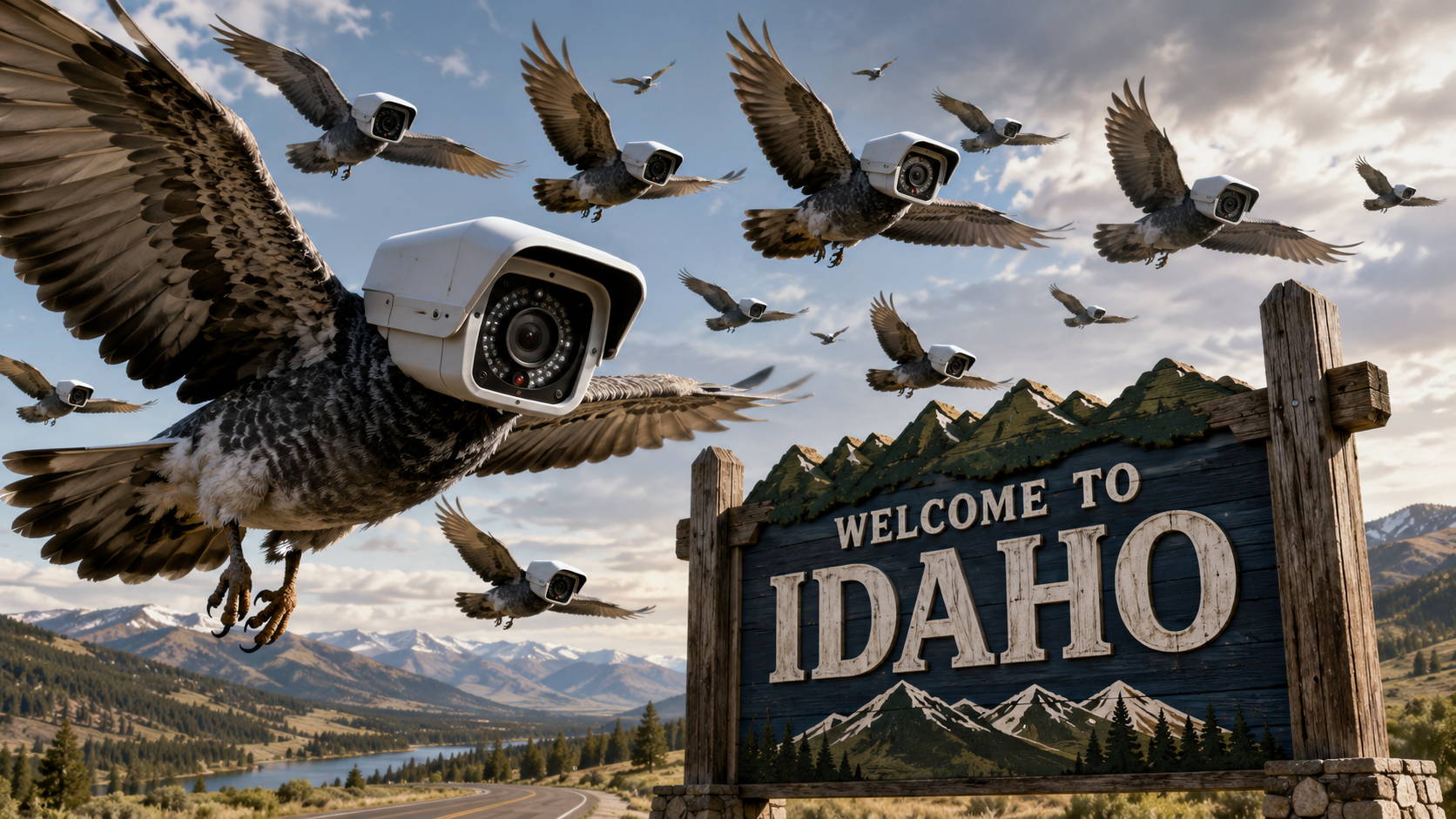
Automated License Plate Readers (ALPRs) are sweeping across Idaho and prompting fears that the Gem State may soon become another surveillance state. Some residents, however, are pushing back against police departments using a private company to collect data on Idahoans’ vehicles.
Flock cameras, a technology from the Georgia-based Flock Safety company, are ostensibly used to help law enforcement, businesses, and schools find vehicles for public safety purposes. Flock cameras are motion-activated, and they collect data such as license plate numbers, vehicle information, and general location.
Flock contends its technology has safeguards in place to protect privacy, and that they do not surveil people, but instead collect data on license plates and vehicles. Despite these assurances, many residents are still concerned about the proliferation of Flock cameras.
Wilder resident and DeFlock Idaho member Tyler Cain asserted in two tort claims that law enforcement agencies in Idaho are violating the state’s code against using ALPR data for “non-law enforcement purpose[s],” according to the Idaho Statesman.
Specifically, he pointed to a section of the City of Caldwell’s contract with Flock, which states in part: “Customer hereby grants to Flock a limited, non-exclusive, royalty-free, irrevocable, worldwide license to use the Customer Data and perform all acts as may be necessary for Flock to provide the Flock Services to Customer.”
In addition to filing a tort claim against Caldwell, he also reportedly filed one against Wilder in June over their use of Flock cameras. A Caldwell representative told the Statesman that the city attorney’s office is reviewing the language of its Flock contract to determine whether it adheres to Idaho law. A Wilder representative declined to comment to the outlet.
The Wilder Police Department chief, however, confirmed to Idaho News6 that the city and the mayor approved the cameras. Cain alleged to the Statesman that there was no “public discussion” over the cameras, and he launched a Wilder voter initiative aimed at forcing city council members to vote on the continued use of the Flock cameras already installed in the city.
The Wilder City Council voted unanimously on July 14 to restrict how Flock Safety can use the data it collects, KTVB7 reported. The addendum prohibits the company from using camera footage obtained in Wilder to improve or train its “artificial intelligence or machine-learning models,” according to the report.
Some law enforcement officials argue that Flock cameras and artificial intelligence are critical to helping officers combat crime. The Meridian Police Department has adopted ALPR cameras, with investigators reportedly claiming this technology can assist in detecting suspect vehicles. Based on public reports, it is unclear which vendor they are using.
Some cities, including Coeur d’Alene, have reportedly used ALPRs for years. The Twin Falls Police Department has operated ALPRs since 2023, and according to their Flock Transparency Portal, the data is retained for 30 days. The portal cites a case in which a Flock camera detected a stolen vehicle from Nampa, and officers were able to locate the vehicle and arrest the suspects.
While police have touted recent successful cases, the increasing reliance on Flock cameras has created new avenues for potential waste and corruption. Idaho localities may not be spending thousands of tax dollars on “Learing Centers” (although there are potentially fraudulent state programs in Idaho), but they are seemingly spending thousands on license plate readers.
Pocatello’s Police Department spent over $100,000 on 34 cameras from Flock Safety, according to a 2024 Idaho State Journal report. Each camera costs $3,000. The Bellevue City Council unanimously voted in 2025 to fund two Flock Safety cameras, which cost over $13,000 for “two years of equipment and operation,” according to the Idaho Mountain Express. The city will reportedly accrue additional costs for the continued use of Flock cameras after the initial two years.
Caldwell’s City Council approved a three-year deal with Flock in a unanimous vote in 2023 – for $378,000 a year – to install 33 cameras throughout the city, the Statesman reported. Caldwell spends over $484,000 annually on drones and Flock cameras, the outlet claimed, citing Caldwell Police expenses.
DeFlock, which tracks ALPRs, has mapped over 100,000 of the cameras across the United States. The map shows that Meridian, Caldwell, and Twin Falls are particular hot spots for this type of technology.
While some argue these cameras are vital to protecting the public, history demonstrates that people have reason to be wary of private-public partnerships. During COVID-19, the public and private sectors merged to monitor and surveil the populace under the guise of public health and “disease surveillance.” Now, the justification appears to be public safety — but in a future public health “emergency,” these cameras could very well be used to enforce lockdowns.
Cain cited Idaho Code § 49-1432, which regulates ALPRs. It explicitly prohibits the use of this technology for purposes unrelated to law enforcement, including for “personal use [or] political activity.”
Idaho Senate Bill 1180 amended existing law regarding ALPRs and their data, effective July 1, 2025. The bill, which also included a separate provision regarding mounting brackets, did not specify how long ALPR data can be stored. Regardless, the bill provided a critical privacy safeguard, and Idaho Freedom Foundation (IFF) gave it a positive (+2) rating.
The legislation restricted access to ALPR data to approved agency personnel and required that law enforcement only use the data to investigate “felony or misdemeanor crimes or traffic accidents or to search for missing or endangered persons.”
Thirty-four members, however, voted against the legislation, and the list of those officials is available to the public here. Both Republicans and Democrats opposed the bill, with 10 senators and 24 representatives casting “Nay” votes.
A few of the votes may raise eyebrows, but it should come as no surprise that politicians are voting against curbing surveillance powers. Although the media typically focuses on the major privacy scandals, like abuse of the Foreign Intelligence Surveillance Act (FISA), federal agencies are not the only ones in need of proper oversight. Local governments can be bastions of corruption, and while Flock cameras may help officials combat crime in certain instances, they should still be subject to audits and have proper privacy safeguards in place.
Flock cameras, however, are not necessary for holding elected officials accountable. Individuals concerned about Flock cameras can attend city council meetings, file Idaho Public Records requests, or publicly report on the cameras in their city.
Government is not transparent by nature, but the people can demand transparency and accountability from their local officials. Otherwise, the surveillance dragnet will inevitably sweep everyone into it, regardless of whether one wants to opt in.