Massachusetts has some of the highest wages in the nation, but soaring housing, energy, and everyday costs eat into that advantage, leaving residents facing a cost of living higher than most of the country.
Housing prices
Nationally, Massachusetts has among the highest housing prices, with a median sale price of $667,628 for all homes compared to the national average of $398,771.
Between October 2016–2025, Massachusetts single-family home prices went up 80.5%, mirroring the climb of housing prices across New England following the COVID-19 pandemic. In 2026, Massachusetts has the nation’s third highest average rent at $2,259 a month.
House prices nationally surged in 2021. This was mainly attributed to increased housing demand resulting from remote work, federal stimulus payments, and low interest rates coupled with increased supply chain disruptions that raised the cost of building and limited construction of new homes.
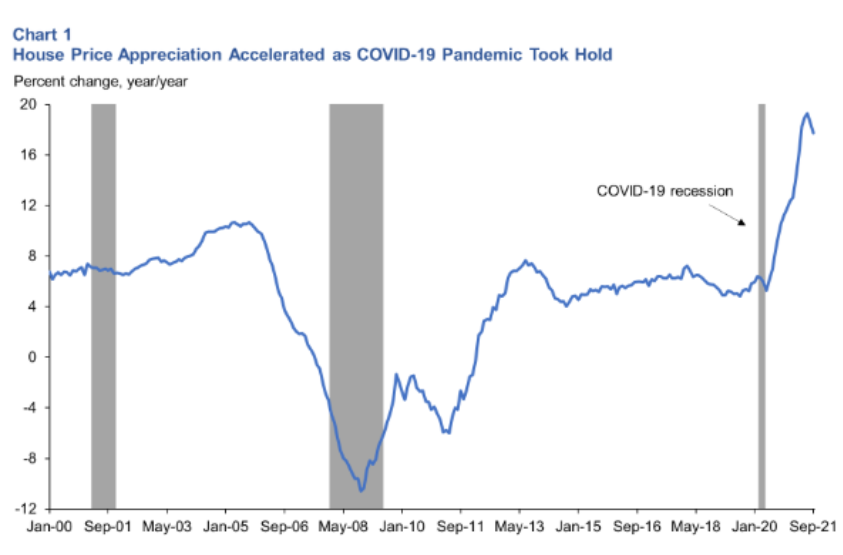
Figure 1: House price appreciation after the COVID-19 pandemic from the Federal Reserve Bank of Dallas.
The phenomenon was national, but it was more severe in Massachusetts. Although already higher than the national average before COVID, the trend of growth continued in Massachusetts. In 2021, Massachusetts had an average inflation-adjusted housing price of $607,302 compared to the national average of $457,478. New Hampshire sat at $435,748 in 2021, more than $171,500 less than Massachusetts. In June 2021, the median sale price for all home types in the Commonwealth was around $551,000 while average price was $619,000 in June 2023.
As of May 2026, when comparing these four states, Massachusetts leads in median sale prices at $667,628, followed by New Hampshire ($533,106), Florida ($395,595), then Texas ($343,779). Ranked the lowest out of the states, and its large abundance of undeveloped lan  coupled with lower land prices – keeps prices low.In contrast, states like Massachusetts that are more urban don’t get this indirect reduction in home prices. upward pressure on prices.
Energy prices
When it comes to 2023 retail electricity costs, the U.S. average was $0.127 cents per kilowatt hour. Massachusetts had the fourth highest prices at $0.232 cents per kilowatt hour—with New Hampshire at 5th ($0.230 cents per kilowatt hour), Florida at 15th ($0.135 cents per kilowatt hour), and Texas at 40th ($0.100 cents per kilowatt hour). Energy prices across New England remain elevated especially after 2020. Just last year the national average was 17.9 ¢/kWh while New England was 27.9 ¢/kWh.
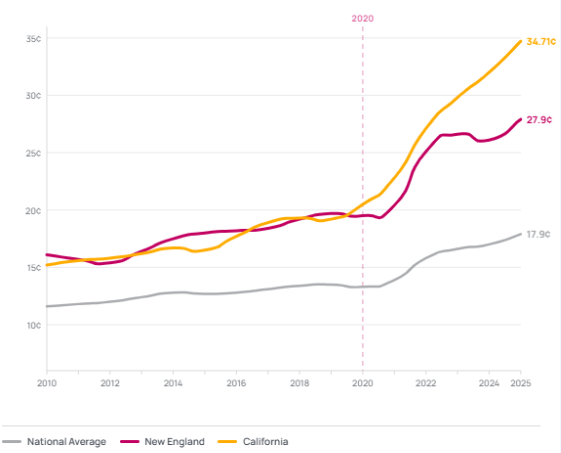
Figure 4: The national, New England, and California averages for electricity prices from 2010-2025 from EQT.
Two notable factors that are driving up energy costs are how energy is imported as opposed to produced in the Commonwealth as well as how the state levies significant taxes to energy consumption to support energy efficiency programs, and they are passed on to consumers. Massachusetts is pursuing a number of policies to decrease these prices. One is a proposed expansion of the Algonquin Gas Transmission (AGT) pipeline system called Project Beacon. This would extend access to natural gas from New Jersey all the way up to Massachusetts by 2030 and work to combat rising demand—and prices—for energy through increased supply. However, this proposal has sparked controversy, with opponents reluctant to increase the Commonwealth’s dependence on fossil fuels rather than generating more sustainable forms of energy. This year survey found that households’ top concern was energy affordability, making it clear that there is a genuine desire for a solution that will make energy prices more affordable.
Utilities, Goods and Services
When it comes to utilities, goods, and services, Massachusetts is again more expensive than Florida, New Hampshire, and Texas. When it comes to regional price parities (RPP), which is the measure of how expensive a state or metro area is compared to the U.S. average shown as a percentage, Massachusetts ranked 6th nationally in 2023 with the utilities portion possessing the highest RPP of 166.3, meaning Massachusetts utilities RPP was 66.3% higher than the average state.
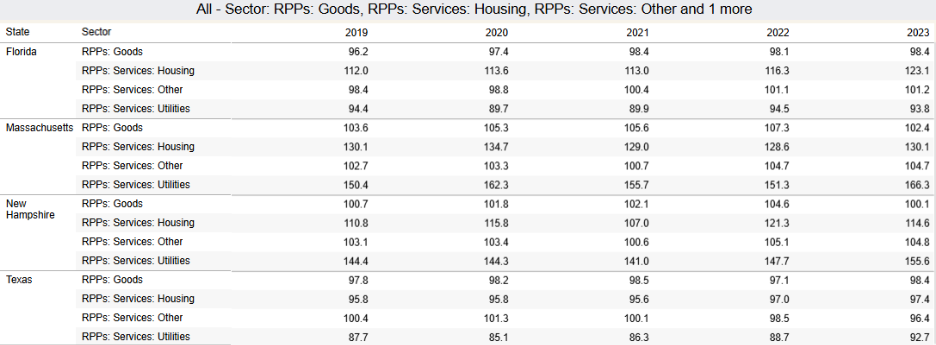
Figure 5: Regional Price Parities (RPPs) of goods and services in Florida, Massachusetts, New Hampshire, and Texas from U.S. Data Labs.
In 2023, Massachusetts residents paid an average $696.52 per month for utilities compared to the national average of $643.67. This pattern extends beyond utilities into everyday goods. Massachusetts carries a grocery price index of 114.1, well above Florida’s 105.4 and New Hampshire’s 104.6, and far above Texas, which sits at just 90.3 — nearly 10% below the national average.
These abnormally high prices significantly eat into the income of Massachusetts residents, undercutting much of the advantage their higher wages would otherwise provide.
Do higher wages offset the cost?
After D.C., Massachusetts has the highest wages, but this does not offset its high cost of living. Compared to New Hampshire, Texas, and Florida, Massachusetts has higher wages by almost $200 per week, but the Commonwealth still remains more expensive than about 86% of the nation. With some of the highest numbers of housing, utilities, goods, and services, a high income is less impactful when spread thin across the high, general cost of living.
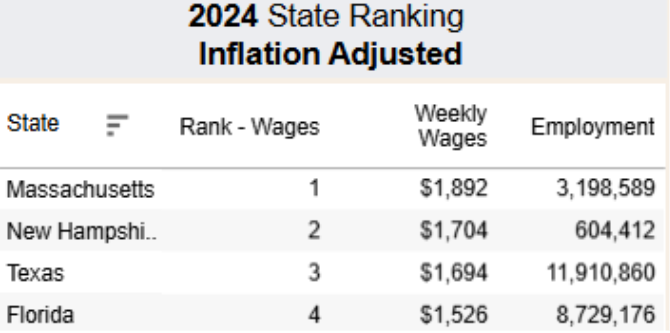
Figure 6: 2024 state ranking of weekly wages from U.S. Data Labs.
In 2024, people used about 34.9% of their income to pay for housing in Massachusetts. To put it into perspective, financial experts only recommend spending up to 28% of one’s monthly pre-tax income on housing.
Considering the net effect, high wages do not necessarily keep up with expenses in the Commonwealth. High wages can create the appearance of prosperity, but with soaring prices of housing, utilities, and even transportation—Massachusetts residents may not be as far ahead of their counterparts in other states as it initially appears based on wages.
The post The high cost of living in Massachusetts: why the Commonwealth’s wages don’t stretch far appeared first on Pioneer Institute.