Minnesota’s Class of 2025 has the highest graduation rate on record, and similarly record-breaking low mathematics proficiency rates. Hooray?
As I’ve written previously, it is of the utmost importance that the diploma Minnesota’s students attain at the end of their K-12 journey is a piece of paper that signifies the completion of real, robust coursework. No matter what a student’s life path might be, it’s important that they master high-school level mathematics and reading before their graduation. A diploma must be a prize earned, not a gift bestowed.
While great attention has been paid to early literacy, it’s important not to miss the second pillar of an essential scholastic foundation: early mathematics.
When a closer look is paid into the Class of 2025’s poor mathematics comprehension, it becomes clear that policymakers must consider reforms to Minnesota’s early mathematics education pathways.
The class of 2025 boasted an 84.9 percent graduation rate, but their most recent performance on math state tests in 11th grade (as measured by the Minnesota Comprehensive Assessment) showed that just 34.7 percent of the graduating class was at grade level. The class of 2025 had been several grade levels behind for some time, as their overall mathematics proficiency in 8th grade was a mere 39.4 percent. Their math performance in 3rd grade was much higher at 69.4 percent proficiency.
Third grade is the first time that mathematics proficiency is tested in Minnesota on a statewide test, meaning that policymakers first get a glimpse into the efficacy of the system during third grade. Not all students in the Class of 2025 tested highly in third grade mathematics: Black students had a proficiency rate of 40 percent, Hispanic students were at 47 percent, and Indian students were at 44.1 percent. White students were at 79.5 percent proficiency in third grade. Clearly, there were significant disparities in early mathematics proficiency.
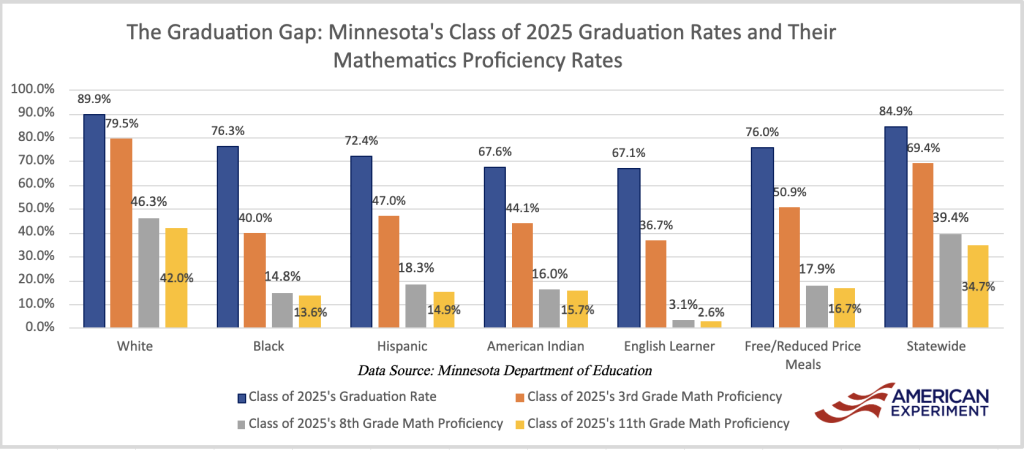
When a student does not have a solid mathematics foundation, they fall further and further behind as each year passes. Unlike reading skills, which can be buttressed by at-home practice, mathematics does not have a straightforward remedial pathway. By 8th grade, it seems that the students in the class of 2025 who fell behind grade level largely stayed behind grade level.
Minnesota’s Class of 2025 faced multiple challenges on their pathway to graduation. They experienced the COVID-19 pandemic during the end of their 6th and the entirety of their 7th grade years. A recent Brookings paper found that the older a student was during COVID-19, the lower their subsequent proficiency dropped.
Below is the Brookings analysis of the Minnesota Class of 2025’s expected mathematics proficiency (grey line) compared to their actual proficiency (blue line, dotted when state tests were canceled due to COVID-19). In seventh grade, pre-pandemic cohorts in Minnesota had an average 56 percent math proficiency rate; the Class of 2025 had a rate of 40 percent.
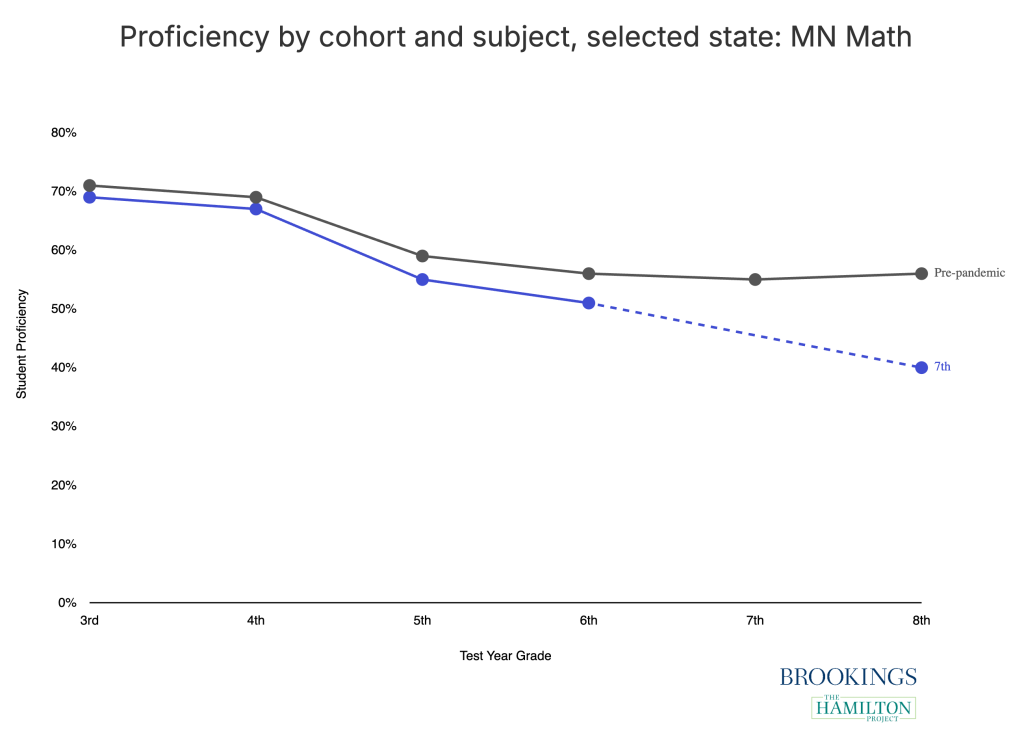
The learning loss from COVID-19 is part of the story, but it isn’t the full tale. Even in third grade, the Class of 2025 was behind their pre-pandemic cohorts, with a 5 percent gap by 6th grade. The pre-pandemic cohorts, too, were not shining examples of robust mathematics proficiency. Minnesota’s pre-pandemic average mathematics proficiency dropped an entire 10 points from 4th to 5th grade — why?
One answer might be that 5th grade is a pivotal, transitional year in a child’s mathematics education. A child “puts together” all the key concepts that they have learned in earlier grades and creates a base for future algebraic thinking. If math scores drop dramatically from 4th to 5th grade, it suggests that a child’s academic base is weak. Just as we’ve seen in other states, it’s clear that early mathematics pedagogy needs a refresh.
Additionally, Minnesota possesses a unique requirement that all students take 8th grade algebra, ensuring that every child has the chance to take higher-level math in high school and in college. However, this worthy goal must have corresponding academic supports in early grades, or, as Minnesota has seen too often, this one-size-fits-all policy will truly fit only a few students. High academic expectations should bring correspondingly high system investment.
Mathematics education in Minnesota needs a refresh. Last year’s (2025) third grade students, who have never experienced the effects of COVID, had an MCA proficiency rating of 57.8 percent — far below the class of 2025’s 69.4 percent proficiency rating. In fact, ever since 2021, third grade mathematics proficiency has ranged from a poor 57 percent to 59 percent.
There are two possible first steps for mathematics education reform. One is to implement end-of-course tests on every subject, worth 20 to 25 percent of a student’s grade. This prioritizes real learning and fights against grade inflation. Another essential move is to overhaul early mathematics education in the same style as the READ Act, by prioritizing science-based curriculum, rigorous teacher training, and scaffolded tutoring supports.
It’s time to get serious about mathematics proficiency. The Class of 2025 may have graduated with only about three in 10 students performing at grade level in mathematics, but Minnesota can refresh, reform, and update — and do better for the class of 2035.