When the debate over vice laws, those governing drugs, gambling, or pornography, reaches the halls of our legislature, a familiar, hollow cry rings out: You can’t legislate morality! While it might be a catchy slogan (oft repeated by the vice peddlers themselves), it is designed to end a conversation before it begins. It suggests that there is a neutral, amoral way to govern, and that any law touching upon right and wrong is an overreach of the state into the private souls of its citizens.
But let’s be honest with ourselves: That’s nonsense.
As someone who has spent my career navigating the intersection of policy and the public good, I can tell you that lawmakers legislate morality every single day. In fact, they do almost nothing else.
Consider fiscal policy. When we debate a budget, we aren’t just moving numbers around on a spreadsheet; we are practicing stewardship. Every budgetary decision is a prioritization born of moral judgment. When we design entitlements and safety nets, we are making a moral decision regarding who is and isn’t needy and what our duty is to our neighbor.
When we set education curricula, we are deciding which moral worldview we want the next generation to inherit. When we pass consumer protection laws, we are codifying the universal truth that lying is immoral. Even our law enforcement agencies spend the vast majority of their time enforcing an agreed-upon societal moral code. From sin taxes to marriage laws, child-rearing, and sexuality, the moral vacuum in lawmaking simply does not exist.
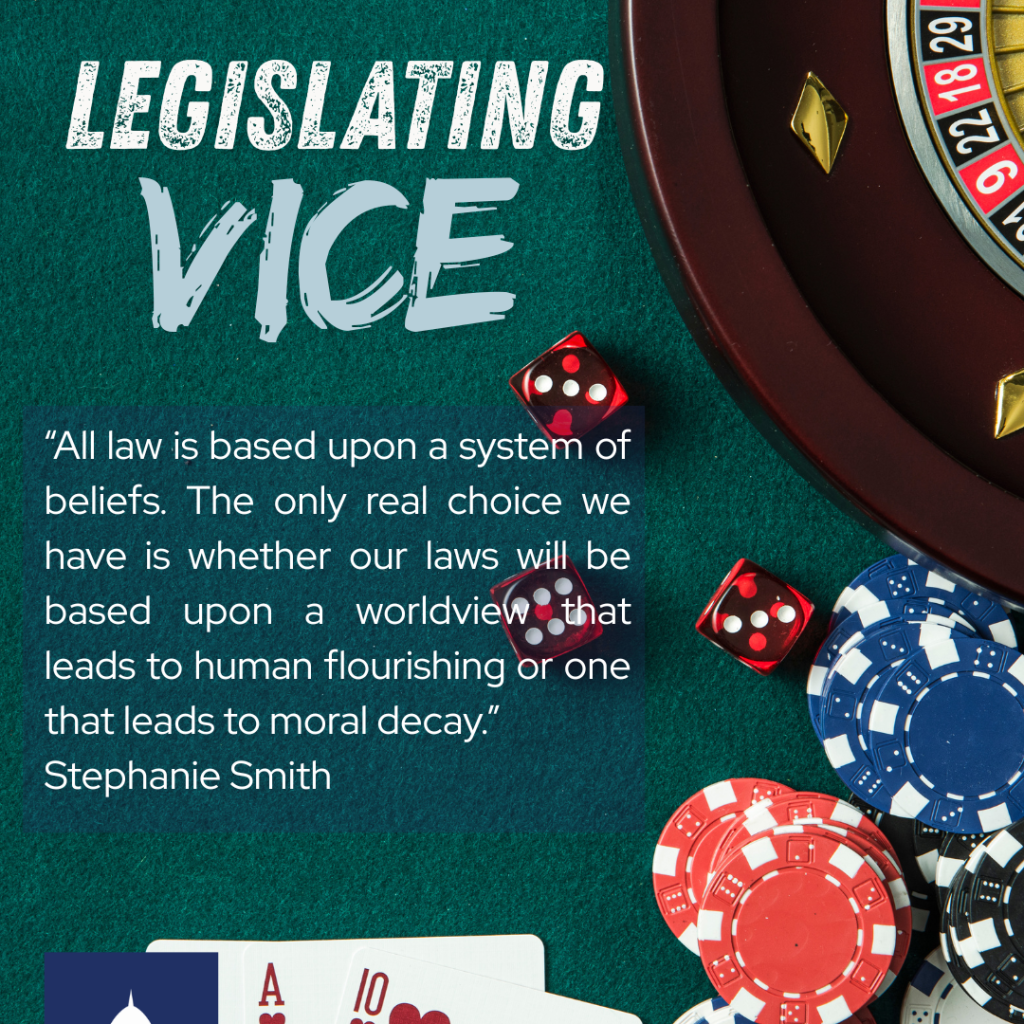
The question, then, isn’t if we should legislate morality, but whose morality we are legislating—and to what end. We must recognize that the separation of morality from law is a folly; because all law is based on a system of beliefs, the only real choice we have is whether our laws will be based on a worldview that leads to human flourishing or one that leads to decay.
In a recent and profound essay for National Affairs, Charles Lehman argues that our current hands-off approach to vice, the legalization of marijuana, the explosion of sports-betting apps, and the ubiquity of pornography, is failing because it relies on a narrow harm principle. We have convinced ourselves that if an action doesn’t cause immediate, measurable physical harm to another, the state has no business interfering.
However, the data shows this permissiveness is creating a new kind of tyranny. We are seeing the slow erosion of human agency. We must understand that what is legal eventually becomes acceptable in the public mind. When the law stays silent on vice, it doesn’t remain neutral; it serves as a teacher, signaling to our children that these destructive behaviors are a normal part of a life well-lived.
Vice and addiction do more than just harm individuals; they suppress the very freedom that our Republic requires to function. A citizen who spends his life enslaved to a substance or a screen is not a fully free participant in self-government. True freedom is not the license to do whatever one wants; it is the capacity to do what we ought. It is the ability to live a life of flourishing and responsibility.
If we want to see our society flourish, we must stop pretending that our laws can be divorced from our values. Every single bill that is passed has a worldview and a moral impact. It is time we stop apologizing for wanting our laws to reflect the truth. If we are going to legislate, and we must, let us legislate for a morality that protects the vulnerable, strengthens the family, and restores the dignity of the human person. That isn’t imposing a worldview; it’s the very definition of good governance.
For more information contact admin@alabamapolicy.org