Takeaways from this article:
- State spending on Medicaid has nearly doubled since 2019
- 250,000 MN enrollees predicted to be removed from Medicaid as a result of Trump’s Big Beautiful Bill did not happen in 2026, in fact spending and enrollment grew.
- Per capita spending on Medicaid in Minnesota is now over $20,000/ person and the costs continue to explode.
Then Minnesota Assistant U.S. Attorney Joe Thompson said in December, 2025 that fraud cost since the pandemic in Minnesota could approach $9 billion across 14 Medicaid programs alone. That $9 billion tab is being paid mostly by taxpayers in other states, but increasingly, Minnesotans will feel more of the pain.
Minnesota’s Medical Assistance (Medicaid) program has undergone explosive growth since 2019. Total federal-plus-state spending rose from $12.3 billion in FY 2019 to a projected $24.0 billion in FY 2026— nearly doubling in seven years.
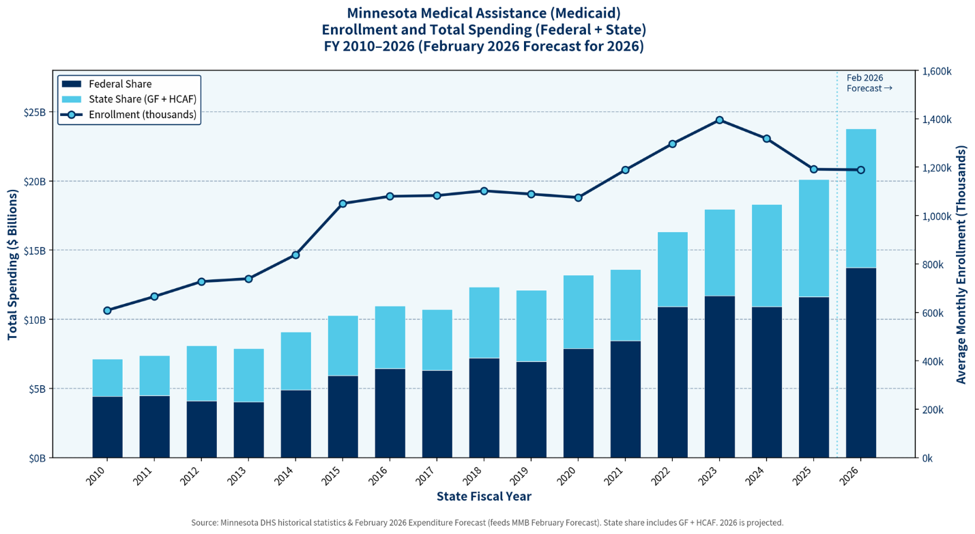
Enrollment grew during the post pandemic years when Medicaid mushroomed and states could not dis-enroll. Average monthly enrollment stood at approximately 1.09 million in 2019, then surged past 1.39 million by 2023 amid continuous eligibility rules and enhanced federal matching funds. Even after the public-health emergency ended and redeterminations began, enrollment has only partially retreated to roughly 1.2 million while spending continues climbing.
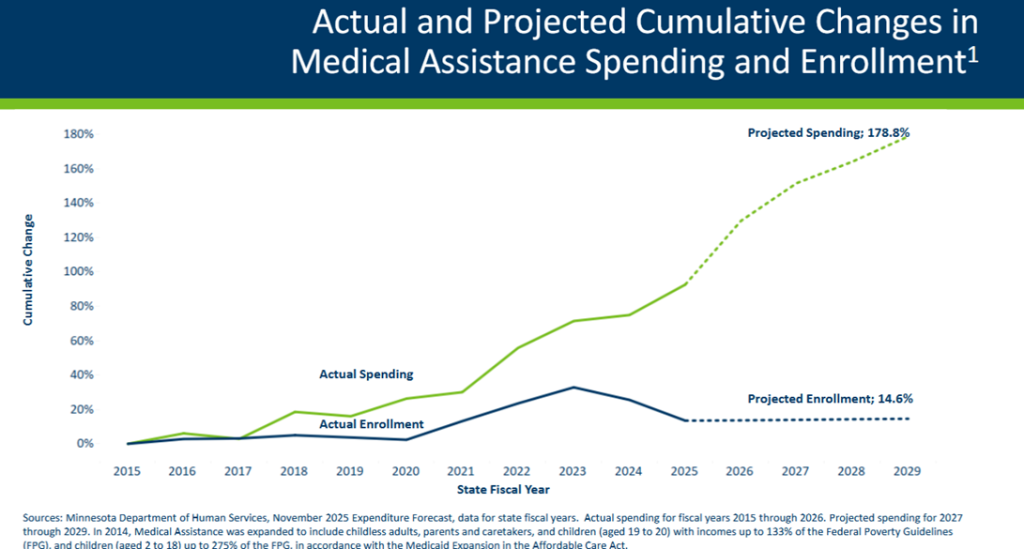
The federal share has carried much of the increase, yet the state share (General Fund plus Health Care Access Fund) has also risen sharply. Higher caseloads, higher average payments, and persistently rising total costs have continued long after emergency measures expired. As my Grandpa Jim used to say “there’s nothing more permanent than a temporary solution.” Spending per Medicaid enrollee has gone from $11,280 in 2019 to $20,280 this year, but just much much of that is due to fraud?
This growth coincides with well-documented fraud vulnerabilities. Fourteen Medicaid services later labeled “high risk” for fraud—most notably Early Intensive Developmental and Behavioral Intervention (autism services) and housing-related supports—saw spending more than double between 2021 and 2025, reaching $4.3 billion in a single year and exceeding $20 billion since 2018. Federal prosecutors have charged multiple schemes involving kickbacks, phantom services, and overbilling; one autism case alone alleged $46.6 million in fraudulent claims.
Despite predictions by state leaders of 250,000 Medicaid enrollees being “kicked off” healthcare because of Trump’s Big Beautiful Bill, spending and enrollment both increased in 2026.
Pandemic-era suspensions of eligibility verification created an open invitation. Once continuous coverage ended, spending did not return to pre-pandemic levels. Taxpayers—federal and Minnesota—are now financing both legitimate care and a system that has proven highly susceptible to abuse. Nowhere in the US has it been easier to grow Medicaid payments and harder to con
In the upcoming weeks, The Center of the American Experiment will be releasing data that details exactly how this problem grew in Minnesota. In these upcoming reports. We will show that without rigorous eligibility verification, prepayment review, and legislative reforms that prioritize the needy over the greedy, Minnesota’s Medicaid budget will continue to explode and the taxpayer will continue to waste billions on the hidden tax called fraud, until the entire budget is entirely destabilized by Medicaid growth.