Newly released chronic absenteeism rates for the 24-25 academic year suggest that Minnesota’s chronic absenteeism has found a new baseline at an unacceptably high level.
Chronic absenteeism (when a student is absent for 10 percent or more of the academic year) creates extraordinary difficulties for students and staff members. Obviously, students who aren’t present can’t learn or complete their assignments. When they do return to the classroom, teachers have to use instructional time reintegrating them to class routines and providing remedial homework packets. Their academic achievement and social and emotional wellbeing drop in response.
This harms every student in the class, as their teacher’s attention is now divided and their classmates are struggling to participate fully. Research shows that classmates of chronically absent students are more likely to become chronically absent themselves.
Chronic absenteeism isn’t a problem siloed away in struggling schools. The COVID-19 pandemic raised the floor for regular absenteeism in high-performing and low-performing schools alike. It appears the pandemic experience permanently shifted norms around school attendance, making all types of families more likely to let their students skip school more often.
During the 24-25 school year, almost one in four (23.5 percent) students were considered chronically absent.
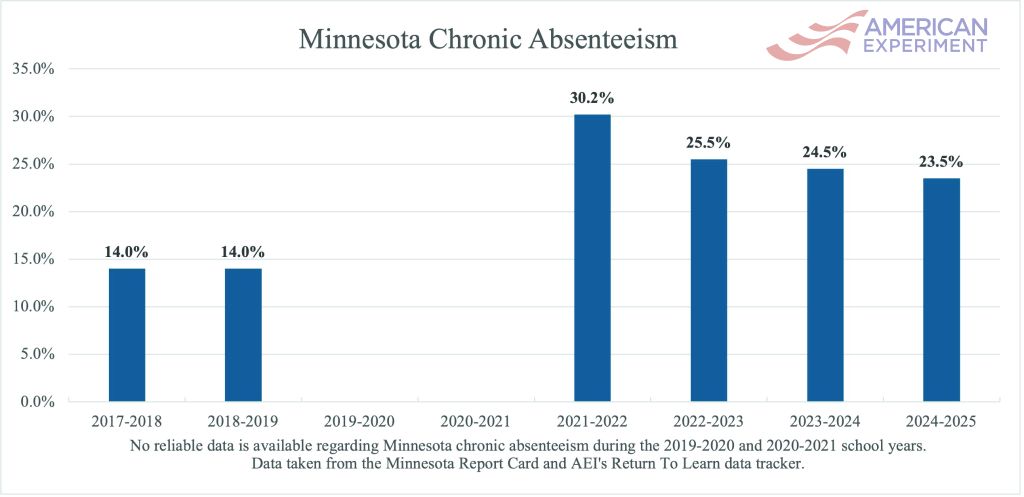
While chronic absenteeism declined by a percentage point from the previous year, it’s highly concerning that the rate of chronically absent students remains so elevated. It seems that Minnesota has plateaued at a new baseline. While about 14 percent of students were chronically absent pre-COVID, about 24 percent of students are now chronically absent post-COVID.
Chronic absenteeism is a complicated social problem without an easy fix. Some student groups appear to be at schools without sufficient resources to change the social dynamics. Generally, chronic absenteeism rates stayed relatively stable (if still elevated) across several demographic subgroups from the 23-24 to the 24-25 school year. Students who are low-income, black, Hispanic, English learners, or in special education all have higher rates of absenteeism than the state average.
Low-income students have chronic absenteeism rates about ten percentage points higher than the state average, at 34 percent. This is a significant education issue for the state; about two in five Minnesota students are low-income.
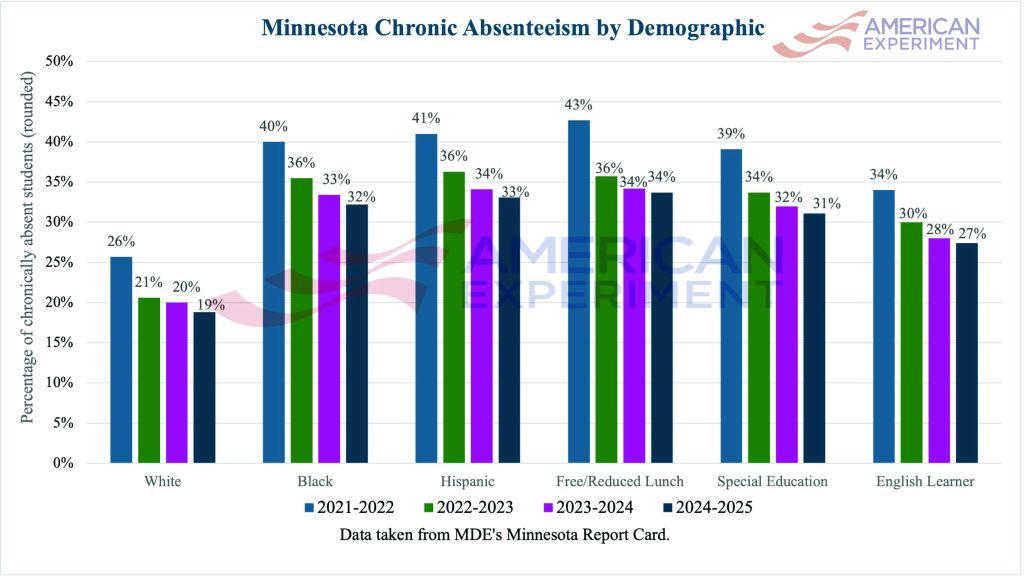
Chronic absenteeism is a systemic issue and will continue to harm all students, but especially the most vulnerable, until it is made a strong priority.
The Minnesota Department of Education (MDE)’s September 30 announcement of the 24-25 absenteeism rates read:
Minnesota students continue to lead in consistent attendance, with at least 76.5% of students attending more than 90% of the time[.]
This framing is a systemic obscuration of ongoing harm. It hurts students to protect adults.
Minnesota’s 24-25 chronic absenteeism rate (23.5 percent) is higher than the national average (22.6 percent).
What’s next?
Lawmakers should make chronic absenteeism a clear public priority. The incoming governor (whoever that may be) should do so as well. For example, Rhode Island governor Dan McKee started a large public interest campaign about the importance of regular school attendance nearly three years ago, and the state has seen jaw-dropping attendance recovery in response.
Minnesota will struggle to compile solutions to the problem until the current antiquated data system is overhauled. As I’ve written previously, districts choose their own internal codes for recording absences, making it difficult to make standardized statewide comparisons. Statewide data is released on a one-year delay, rendering it functionally useless as a policy guide. The delay is a Minnesota Department of Education issue; regular attendance information exists and is used regularly within funding formulas to determine state financial disbursements.
Minnesota is one of the only states in the nation that releases chronic absenteeism rates with such a long delay. Several states, like Ohio, have clear chronic absenteeism dashboards to promote quality student attendance policies.
The desperate need for Minnesota’s data reform isn’t a secret. The Minnesota Legislature’s Student Attendance and Truancy Legislative Study Group released a report in 2024 arguing for change. That report primarily emphasized the importance of creating up-to-date, granular data systems that share data sets quickly across school districts, county governments, and state agencies.
Legislators haven’t led the charge for data modernization, but they have asked school districts to weigh in. A state-funded $4.7 million three-year pilot program, which began in 2024, gave 12 school districts funds with broad spending flexibility to combat chronic absenteeism. A July 2026 report from that program revealed that an up-to-date attendance dashboard was in the works, which hasn’t yet materialized. When it does, it will be a significant resource.
Districts shouldn’t wait for data modernization to act. School boards can and should consider implementing programs designed to connect with families and educate them on the importance of school attendance. Boards should start by ensuring that parents can access their child’s attendance records.