Many years ago, Congress adopted a law that prohibits home whiskey distilling. That law is now under constitutional challenge.
John Ream is a home whisky distiller. He points out that the Constitution grants Congress only certain enumerated (listed) powers and that regulating home distilling is not on the list. He lost in the lower courts but has filed a petition asking for Supreme Court review.
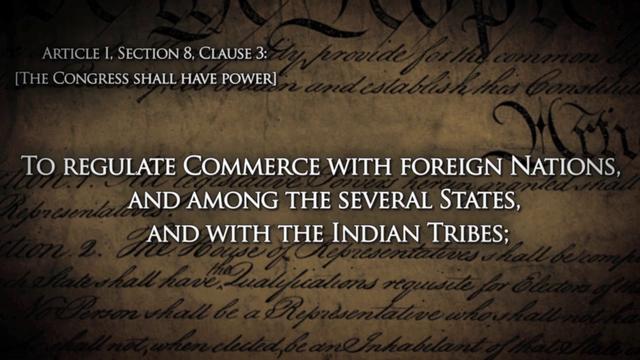
One way the government’s lawyers defend the home-distilling ban is to refer to the Constitution’s Interstate Commerce Clause: It grants Congress power “to regulate Commerce … among the several States” (Article I, Section 8, Clause 3).
The government’s lawyers also point out that the Constitution gives Congress authority to make laws “necessary and proper” for carrying out its other powers (Article I, Section 8, Clause 18). They contend that a ban on home whiskey distilling is “necessary and proper” for exercising Congress’s prerogative of regulating “Commerce … among the several States.”
Mr. Ream’s case is not hopeless, but he is pushing uphill. In my Epoch Times series “How the Supreme Court Rewrote the Constitution,” I described how, during the early 1940s, the justices converted the congressional Commerce Power (an amalgam of the Commerce Clause and the Necessary and Proper Clause) into general authority to regulate almost all human activity—at least all economic activity.
Thus, in 1941, the court decided United States v. Darby, which authorized Congress to regulate a small manufacturer on the ground that its activity “affected” interstate commerce.
Based largely on those cases, in 2005, a 6–3 decision in Gonzales v. Raich upheld federal regulation of window-box marijuana raised for personal, medicinal use.
Mr. Ream argues that Gonzales v. Raich should be overruled. He is correct.
But so should Darby and Wickard.
What Does ‘Regulate Commerce’ Really Mean?
In my day job as a constitutional scholar, I have researched extensively what the phrases “regulate Commerce” and “necessary and proper” actually mean. You can find the evidence—which is massive—in a series of published academic articles (scroll down to “Commerce and Necessary & Proper Clauses”).
At its core, “to regulate Commerce” means to govern trade among and by merchants. It also includes some associated activities, such as commercial finance, navigation, marine insurance, and (to a lesser extent) ground transportation.
The power to pass laws “necessary and proper” means that Congress can govern incidental (ancillary and subordinate) activities that, while technically non-commercial, are traditionally or necessarily connected to commercial regulation. An example of a necessary and proper law is one that requires manufacturers to affix standardized labels on goods to be shipped across state lines.
Technically, though, the Necessary and Proper Clause is not a separate power at all. Rather, it is what lawyers call a “rule of construction”—a direction to the reader to interpret language in a particular way. In this case, it tells the reader to interpret “regulate Commerce” as the Constitution’s ratifiers would have interpreted it, rather than super-strictly.
Chief Justice John Roberts’s opinion for the court in the 2012 Obamacare case recognized the correct meaning of the Necessary and Proper Clause. He did so in ruling that Obamacare’s mandate to force everyone to buy health insurance was not within the Commerce Power. (The mandate was, however, upheld as an exercise of the taxing power.)
My point here is that Darby, Wickard, and Gonzales were all wrongly decided. Manufacturing and agriculture are not mere “incidents” of commerce—they are not subordinate ancillaries of commerce. They are distinct economic fields just as important as commerce.
And regulating what one grows in one’s own window-box for one’s own consumption certainly is not a customary or necessary way of regulating interstate commerce.
A Once-Famous and Now-Neglected Case
Some constitutional writers argue that—whatever the intent of the Founders might have been—it simply is impractical for courts to separate out different activities as “commerce vs. non-commerce” or “incidental vs. not incidental.”
But advocates of this position overlook an important fact: Before the Supreme Court blew up the limits in the early 1940s, judges and lawyers regularly and successfully made such distinctions.
I recently came across an example. In his book “Theodore Rex” (an account of Theodore Roosevelt’s presidency), author Edmund Morris discussed the public impact of a 1908 Supreme Court decision that struck down one of TR’s signature pieces of legislation.
The decision was a major news flash at the time. Moreover, in all the ensuing years, it has never been overruled.
And yet, in my 50-plus years of studying law, I had never heard of it.
“Well,” I thought, “maybe I just missed something.”
So I checked the legal database Westlaw. It found the decision for me. But it also showed that in subsequent years, the courts have almost entirely ignored it. Then I asked Westlaw how many times it was mentioned in the legal literature—that is, in articles written by law professors and such.
The answer was “Zero.”
In other words, it has been buried very, very deep! (It is one of several important Supreme Court cases to suffer a similar fate.)
The Employers’ Liability Cases
Now, I’ll tell you about the decision because I’m sure you’ve never heard about it, either.
It was a single decision, but it resolved two very similar cases that the Supreme Court considered together. One of the cases was Howard v. Illinois Central Railroad. The other was Brooks v. Southern Pacific Company. The two are referred to (on the very rare occasions when they are referred to at all) as “The Employers’ Liability Cases.”
They arose this way:
In 1906, at President Roosevelt’s urging, Congress passed a law changing the rules of liability for personal injury on the job. Congress did not pretend to extend its law to every employer (as it probably would do today). Congress applied the law only to “Common Carriers (trains, busses, ships, etc.) engaged in Commerce between the States and between the States and Foreign Nations.”
Anyway, two railroad employees died while serving on a train operating in interstate commerce. Their heirs (the plaintiffs) sued their railroads under the statute. The railroads objected, and both cases ended up in the Supreme Court.
Justice Edward Douglass White wrote the opinion for his colleagues. He was a respected member of the court who later served as Chief Justice (1910–1921).
The defendant railroads argued that the liability law went beyond Congress’s power to regulate interstate commerce. First, they argued that Congress could not govern the employer/employee relationship because only states could regulate that relationship. The court rejected that view: Justice White pointed out that sometimes regulating employer/employee relationships is part of regulating commerce.
Next, the railroads contended that the law was unconstitutional because it applied to all activities by an interstate common carrier. The railroads explained that they engaged in a lot of activity that was not interstate commerce. For example, a railroad might operate a warehouse in a single location, or a repair shop, or a construction site.
The railroads maintained that Congress can’t regulate non-interstate commerce simply because the company that engages in it happens to engage in interstate commerce as well.
Justice White agreed with that position. He concluded that because the statute extended beyond regulating interstate commerce into other activities, it was unconstitutional.
What This Tells Us
Lawyers for the plaintiffs and the U.S. Government could plausibly defend the federal statute at issue in The Employers’ Liability Cases only because Congress had been far more restrained than Congress usually is today. Congress didn’t purport to regulate manufacturers, wheat growers, or in-home activities. Its statute focused only on the segment of the transportation industry that engaged in interstate commerce.
But the plaintiffs and the government still lost.
On the other hand, if the plaintiffs or the government had tried to defend a law imposing employer liability rules on manufacturers or wheat growers, it would have been creamed—almost certainly by a unanimous vote.
So why has this decision—so useful and important—been ignored and neglected by judges and commentators?
In my view, one reason is that it makes them uncomfortable. It shows that distinguishing interstate commerce from other activities is not impossible after all. The Supreme Court was able to do it even in very close and tough cases.
If the justices could do that in 1908, they can do it today.