Entrepreneur Alex Carter invested about a quarter-million dollars to build an innovative cost-sharing service for auto repairs. Unfortunately, state regulators in Utah shut it down, not because it caused any harm, but because it resembled insurance closely enough that regulators deemed it illegal. Unable to afford lawyers to fight the ruling, Carter was ultimately forced to close his company.
His experience is not uncommon. Regulations written decades ago can hamper business creation in a way lawmakers never anticipated. When a business model does not fit nicely into a regulator-recognized category, it is often treated as a violation rather than an innovation. The cost falls on businesses that quietly fail to launch. A growing number of states are now testing a policy to address this issue – regulatory sandboxes.
What is a Regulatory Sandbox?
A regulatory sandbox is a temporary, supervised program that allows approved businesses to test innovative products without complying with certain regulations. Regulators monitor performance and consumer outcomes during the trial period, after which the state may revise its rules or require full compliance. The model gives policymakers real-world evidence while allowing entrepreneurs to enter the market without first securing legislative changes.
This concept started abroad. In 2015, the United Kingdom’s Financial Conduct Authority launched the first sandbox so that fintech startups could test products without triggering every rule meant for established banks. Eventually, Singapore, Hong Kong, and others followed suit. Arizona became the first U.S state to adopt a sandbox in 2018, also for fintech, and the model has since spread nationally.
Sandboxes address the problem of regulations’ stagnation. Most regulatory rules answered a real concern at some point, yet once enacted they stay the same while technology evolves. The only entities that seem to benefit are established firms, since every costly requirement a new business must meet also works as a barrier to competition. A rule originally meant to protect consumers may end up protecting incumbents’ market share instead.
Ridesharing is a major example. When Uber and Lyft launched, many cities tried to regulate them like traditional taxi companies even though their business models were completely different. This led to years of confusion and legal disputes before regulators developed rules that actually fit the industry. A regulatory sandbox helps avoid those problems by allowing new businesses to operate under supervision while regulators learn how the business works and decide what level of oversight is necessary.
Which States Have Adopted a Sandbox?
About 14 states have now passed some form of regulatory sandbox legislation – creating either industry-specific programs like fintech or insurance, or an all inclusive program open to any business. However, only a few states have actually enrolled participants.
Utah currently has the most active sandbox. It’s all inclusive and its specialized sandboxes have admitted dozens of businesses, most of them in legal services. Arizona and Hawaii have also each enrolled several businesses through fintech and other technology-specific programs. The impact of these sandboxes, however, extends beyond the companies formally admitted, as administrators also advise businesses that ultimately do not enter the program, helping them operate within regulatory requirements and explore potential pathways to market.
Figure 1: Regulatory Sandboxes Across the U.S.
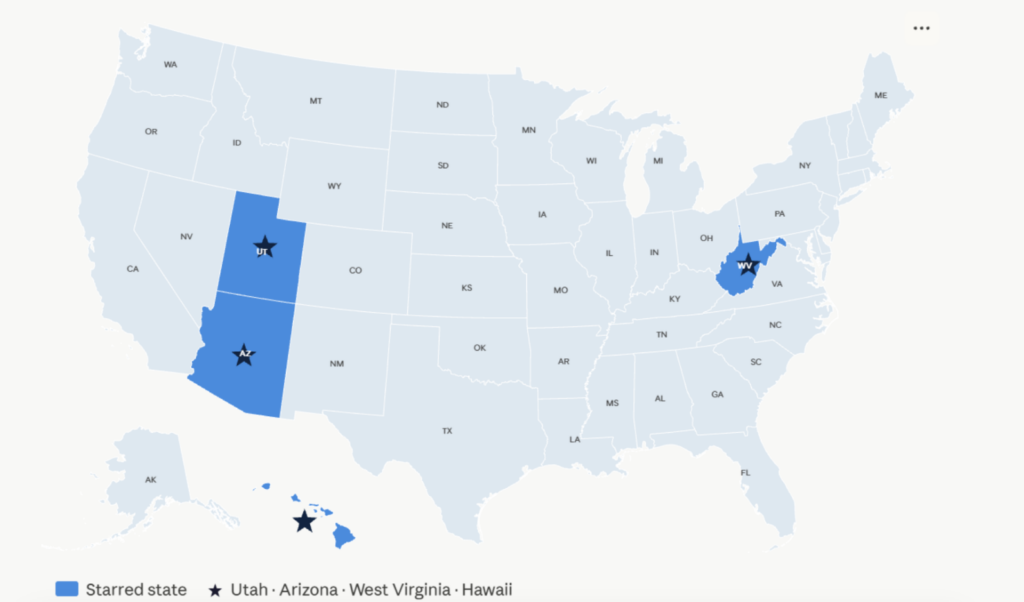
The map depicts the 50 U.S. states and their political boundaries. Regulatory sandboxes are popping up all over the country, the starred states (Utah, Arizona, Hawaii, and West Virginia) are a few that already have programs up and running.
How Sandboxes Works in Practice
Where in state government a sandbox is housed may influence how it operates. Programs administered by economic development agencies are often designed with business formation and innovation in mind, while those overseen by attorneys general or financial regulators may place greater emphasis on consumer protection and regulatory compliance. The institutional home can therefore shape application requirements, review processes, and the overall experience for participating firms.
Utah offers one of the clearest examples of how these programs work. Its first participant was Homie, a real estate startup that challenged a state restriction preventing brokerages from owning title companies. Despite objections from regulators, Homie was admitted to the sandbox under supervision and, according to Utah’s Office of Regulatory Relief, saved consumers more than $13 million. The case highlighted how sandboxes can test whether existing regulations protect consumers or simply shield established firms from competition.
An even more significant experiment has been Utah’s legal services sandbox. Created by the Utah Supreme Court in 2020, the program allows nonlawyers, software platforms, and firms with nonlawyer ownership to provide limited legal services with close oversight. Critics warned of consumer harm, conflicts of interest, and lower-quality representation, but the data have not supported those concerns. By early 2024, the program had received more than 100 applications and authorized over 50 providers. Utah recorded roughly one complaint for every 2,123 services, on par or better than traditional lawyers. An independent evaluation by IAALS found little evidence of the harm critics predicted even as the program expanded legal assistance to thousands of people.
These statistics are significant because legal representation remains out of reach for many Americans. In Utah, more than 90 percent of filed cases involved at least one unrepresented party. By allowing lower-cost providers to compete, the legal sandbox seeks to narrow that gap and has helped inspire similar reforms elsewhere, including Indiana. Regulations often benefit large, established companies more than consumers. For entrepreneurs without political influence or resources, challenging outdated rules is difficult, making regulatory sandboxes an important tool for innovation and competition.
Conclusion
Overall, regulatory sandboxes allow governments to keep pace with innovation without giving up oversight. They let businesses test new ideas under supervision while providing policymakers with evidence about what works. Early results suggest sandboxes can encourage competition and innovation without many of the harms critics predicted, making them an increasingly attractive policy option for states.
Shriya Buche is a rising senior at the Georgia Institute of Technology majoring in Economics with minors in Public Policy and AI/Machine Learning. She is interested in the intersection of economic policy, technology governance, and law, and plans to attend law school after graduation.