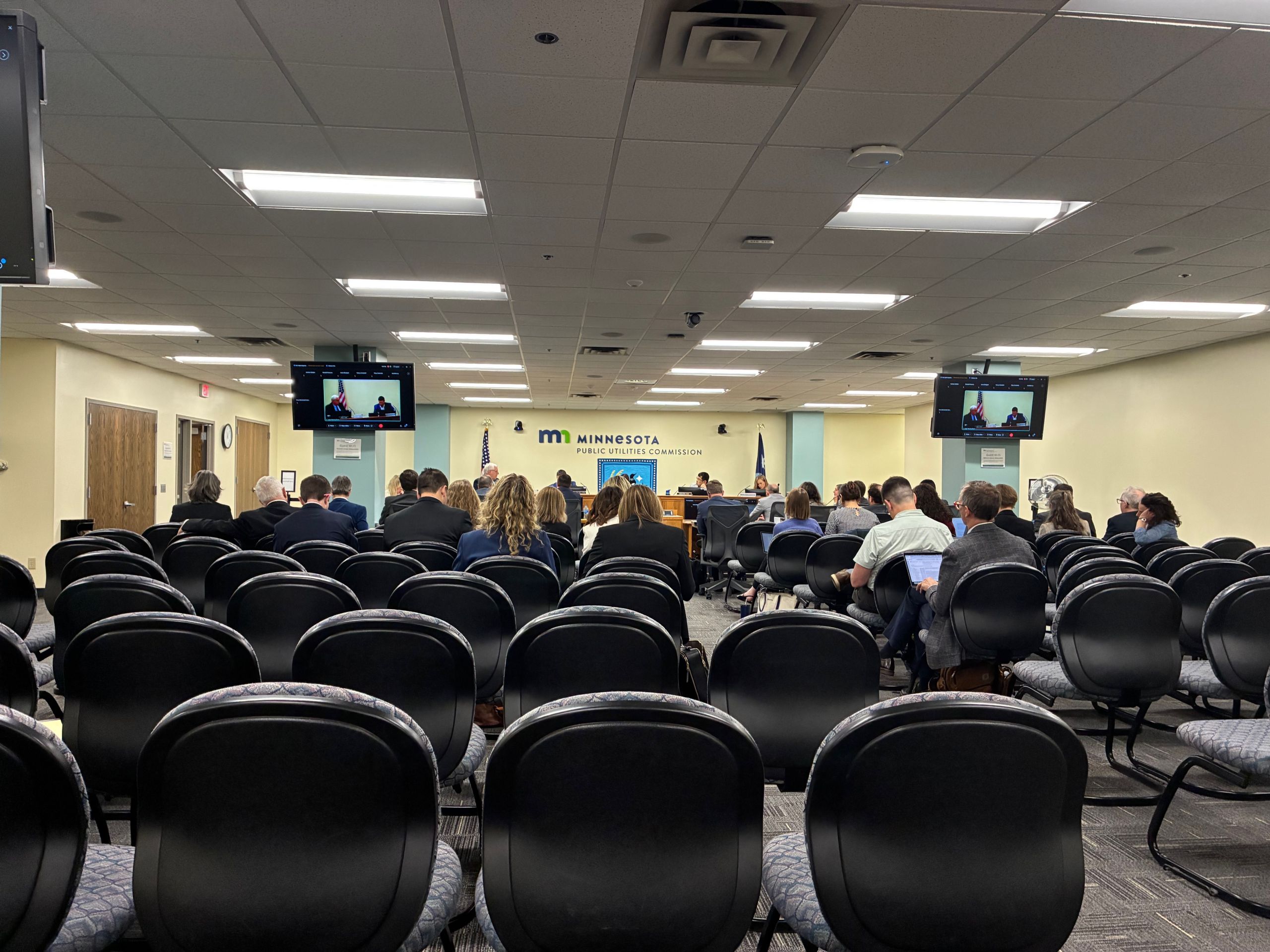
I recently attended (not online, but in person no less) two public meetings at the Minnesota Public Utilities Commission (PUC).
These were both all-day events on June 11 and 18, in the main conference room of the PUC’s headquarters in downtown St. Paul. The one on the 18th was the final one in Xcel Energy’s current bid to inflate prices to their 1.38 million electricity users in the state.
Even though I am an economist, who is a very experienced in public utilities regulation in other jurisdictions (as well as, to some degree, in accounting, finance and law), I found the whole affair a bit of a “black box.”
black box noun (unknown system): “a system that produces results without the user being able to see or understand how it works.” – Cambridge English Dictionary
PUC “system”
The PUC’s history goes all the way back to 1871, with the establishment of the Office of the Railroad Commissioner (ORC). In 1874, ORC was “added the responsibility for the oversight of railroad rates.” ORC was renamed in 1967 to the Public Service Commission (PSC), then in 1974 it “began regulating the rates charged by…electric utilities.” It finally became known as the “Public Utilities Commission” in 1980.
The PUC was established, and is governed, by state law. The key one is Chapter 216 of the 2025 Minnesota Statutes, which states: “The functions of the commission shall be legislative and quasi-judicial in nature,” along with “administrative.” This includes the power to “review and ascertain the reasonableness of…rates” as well as “the manner in which their businesses are conducted and the adequacies of the services which they are affording to the public.”
In their own words, the PUC sets “just and reasonable rates that electric…companies can charge their customers” through “a process called a rate case”. This applies to “all investor owned electric…utilities in Minnesota,” and involves “a comprehensive review of the utilities’ investments and expenses.”
The PUC has no transparent methodology for either determining electricity rates, in general, nor for Xcel’s rates, in particular. However, their approach appears to be consistent with the formula below from the book entitled “Public Utility Economics: Separating Ratepayer Costs from Shareholder Risk,” where: R = revenue requirement; O&M = operating and maintenance expenses; D = depreciation; T = taxes; and Rb = return on rate base.

Rate cases are initiated “when a regulated utility requests the Commission to authorize it to raise its rates,” and “the Commission has 10 months to decide on this request.” The PUC’s “order deadline” for the following request is July 31, 2026.
“Xcel Energy has asked the Minnesota Public Utilities Commission to approve a two-year rate plan to increase rates. For 2025, the company is proposing a $353.3 million increase, or 9.6%. For 2026, they are asking for an additional $137.5 million, or 3.6%. Altogether, the total requested increase over two years is $490.7 million, or 13.2%.”
PUC “results”
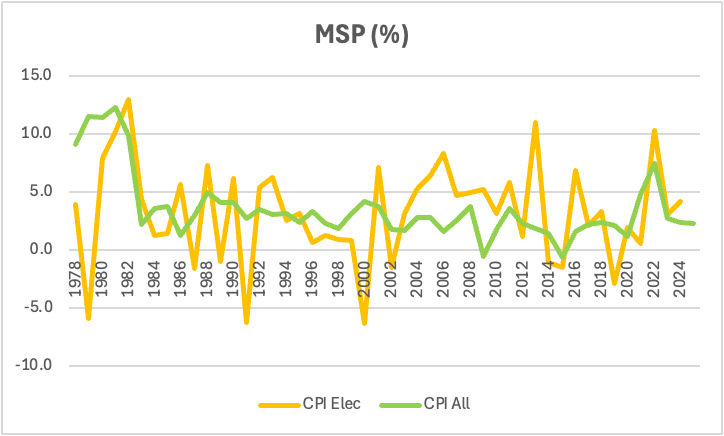
“Context matters.” I often post these two words on Twitter/X, to accompany a revealing statistical chart. The first chart below shows electricity CPI versus overall CPI, in terms of annual percentage (%) change for the Minneapolis St. Paul (MSP) urban area. CPI being Consumer Price Index, as published by the Bureau of Labor Statistics or BLS. The previous record high for MSP electricity CPI was 13.0% in 1982. The median from 1978 to 2024 was 3.2%.
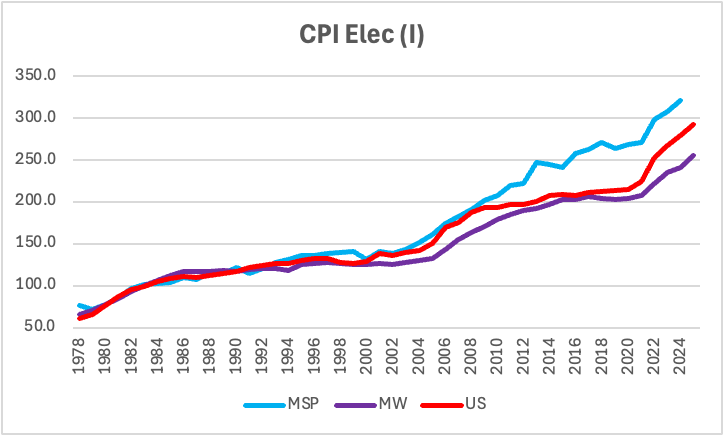
“More context, matters more.” I sometimes then quote my original X post, along with those four words. As can be seen in the second chart below, MSP electricity CPI starts to take off in the 21st century, as well as diverging upwards from the midwest (MW) and US. This divergence becomes pronounced from 2008 onwards. This is no coincidence given, as per the first chart above, there are three years above eight percent: 8.3% in 2006; 11.0% in 2013; and 10.3% in 2022.
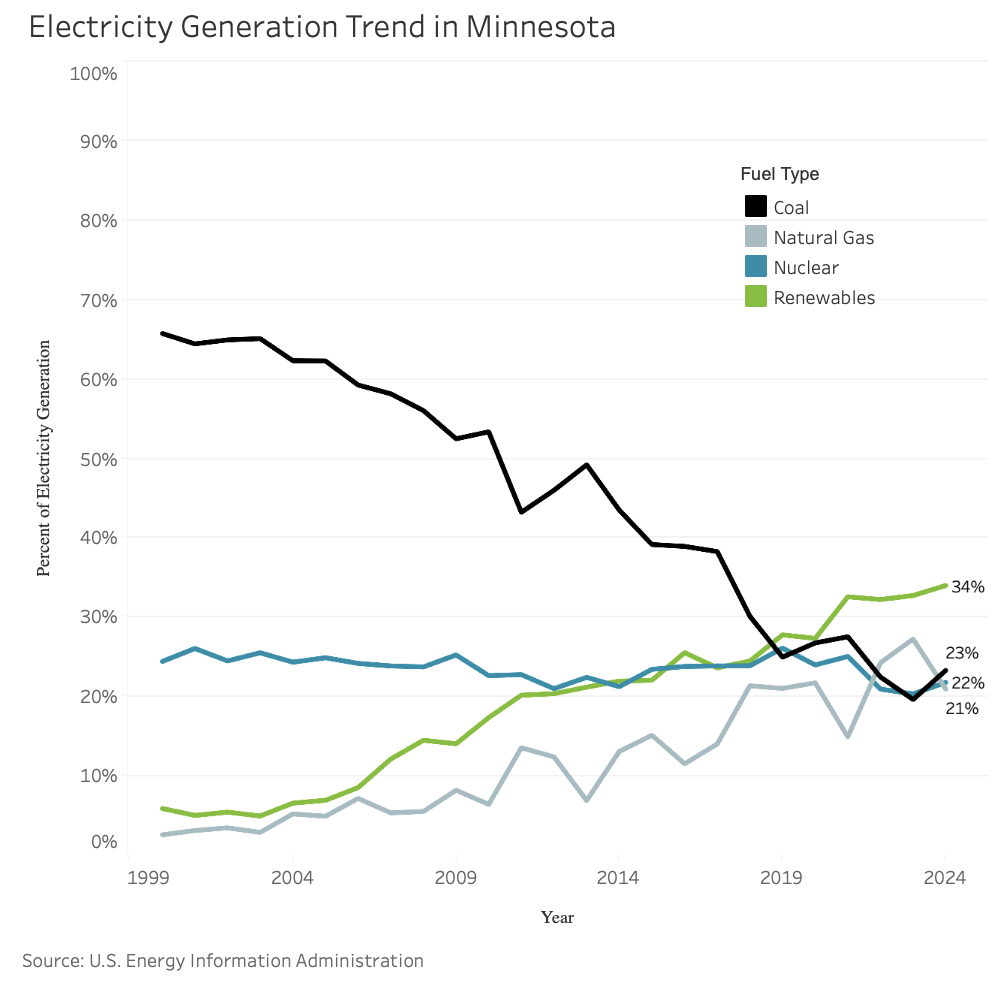
“Yet more context, matters more yet.” I will even go further to quote my quote for a third and final time, with those six words. The third chart below reveals what is driving up revenue requirements and electricity rates, as then reflected in user bills and electricity CPI. That being the disingenuous transition in electricity generation away from (cheap and reliable) coal towards (expensive and unreliable) renewables. Natural gas has also increased and nuclear has been steady, but these are reliable like coal and not as costly as renewables.
PUC “user”
The PUC 2024–2028 Strategic Plan sets out their top two priorities as: 1.) “Serve as a…transparent resource on utility regulation;” and 2.) “Maximize efficiency in effective utility regulation and oversight.” The first priority includes: “Make Commission activities accessible and understandable to the public.” The second priority notes: “Current data is inconsistent and labor-intensive to compile.”
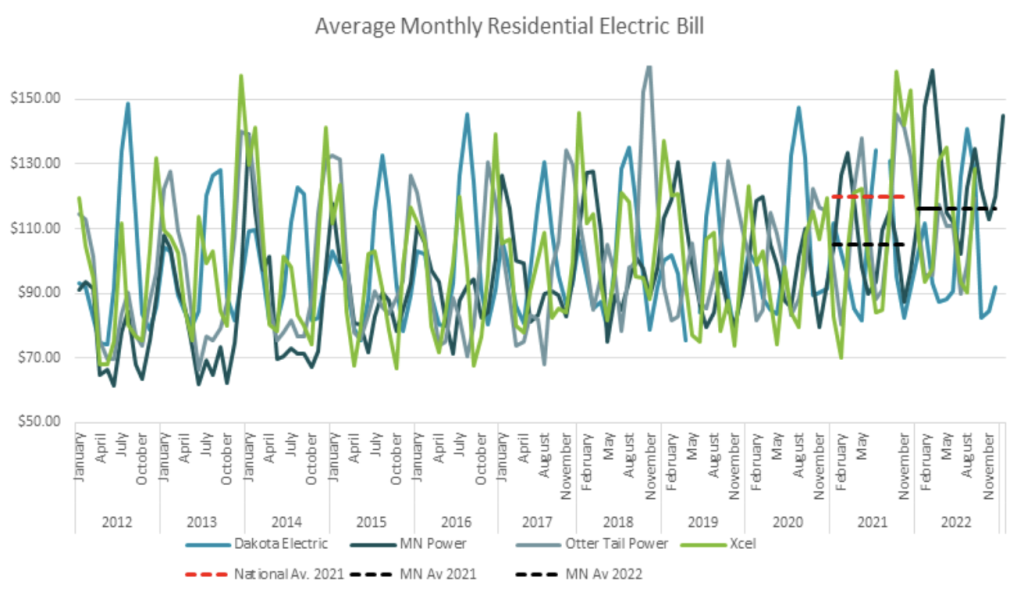
The PUC website is largely user friendly at first glance. For instance, there is a “Consumer Support” drop-down menu at the top of the home page. That menu includes “Understanding Your Utility Bill,” although it is seven places down on a list of nine topics. There is also a link to “Understanding Your Residential Electric Bill” that helpfully states “electric bills…generally are between about $90 and $150 per month for the average residential customer.” Although the fourth chart below, that accompanies the statement, is less than helpful.
There is no straightforward path on the website for users, be they residential, commercial or industrial, to reasonably connect-the-dots from electricity bills to rate cases. For example, if one wanted to find out about the current “Xcel Energy electric rate case,” then this is nested within “General Rate Cases,” which is in turn nested within “Financial Analysis,” which is fourth place in a drop-down menu for “Activities” on the home page.
As is often the case, such as with the upcoming MN nuclear study, the “devil is in the detail.” However, one needs to be able to easily find and “see” the details and then not be so overwhelmed by these that one cannot “understand” the details or, in other words, “can’t see the forest for the trees.” These details are tucked away, in part in the “Calendar of Events” under “About Us,” and in part in searching “eDockets” using an elusive Docket number. And these can be very detailed indeed, from a few pages to a few hundred pages, often drawn from a huge list of documents. Xcel’s current case of “24-320” has a list of 1,000 documents.
PUC “works”
It was recently reported in the news, on June 22, by Investing.com that:
“Xcel Energy Inc. (NASDAQ:XEL) announced Monday that the Minnesota Public Utilities Commission (MPUC) issued a verbal order on June 18 approving a rate increase for its subsidiary, Northern States Power Company (NSP-Minnesota). … A final written order from the MPUC is expected by July 31, 2026.”
I was at that particular “Commission Agenda Meeting,” and it was unclear to me, and probably anyone else who is not a PUC system insider, if the Commission made such an order then verbally, or that was yet to come in writing by July 31. It is also unclear what happens if there is any inconsistency between that verbal order and the written one to come.
The Investing.com report also illuminated the following:
“According to the company’s statement, the MPUC’s verbal decision authorizes an estimated rate increase of approximately $211 million over two years, averaging 2.9% per year. The approved return on equity (ROE) is set at 9.60%, up from the previous 9.25%, while maintaining an equity ratio of 52.5%. … Xcel Energy reaffirmed its 2026 ongoing earnings per share guidance of $4.04 to $4.16. … The company also declared a quarterly dividend of 59.25 cents per share, payable on July 20, 2026, to shareholders of record as of June 15, 2026.”
In conclusion, and to paraphrase the Cambridge English Dictionary definition from earlier:
black box [of electricity inflation]: “a [PUC] system that produces results [for Xcel Energy and their shareholders] without the [residential or commercial electricity] user being able to see or understand [the reasonableness of] how it works [to even seriously pursue, much less, actually achieve affordability].”