“Medicare for All” costs seem to be of little concern to far-left Minnesota candidates who never bother to read their bill that would outlaw private health insurance in favor of a government-run plan.
Minnesota DFL congressional candidate Matt Little claimed that outlawing all private health insurance (plans you get through work, that you buy from an insurance agent or through MNsure, and Medicare Advantage) would save $3,000 per family and 100,000 lives. He cites a study by the American Medical Association.
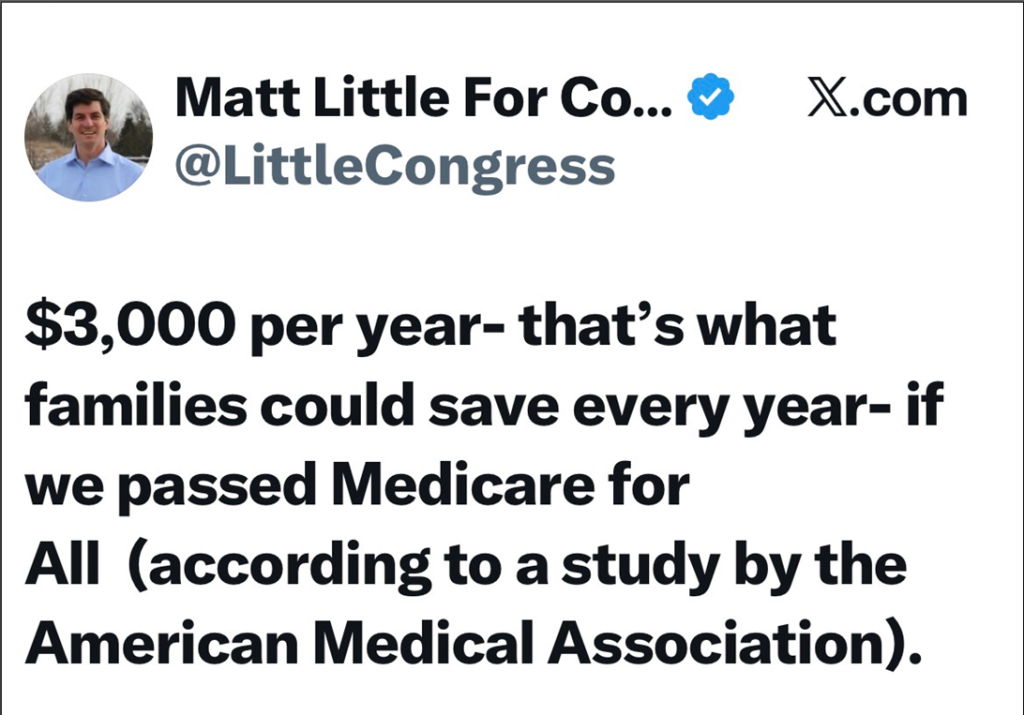
That would be a compelling study to read if it were true. But the American Medical Association did not produce a study concluding families would save $3,000 a year under Medicare for All (M4A). In fact, the AMA has long opposed single-payer proposals. The AMA House of Delegates voted to maintain opposition to single-payer rather than adopt neutrality. AMA leadership has repeatedly stated that Medicare for All would reduce patient choice and competition and rests on flawed financing. The AMA got into a lot of hot water for helping launch Obamacare, and they are (at least for now) being more cautious about jumping into another swimming pool without first checking for water.
Rep. Angie Craig, whom Little would like to replace, would not have made such a mistake. Craig, who does not support outlawing health insurance through M4A, could have told Little the AMA position and spared him the embarrassment. She may have been able to warn Little that every credible study shows M4A gutting the budget and delivering substandard health care to the state that just a few short years ago had the best care in the world at comparatively low cost. Peggy Flanagan beat Craig in a primary election to succeed Tina Smith as Minnesota’s junior U.S. senator. Flanagan supports M4A, and that was the major difference in the primary election. So supporting M4A is important; knowing about it is not.
One old study Little might have been trying to reference (specifically the $3,000-per-person claim) comes from a completely debunked RAND study from 2018, and no peer-reviewed study since has made any such claim. That analysis was based on ignoring nursing-home and home-and-community-based services. If those were included, it would have exploded the costs by $26 billion (in 2017 dollars).
Another possible study he could have overheard someone talking about is a 2026 Yale School of Public Health analysis that claims $1 trillion in savings from Medicare for All. This study has been thoroughly discredited for its unrealistic assumptions that appear to have generated a somewhat random and unsupported laundry list of cuts to payments and benefits. However, it would be interesting to ask Mr. Little if this is the study he was trying to reference, because nearly a third of the cuts rely on “eliminating fraud.” Does this mean Little thinks we can cut $286 billion in medical fraud?
The Congressional Budget Office (CBO) scored the additional costs at $1.5–$3 trillion per year. The Urban Institute pegs the costs at roughly $32 trillion over ten years.
On September 21, Peggy Flanagan told the Star Tribune she did not start the campaign as a supporter of M4A, then decided she was “not nibbling around the edges” when it came to health care in deciding to embrace Medicare for All.
If only there were a credible cost estimate of M4A completed in the past few years for Little and Flanagan to sell their plan. Oh, but we are in luck! In 2023, when Tim Walz was riding high, the administration signed a bill authorizing $3 million of your tax money to be spent studying the cost of M4A specifically for Minnesota. It was due in January 2026. The money has been spent. The report is sitting on someone’s desk, and if it were good news for Flanagan and Little, you would be able to read it before the election.