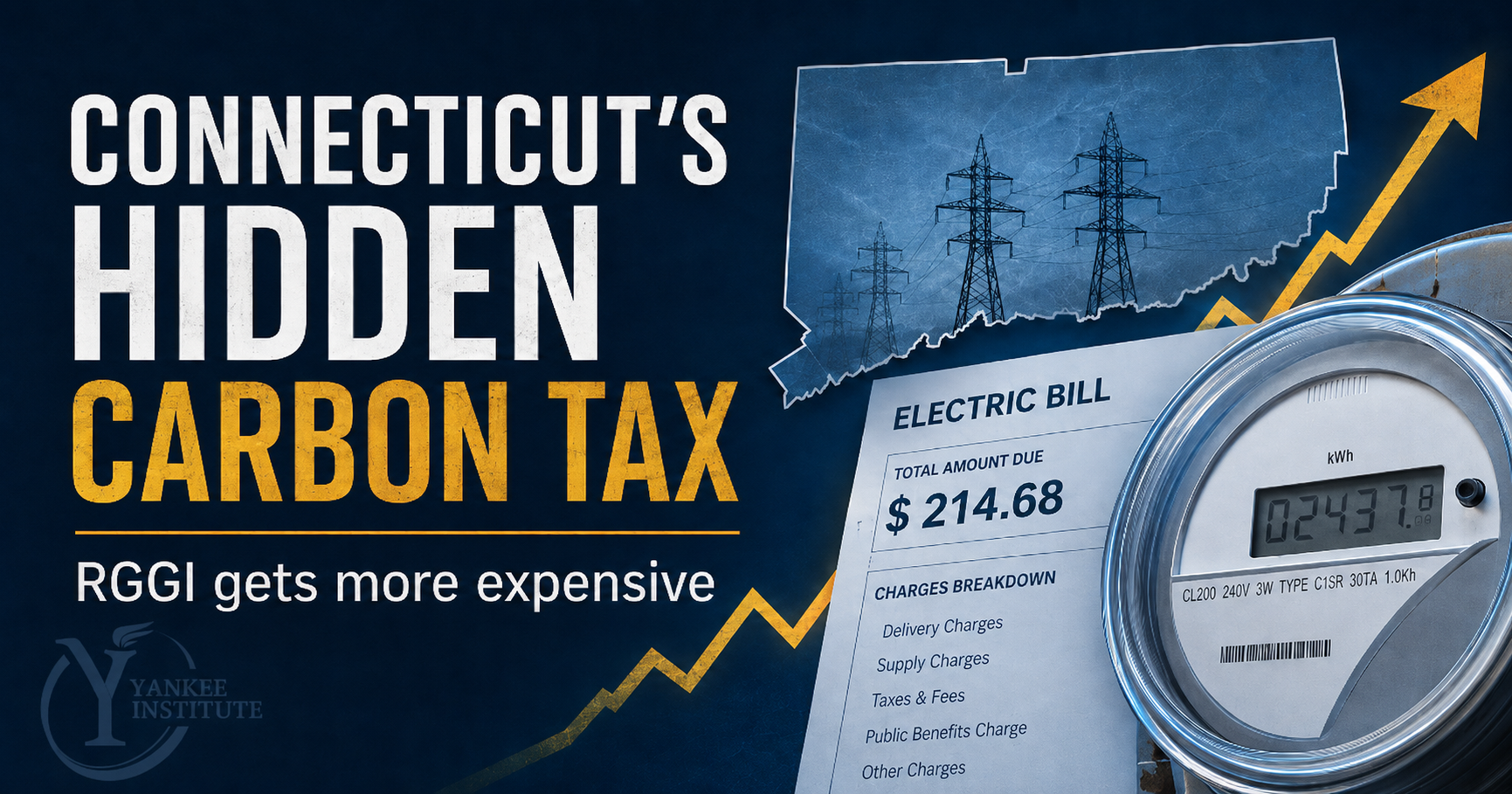
Connecticut residents know their electric bills are packed with government costs. The public benefits charge is printed directly on the bill, where customers can see it.
RGGI is harder to spot.
The Regional Greenhouse Gas Initiative — pronounced “Reggie” — is a multistate carbon-pricing program covering large fossil-fuel power plants. Connecticut and 10 other states limit the number of tons of carbon dioxide power generators may emit and auction allowances, each permitting one ton of emissions.
Power plants must buy enough allowances to cover their emissions. As the states reduce the number available, the price tends to rise. Power generators pay for the allowances and build those costs into the price of electricity.
There is no separate “RGGI charge” on the bill. The cost is buried in the price of electricity.
Now the Department of Energy and Environmental Protection wants to tighten the program again, beginning in 2027. Connecticut residents have until Aug. 3 to comment.
A Carbon Charge Hidden in the Supply Rate
Inside Investigator reported that RGGI allowance prices have climbed more than 1,000 percent, from $3.07 at the first auction in 2008 to $35 in June 2026.
Connecticut has also cut the number of allowances available. The state’s cap fell from about 10.9 million allowances in 2009 to 4.1 million in 2026. Fewer allowances mean power plants have to compete for a shrinking supply, pushing up the cost of staying in compliance.
The auctions brought Connecticut $84.1 million in 2025. DEEP says RGGI has generated $627 million for the state since the program began, including $338 million for energy-efficiency programs, more than $100 million for Green Bank projects and electric-vehicle rebates, and $117 million for bill relief.
That money does not appear out of nowhere. Power generators pay for the allowances and build those costs into the price of electricity. The state then spends the proceeds on efficiency programs, clean-energy projects, EV rebates and temporary bill credits.
In other words, ratepayers pay more on the front end, and Hartford takes credit for giving some of the money back.
DEEP now wants to tighten the cap again. The proposed rules would cut Connecticut’s allowance budget from 4.1 million tons in 2026 to 3.7 million in 2027. By 2037, the cap could fall to about 393,000 tons — roughly 90 percent below today’s level.
The proposal includes backup allowances that can be released if prices climb too high. Even with those protections, DEEP says the cap could still shrink by 61 percent to 90 percent by 2037.
That is a major cut for a state where families and businesses are already struggling with electric bills.
DEEP says the effect on bills will be “minimal,” projecting anything from a small increase to a decrease of nearly 2 percent.
Connecticut ratepayers have heard that before. One mandate may look small on paper. Add it to all the other subsidies, contracts and policy costs buried in electric rates, and customers are left paying the total.
DEEP’s fiscal note also says the rule will cost state government nothing because the agency can handle it with existing staff and RGGI money.
That only means DEEP does not need to hire anyone. It does not mean the rule is free. Power producers, businesses and ratepayers will still pay for it.
RGGI Came Through the Back Door
RGGI was not entirely secret before Connecticut authorized it.
Connecticut was among seven states whose governors signed the original RGGI memorandum of understanding (MOU) in December 2005. A regional model rule was released in 2006. The Rell administration supported the program, state regulators held stakeholder discussions and environmental organizations submitted comments before lawmakers acted.
But ordinary Connecticut residents never received a clear legislative debate over whether the state should enter a mandatory regional carbon market.
Lawmakers authorized RGGI through Section 93 of Public Act 07-242, a 130-section electricity and energy omnibus bill passed under an emergency certification (e-cert). The bill did not go through the normal committee public-hearing process.
That distinction matters.
Agency stakeholder meetings attended largely by advocates, utilities and policy professionals are not a substitute for a legislative hearing. A public hearing would have forced lawmakers to explain the program, hear objections from residents and businesses, and put the arguments for and against RGGI on the record.
Instead, the administration negotiated the agreement, policy insiders debated the details and lawmakers placed the authorization inside a massive emergency-certified bill.
RGGI was no secret inside state government. But ratepayers never got a public hearing or a clear, stand-alone vote on whether Connecticut should join.
The insiders knew what was coming. The public never got a meaningful seat at the table.
That decision also made the program difficult to reverse. DEEP now argues that Connecticut must update its regulations to remain in RGGI and continue receiving its share of auction proceeds. The agency also says Connecticut customers would still encounter RGGI-related costs in the regional electricity market because every other New England state participates.
That is the trap. Once states build a regional program together, each one is told it cannot leave because the others are still participating.
It is not an argument for automatically approving another decade of tighter limits. It is an argument for lawmakers to take responsibility for a program they authorized and examine whether it still serves Connecticut ratepayers.
Ratepayers Should Speak Up
Before Connecticut adopts these regulations, DEEP should provide a clear accounting of what RGGI costs consumers.
The agency should disclose how allowance prices affect wholesale electricity rates, how much a typical household and business pays each year because of RGGI and how much auction revenue is returned as direct bill relief.
It should also explain why Connecticut should commit to allowance reductions of up to 90 percent without a simple household-level cost estimate.
Connecticut residents may submit comments until 5 p.m. Aug. 3, 2026, through the state eRegulations system under tracking number PR2025-028. Comments may also be emailed to [email protected] with “RGGI Rulemaking Comment” in the subject line.
DEEP also scheduled a virtual public hearing for 9:30 a.m. July 23, in the middle of summer when many families are away or focused on back-to-school plans. The agency did not send its reminder email until 4:52 p.m. the day before.
That is not exactly a serious effort to draw broad public participation.
Residents do not need to be electricity-market experts. They can ask DEEP to pause the rule, publish a transparent ratepayer-cost analysis and seek direct legislative approval before imposing another decade of carbon-cap reductions.