
There are many factors that contribute to a student’s academic achievement: natural talent, family resources, conditions of poverty, personal willpower, and school structure. Typically, researchers isolate student groups by their race, gender, poverty, special education needs, and English learner status. But should researchers turn their attention to another student characteristic — family structure?
In a new report published by the American Enterprise Institute (AEI), former charter school network CEO Ian V. Rowe, alongside professor Brad Wilcox, argued that an analysis of family structure data should be an essential component of academic achievement research. In particular, Rowe examined the National Survey of Children’s Health to determine if family structure was strongly associated with three outcomes: the number of times a school contacts a household regarding their child’s behavioral or learning problems, student GPA, and depression.
(Rowe clarified, “For the purposes of our report, ‘intact families’ are homes headed by children’s married birth or adoptive parents, and ‘non-intact’ families are households where children are raised by stepparents, single parents, cohabitating parents, foster parents, or kin such as grandparents.”)
Rowe found that students living with intact families were far less likely to be contacted by a school for behavioral or learning problems. Family structure was a stronger predictor of problems at school than race, gender, socioeconomic status, or student age.
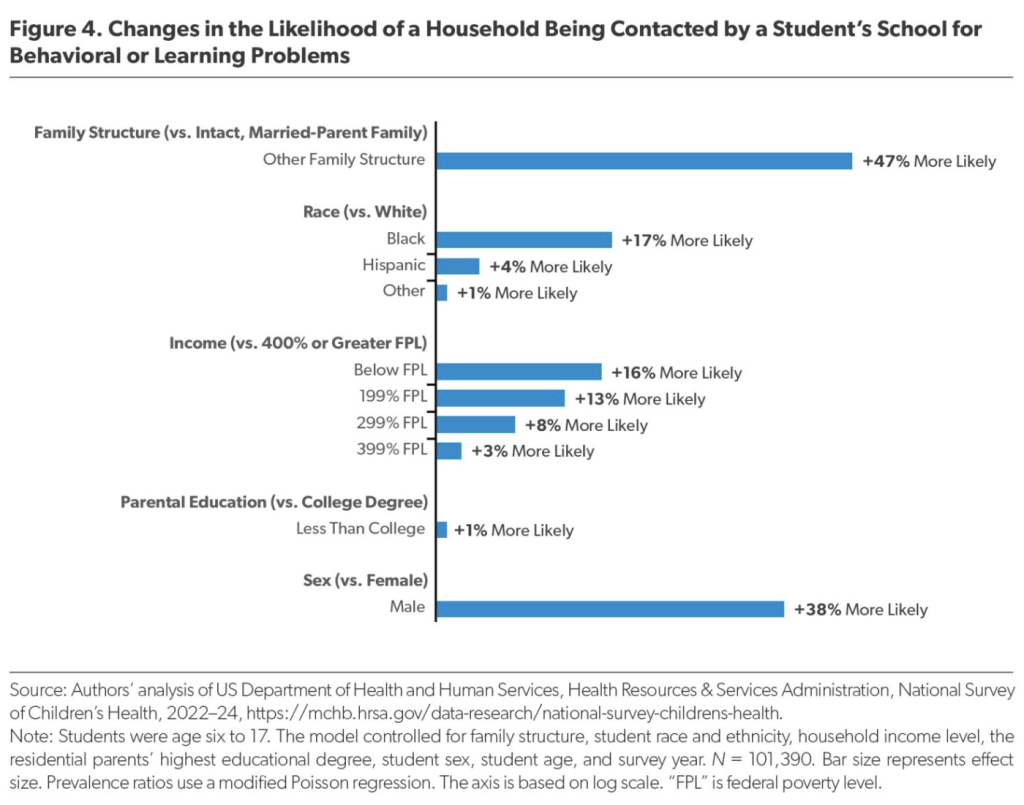
Students who were in non-intact families were 47 percent more likely to have their household be contacted by school. Interestingly, under this framework, poverty no longer becomes a strong correlative with increased school concern; once the data was controlled for family structure, students in poverty were only a bit more likely (16 percent) to need school outreach.
The benefits of intact families applied to academics as well as classroom behavior. Rowe found that an intact home had an effect on GPA comparable to that of growing up with a college-educated parent. He wrote that
From 2022 to 2024, 74 percent of children age six to 17 from intact, married parent families got A’s and B’s or straight A’s. This compares with 60 percent of those from non-intact homes or living with unmarried parents—a 14 percentage point gap.
Additionally, family structure was found to be more predictive of childhood depression than race, income, or gender. Rowe found that
After age…family structure was the most predictive of a child having depression in our sample. Children from non-intact or unmarried-parent households were over twice as likely to be diagnosed with depression as their peers from intact, married-parent homes.
The data collected from the National Survey of Children’s Health seems to suggest that students from intact households have higher grades, lower rates of depression, and significantly lower chances of being in need of more support at school. Additionally, Rowe’s analysis suggests that family structure is in many cases a stronger indicator for student performance than race, gender, or poverty level.
A better metric?
It’s no secret that a student’s home life has significant impacts on their academic performance. My colleague Catrin Wigfall has analyzed the National Assessment of Educational Progress (NAEP) test scores by parental education level. She found in particular that Minnesota’s achievement gaps between 8th graders whose parents hold a college degree and those who do not hold a college degree are (while relatively consistent with the national average for such gaps) regrettably stark.
Parental education level has a strong correlation with student academic achievement, but research has shown that minority student groups don’t always experience the same GPA boost from well-educated parents. A data analysis that takes family structure into account could bring clarity to this question, and perhaps give school administrators the ability to create targeted supports to students and families who are in need of extra care.
Rowe pointed out that family structure data is available — it just hasn’t been published. NAEP has been collecting and compiling student survey responses about family structure since 2013. That family structure data, Rowe argued, needs to be made available to researchers.
It’s a strong argument. If family structure doesn’t matter to academic performance, then the publication of the data will allow researchers to settle the question. If, as the National Survey of Children’s Health data suggests, family structure does matter, then school administrators can pursue clear-eyed, data-driven tactics that support students.
Some states, like Alabama, Tennessee, and Ohio, have already begun “success sequence” initiatives that inform students about wise and strategic life choices. Rowe pointed to success sequence education as a possible policy solution, writing,
In light of [family structure] research, the universe of interventions could be expanded to help young people think differently about their future. For example, it is true that educators cannot control or change the structure of the families that students are from. But we can influence how our students think about the families they form and the series of life choices that will likely lead to their life success—and that of their children. One way of doing this is teaching middle and high school students the “success sequence”: 97 percent of young people who graduate with at least a high school degree, enter into full-time employment, and then get married before having children are not poor as adults, and the vast majority enter the middle class or beyond.
Success sequence education doesn’t have to imply or impose a religious sexual ethic on students, and states that have implemented this education have been careful to avoid that implication. This approach simply states what many know to be intuitively true: the decisions to create a child with another person, graduate from high school, or spend one’s days working full-time have significant consequences for one’s stability and financial success, and young people need to approach these choices with seriousness and prudence.
Minnesota doesn’t have to wait for a full publication of NAEP data to encourage our students to make strong life choices. The North Star state can promote “success sequence” curricula, folding the data-driven presentation on poverty avoidance into the required personal finance course.
Additionally, Minnesota should begin to collect data on student family structure, allowing researchers to understand the relationship between family structure and achievement on state tests. If Rowe’s NAEP data release advocacy is successful, family structure analysis will be the next priority in many states for effective student support. Minnesota policymakers shouldn’t allow the state to be left behind.
The data seems to suggest that family structure matters significantly for student academic achievement. It’s time for Minnesota to decide what to do about that.