Massachusetts has distinguished itself as a national leader in education, health care, and biotechnology. While many other states rely on manufacturing, energy, or tourism as their economic drivers, Massachusetts has built an economy centered around research and innovation at some of the nation’s best academic and medical institutions.
Data from Pioneer Institute’s US DataLabs shows that education, healthcare, and scientific and professional services account for a larger share of employment in Massachusetts than in nearly every other state, ranking between 3rd and 5th nationally for all three sectors in 2024 (see Figure 1).
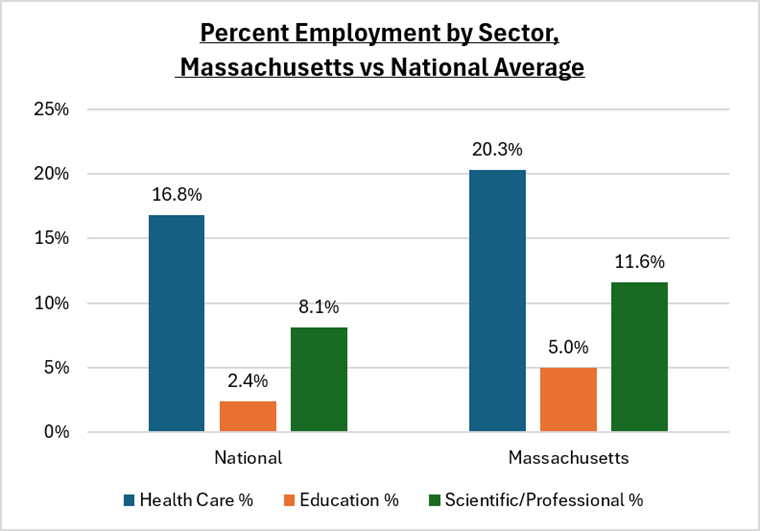
Figure 1: Comparing Massachusetts Employment Breakdown by Sector against National Levels. Source: Pioneer Institute US DataLabs
Recently, the Boston Chamber of Commerce released a report that outlines exactly how “eds and meds” contribute directly and indirectly to Massachusetts’ economy, as well as how they have evolved greatly over time. More recently, Massachusetts has also become a leader in the biotechnology space and is recognized as a global hub for the pharmaceutical and life science industries.
The education and healthcare sectors exhibited consistent job growth over the past few decades, while innovations in biotechnology have driven growth in scientific and professional services. Taken together, these industries generate high-paying jobs, attract skilled workers, and support countless businesses in the Commonwealth. Eds and meds generates economic impact directly and indirectly, as Massachusetts universities created $57.4 billion in total output and supported 407,000 jobs in 2025 alone. Hospitals added another $72.9 billion in total output and supported 298,000 jobs. These institutions are not just employers but also economic anchors in communities across the Commonwealth. However, there is cause for concern as growth in the private sector overall has slowed since the pandemic began with a net contraction of 1.1% Among the biggest declines was the scientific and professional sector with a 5.3% loss after peaking in 2022, meaning that the proposed NIH cuts could further exacerbate an industry that is already weakened.
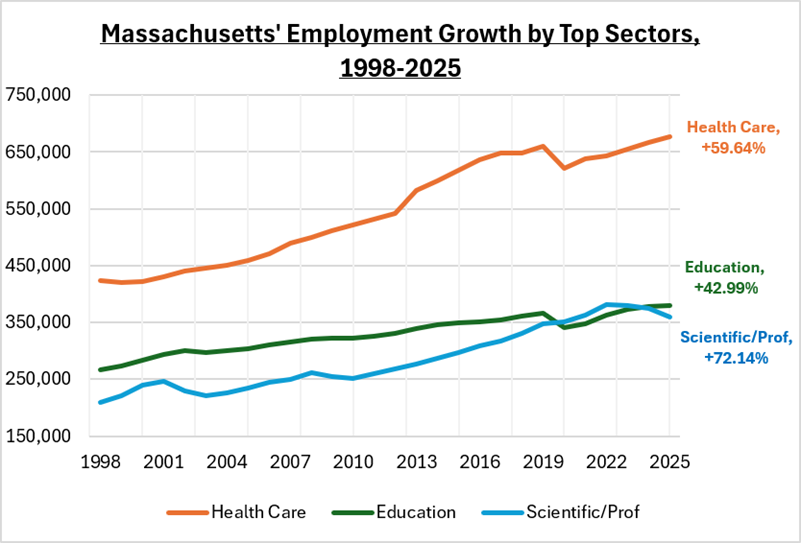
Figure 2: Massachusetts’ Employment Growth by Sector, 1998-2025. Source: Pioneer Institute US DataLabs
Because of its status as a global leader in these areas, Massachusetts tends to be among the top recipients of National Institute of Health (NIH) funding. The Commonwealth ranks first nationally in NIH funding per capita, receiving approximately $5.2 billion in grants in 2023. It also leads the nation in innovation as measured by patent production, which was the highest of all states at 15.5 patents per 10,000 residents. Despite the state’s superb performance and robust growth (see Figure 2), recent federal reform and NIH cuts have brought up concerns that Massachusetts is overdependent on the eds and meds economy.
With the signing of the One Big Beautiful Bill Act, the federal administration proposed significant changes to both biomedical research funding and Medicaid spending. NIH Director Jay Bhattacharya has argued that cuts will be made to spread successes more evenly across the country. He hopes the nation’s infrastructure as a whole will “better reflect the country’s health problems” by diversifying their funding in places like Alabama and Iowa.
While expanding research capacity nationwide is a worthwhile objective, it would have meaningful economic consequences for states like Massachusetts that have become so reliant on specific industries. Research institutions have reportedly delayed hiring because of the funding cuts, and there is increased uncertainty surrounding graduate student and postdoctoral opportunities. On top of this, those who are in the field have been forced to shift their research priorities to remain competitive for the funds that are still available. The changes brought on by the Act have triggered what some call the “flight of the scientists,” as some research institutions lost between $47 million and $100 million in critical funding in fiscal year 2025.
The same is scheduled to occur with Medicaid funding over the next few years. These cuts greatly affect both the industries and those they seek to serve, with estimates suggesting that up to 300,000 Massachusetts residents could lose their health insurance coverage over the next 2-3 years. While the Commonwealth has built one of the strongest economies in the country through its investment in higher education, healthcare, and biotech, the shift in federal priorities will be a true test of its economy’s strength and adaptability.
Mia Raineri is a Roger Perry Government Transparency Intern at Pioneer Institute. She recently earned her M.S. in Applied Economics from Boston College.
Sources
Mass. ‘Eds and Meds’ Economy in Trump’s Crosshairs – Banker & Tradesman
Greater-Boston-Chamber-of-Commerce-Eds-and-Meds-Report.pdf
Mass. ‘eds and meds’ sector in the cross hairs
How Trump administration funding cuts put Massachusetts research at risk