The Missouri Department of Elementary and Secondary Education (DESE) reports that 188 of 518 school districts will be operating on a four-day school week (4dsw) during the upcoming school year.
The figure below shows the rapid growth of the 4dsw since the 2010–11 school year.
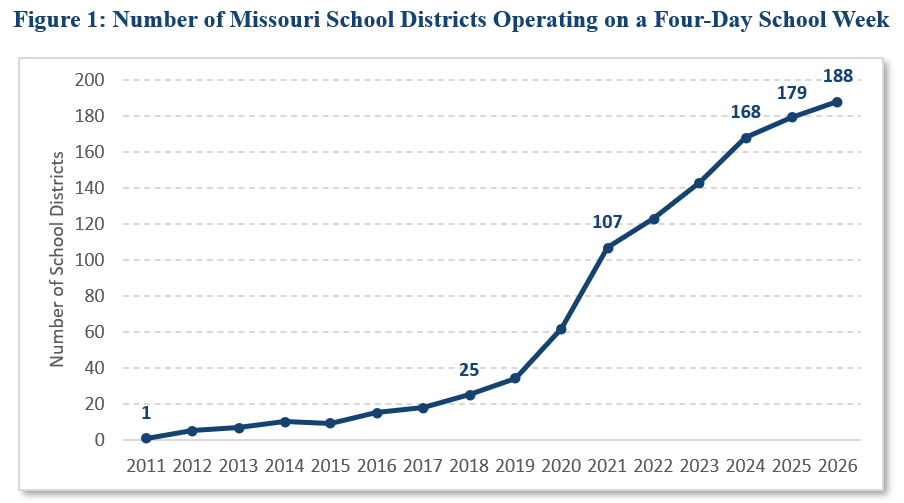
Source: DESE
Missouri is not alone in this phenomenon. The 4dsw is increasingly popular across the country, especially in rural districts. Even though 36 percent of Missouri school districts use a 4dsw, they cover only 13 percent of students because rural districts are smaller. However, it is notable that the Independence School District in Kansas City, with over 13,000 students, is also on a 4dsw.
Districts typically adopt a four-day calendar in hopes of improving teacher recruitment and retention and, in some cases, reducing costs. In 2024, Senate Bill 727 included a modest financial incentive for districts to have at least 169 instructional days to encourage districts to remain on a five-day schedule. Nevertheless, the use of the 4dsw continues to expand.
My colleague James Shuls and I authored a series of papers examining the effects of the 4dsw on academic achievement, district finances, teacher retention, and parental satisfaction:
Across these reports, we found that the 4dsw was harmful for student achievement, with stronger negative effects for non-rural students. We found that the 4dsw either had no meaningful effect on finances, or that a decrease in costs was almost entirely offset by a decrease in revenues. For teacher retention, the results were mixed. We found that parents had a slight preference for the five-day school week (with those using a 4dsw as the strongest supporters, and those concerned about childcare as the strongest opponents).
Since our papers were published, several newer studies have been published, though the number of rigorous, quantitative studies on the effects of the 4dsw is still limited.
A 2024 study from the Center for Analysis of Longitudinal Data in Education Research (CALDER) found “small negative or statistically insignificant effects on teacher recruitment and retention outcomes.”
Similarly, a 2025 CALDER study used Missouri data and “found no evidence that the 4dsw improves teacher recruitment or retention,” despite educators and school leaders believing it does. My colleague, Cory Koedel, was one of the study’s coauthors and wrote about the findings in greater detail here.
The 4dsw is not a loophole that saves money and improves teacher retention at no cost to students. In fact, the available evidence suggests that, on average, it is harmful to students while nothing changes for retention and finances.
This does not mean that a 4dsw could never be successful. A district that adopts a 4dsw as part of an innovative educational model could potentially unearth new benefits. However, that is not why most districts switch. School leaders and policymakers should familiarize themselves with the research and approach the continued expansion of the 4dsw with greater skepticism.
Rolf Kremming / Shutterstock