This November, Minnesota voters will weigh in on a constitutional amendment that would change how the state’s Permanent School Fund gets distributed to schools.
Because the fund is not widely discussed, here is how it works and what the proposed amendment would change.
Permanent School Fund
When Minnesota became a state in 1858, the federal government granted land to the state “for the use of schools.” Today, Minnesota still owns roughly 2.5 million acres of this school trust land, which generates revenue from mining and timber production. Under the Minnesota Constitution, the revenue is deposited into the Permanent School Fund (PSF), a constitutional trust that provides annual support for K-12 public education. As of March 2025, the fund is valued at $2.3 billion.
Under the Constitution, schools only receive money from the fund’s investment earnings (mainly interest and dividends), and annual distributions are capped at 2 to 2.5 percent. The principal itself can’t be spent, as the Constitution requires it remain “perpetual and inviolate forever.” And if the fund loses money in a given year, those losses have to be made up before distributions resume, which is one reason payments can fluctuate from year to year.
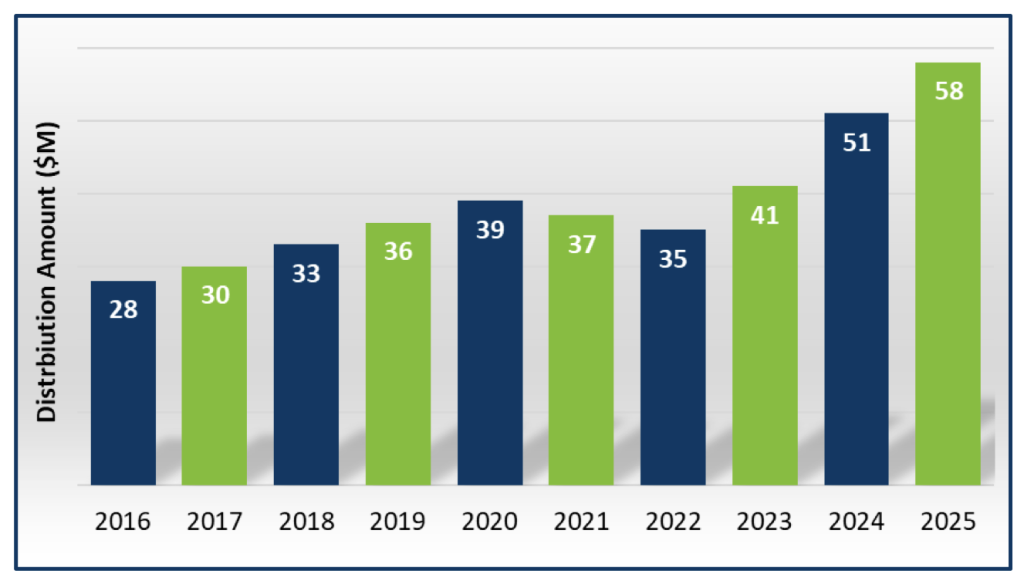
The money distributed among school districts is based largely on student enrollment and shows up twice a year, in September and March. In the 2024-25 school year, the interest and dividends produced a record $58 million for the state’s 329 public school districts and 181 charter schools, or about 0.4 percent of E-12 education’s biennial budget. Statewide, that averaged out to about $68 per student. Anoka-Hennepin, the largest district, collected $2.6 million. Minneapolis got $2 million.
Schools can use these distributions for educational supplies, designing and modeling school curricula, teacher salaries, extracurricular activities, and establishing and maintaining quality facilities, according to the Minnesota Office of School Trust Lands.
Minnesota Permanent School Fund, 10-year distributions (2016-2025)
What would a constitutional amendment change?
The November amendment would change both how much the PSF pays out and how that amount is calculated. Instead of distributing only interest and dividends under the 2 to 2.5 percent cap, the fund would distribute 4.5 percent of its three-year rolling average market value.
A legislative task force recommended that rate and the three-year averaging method, arguing it would preserve the fund’s long-term purchasing power and allow more of its investment growth to be distributed. The task force’s projections suggest this could raise per pupil funding by roughly 40 percent, though that number depends on the fund’s market performance going forward and isn’t a guarantee.
Rep. Spencer Igo (R) and Sen. Mary Kunesh (DFL) carried the bill. It passed the House 133-0 and the Senate 43-24. A point of disagreement during the legislative debate was how easily the distribution rate could be changed in the future. Senate lawmakers fought over a tweak that would require any future change to need a supermajority rather than a simple majority. Sen. Robert Farnsworth (R) pushed for that guardrail, warning that without it, a future single-party trifecta could turn the fund into a “political bargaining chip.” Conference committee stripped the provision out, and the bill went back to a simple majority, which is the same threshold being used to raise the rate now. Future legislatures could change the 4.5 percent distribution rate through the normal legislative process.
The ballot language states that the amendment would increase funding without raising individual income or property taxes, because the additional distributions would come from the existing trust.
Supporters argue the current formula limits how much of the fund’s investment growth can be distributed to schools, even when the fund performs well.
Opponents argue that tying the annual payout to 4.5 percent of market value could leave the fund handing out more than it actually earned in a bad market stretch, which starts to eat into principal. While the three-year average is meant to smooth out short-term market swings, it wouldn’t fully protect the fund through a multi-year downturn. How serious a risk that is depends on assumptions about future market returns that nobody can know in advance.
The amendment only changes the way money from the fund is distributed. It does not create new accountability requirements or establish a process for measuring the effectiveness of the additional dollars.
The ballot question
On the ballot, the question reads:
Shall the Minnesota Constitution be amended to increase the funding going to all school districts from the permanent school fund, which is a fund that supports school districts without raising individual income or property taxes, effective July 1, 2027?
A “yes” vote would allow the fund to distribute 4.5 percent of its average market value each year. A “no” vote, or leaving the ballot question blank, would keep the current constitutional formula in place. The amendment would be ratified only if a majority of all electors voting in the election vote “yes.”