When the Kansas Supreme Court ruled in 2019 that school funding met its definition of constitutionally adequate, we wrote that it was only a matter of time before the next school funding lawsuit. Seven years later, four Johnson County school districts (Blue Valley, De Soto, Olathe, and Shawnee Mission) announced they are preparing to do just that.
Sam MacRoberts, litigation director and general counsel of Kansas Justice Institute, said, “Because Gannon VII focused solely on money instead of students, the same financial issues will undoubtedly appear again. A [school district] will file another lawsuit claiming inadequacy of the State’s funding, and the Court will start the review process all over again.” KJI is a subsidiary of Kansas Policy Institute.
In Gannon IV, the Court noted: “Plaintiffs have shown through the evidence from trial – and through updated results on standardized testing since then – that not only is the State failing to provide approximately one-fourth of all public school K-12 students with the basic skills of both reading and math, but that is also leaving behind significant groups of harder-to-educate students.”
Attorney and former Speaker of the House, Mike O’Neal, said, “It is not the State that is responsible for providing students with these skills, and it is not the Legislature’s role to provide those skills. This is fundamentally a function of the education system. Accordingly, the focus is and should continue to be on how the State’s provision for finance to the schools is being allocated by the schools in a manner that is reasonably calculated to have those under-performing students meet or exceed state standards.”
It’s a predictable pattern. Faced with parental concern over persistently low student outcomes, school administrators in many of the larger districts file suit, blaming poor outcomes on inadequate funding. After that suit is settled and the Court gives them a big funding increase, school administrators in many of the larger districts file another suit, blaming poor outcomes on inadequate funding. Rinse and repeat.
The adjacent table tracks the last 25 years of per-student spending in Kansas against the timing of school funding lawsuits being filed and settled. In each case, funding has been higher than it would have been if adjusted for inflation, yet 8th-grade reading proficiency has declined.
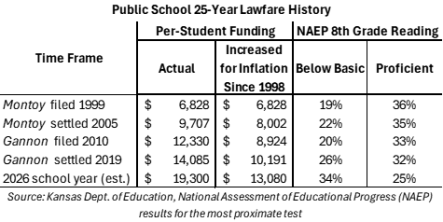 Per-student spending was $6,828 for the 1998 school year; 19% of 8th-graders were Below Basic in Reading on the National Assessment of Educational Progress (NAEP), and 36% were Proficient. Funding this year will be a little over $19,000 per student, which is $6,000 above what it would be if increased for inflation since 1998. The last NAEP test in 2024 showed that 34% of students were Below Basic and just 25% were Proficient. Real spending increased at every juncture, and outcomes declined every time.
The bulk of school funding is provided by the State. It went from about $2 billion in 1998 to $5,7 billion last year. Adding in local and federal tax dollars shows total funding rising from $3 billion to $8.7 billion over the period.
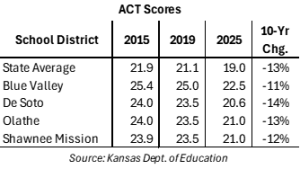 ACT scores are also on the decline, hitting a record low of 19.0 last year. The four districts preparing to sue also have precipitous declines, and they cannot be blamed on COVID. NAEP, ACT, and state assessment scores were falling long before the pandemic began, as the Gannon money was flowing.
The State School Board is trying to make it appear that outcomes on the state assessment are improving by reducing proficiency standards in 2025, but parents and legislators aren’t buying the deception.
In 2015, nearly a quarter of students were below grade level in reading (English language arts), which the Kansas Supreme Court noted as evidence that schools were underfunded. That worsened progressively and reached 33% in 2024, prior to the standards being reduced last year.
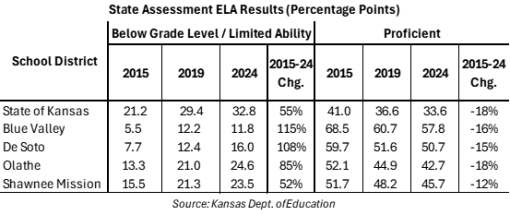
Proficiency levels also declined across the state and in Johnson County. Students in Blue Valley and De Soto are at or a little above 50% proficient, while less than half are proficient in Olathe and Shawnee Mission.
Special Education funding excuses don’t hold water
The superintendents of the four Johnson County districts say they are facing a financial crisis because the Legislature is underfunding special education, but declining enrollment and financial mismanagement are the real culprits.
First of all, the Kansas Supreme Court declared in 2019 that the Legislature’s funding package met its definition of adequate funding, which included a one-time $44 million increase for special education plus $7.5 million annually thereafter. That promised increase has been exceeded.
Based on that settlement, the Legislature should have repealed the statute requiring special education funding to cover 92% of excess costs, as it was no longer applicable. That didn’t happen because many Democrats and Republicans didn’t want to deal with the (unjustified) criticism from education lobbyists.
Still, the statutory formula for determining excess costs doesn’t account for all the money school districts receive related to special education funding. It does not count weightings for at-risk, bilingual, career & tech ed, transportation, and high-density at-risk, even though (then) Deputy Commissioner Craig Neuenswander says special ed students are eligible for those weightings. It also excludes Local Option Budget (LOB) money related to special education funding. (Districts collect over $1 billion in local property tax and state equalization aid to supplement other state aid.) The LOB money related to the regular education funding for special ed students is part of the formula, but Neuenswander said he didn’t know why all of the LOB money isn’t counted.
The unaccounted-for LOB funding alone puts special education funding above the 92% level.
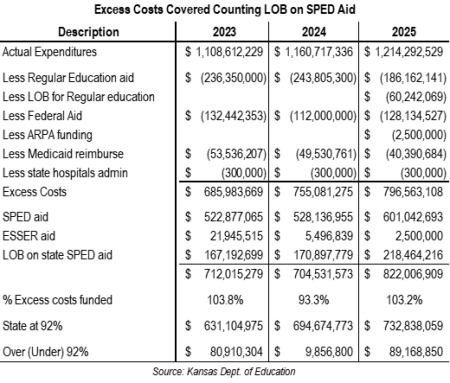
Additionally, Kansas school districts began the current school year with $260 million in carryover cash reserves in special education funds, and those that host special education co-ops had an additional $22 million. Districts are not legally required to maintain special education cash reserves, and several have zero ending balances. IUSD 500 Kansas City is one district that maintains a zero balance, and Olathe is close to zero.
Special education cash reserve increases result from districts transferring too much money from their General Funds. Some transfers are necessary, but districts would have more money to spend on regular education if they did a better job of managing their finances (as Kansas City does).
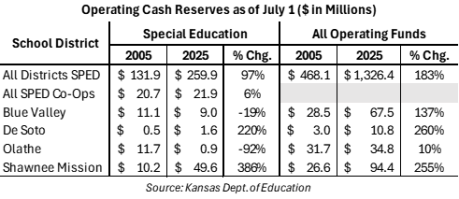 Cash reserves for special education are included in total operating funds, which grew from $468 million in 2005 to $1.3 billion last year. Most of the approximately $900 million increase represents state and local taxes that weren’t spent, which also undermines claims of underfunding. Dozens of districts routinely operate with less than 12% of their operating expenses in reserve at the beginning of each year,
Olathe and De Soto are below 12%, but Blue Valley and Shawnee Mission started this year with 24% in reserve. That’s on top of money set aside for capital projects and debt payments. Getting all districts to the 12% level would free up about $750 million.
School funding isn’t for unproductive, wasteful spending abounds
Everyone wants schools to be adequately funded, but some districts interpret that as permission to spend whatever they want, regardless of effectiveness or efficiency.
For example, De Soto spends $1,145 per student on administration (as defined by the Kansas Department of Education), while Blue Valley spends $1,753 per student, and Olathe spends $1,900.
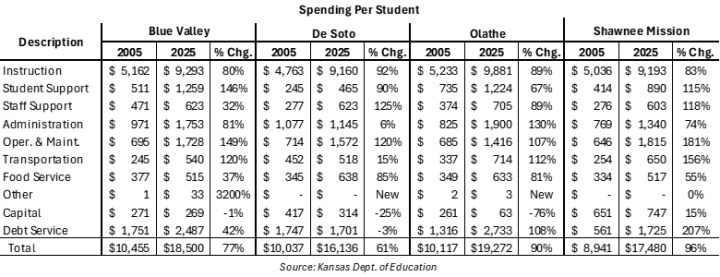
Additional examples of inefficiency and ineffective spending are found in comparisons of enrollment and employment.
Olathe has seen employment increase by 42% since 2005, while enrollment has grown by 21%. Blue Valley’s employment gains are also about double the change in enrollment (31% vs. 17%). The table below shows that Shawnee Mission’s enrollment is lower than in 2005, but the others have also been losing students over the last few years.
A lot of the growth in each of the soon-to-be plaintiff districts is in non-teaching positions. Shawnee Mission added 17% more managers despite enrollment declining, and Blue Valley added 54% more. (Our definition of managers includes superintendents, assistant and deputy superintendents, principals and assistant principals, directors, managers, instruction coordinators, and curriculum specialists.)
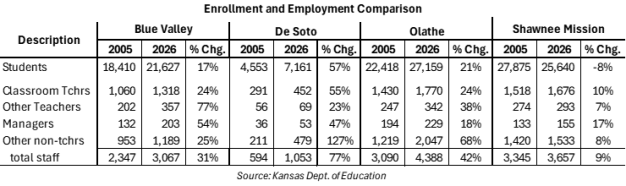
School boards may have approved adding more non-teaching positions in the hope that student outcomes would improve, but that clearly hasn’t happened.
Superintendents and school boards should close their budget shortfalls by right-sizing non-teaching staff and otherwise making better use of the $19,000 per student they collect from taxpayers.
Suing Kansans for more money isn’t necessary, and school districts already have proven that more money won’t improve student outcomes. That will only happen when the adults in charge of schools change their behavior.