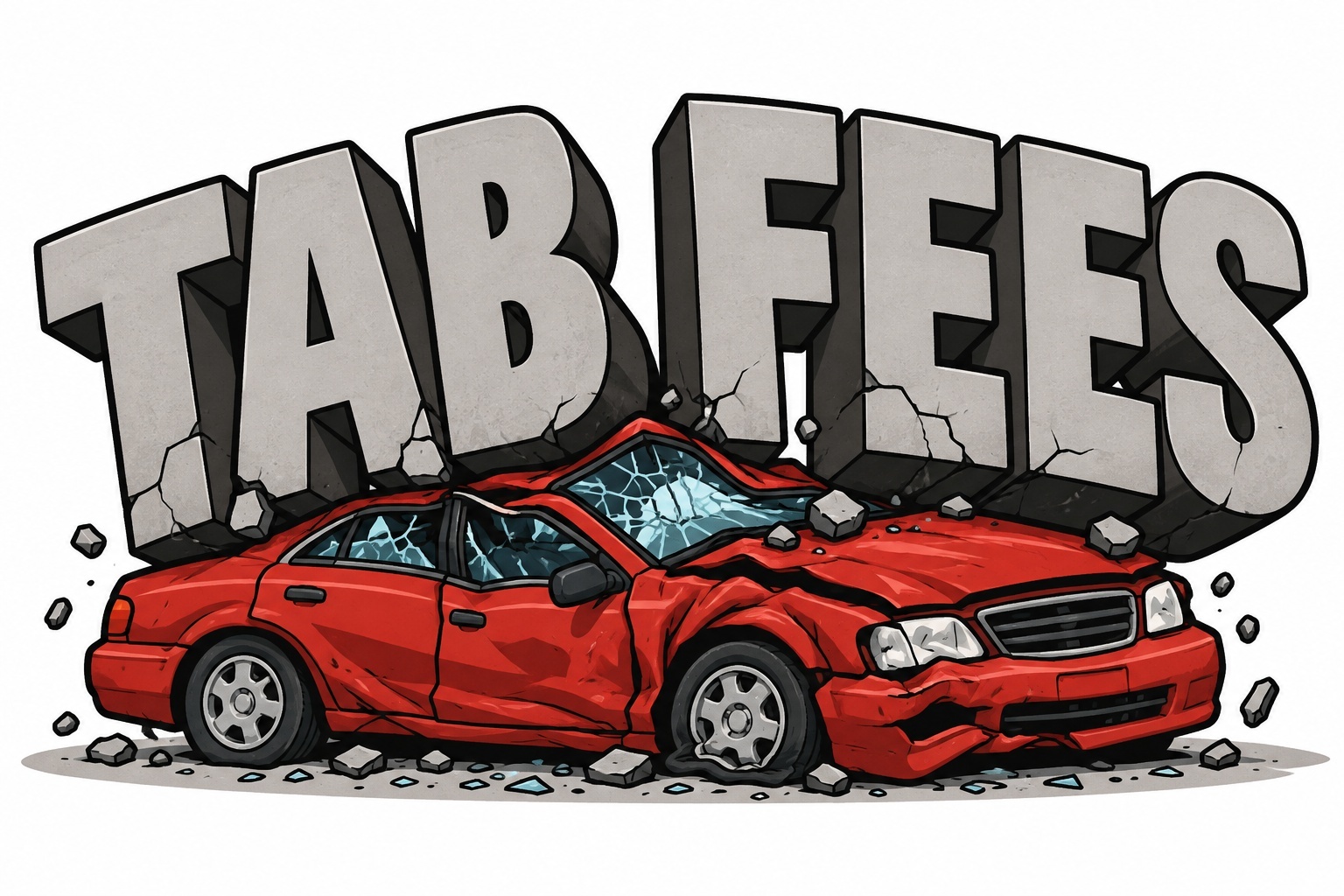
Last November, KSTP produced a report titled: “Wonder why your license tab fees aren’t going down? Here’s why…”
Lately, many Minnesotans who own vehicles less than five years old have probably noticed that their license tabs are not decreasing in cost every year, unlike in the past, as their vehicle ages.
“I just can’t get my head around it. I don’t understand the math,” says Joe Swanson of Plymouth. “The expressed frustration that I’ve heard since I noticed mine (haven’t gone down) and asked friends and acquaintances is that it doesn’t seem to go down anymore, and it used to go down every year.”
State records show the state portion of Swanson’s tab fees has stayed the same, $398, in 2024, 2025 and for the tabs he’s already purchased for 2026.
“Tab fees used to tumble down pretty dramatically as the car aged and you’re not seeing that anymore,” says Scott Lambert of the Minnesota Auto Dealers Association (MADA). He says along with higher motor vehicle sales taxes, tab fees are making vehicle ownership much more expensive in Minnesota.
Once again, the source of this squeeze on affordability in Minnesota turned out to be the “historic” trifecta the DFL had in the 2023 and 2024 legislative sessions.
“[I]n 2023, the DFL-controlled Minnesota Legislature approved a new formula for determining license tab fees,” KSTP explained:
For vehicles initially registered before Nov. 16, 2020, the tax rate for tab fees increased from 1.25% to 1.54% with the starting point being the manufacturer’s suggested retail price (MSRP).
If you registered your vehicle for the first time after Nov. 16, 2020, the tax rate went from 1.285% to 1.575%. At the same time, the legislature slowed the pace at which your vehicle depreciates.
Instead of going down 10% per year after the first year, your vehicle’s value now goes down 5% per year. So, in your third year of ownership, your vehicle has only depreciated 10%, and the state taxes you as if your vehicle is worth 90% of its original value. It doesn’t start going down 10% per year until the fourth year.
Meanwhile, Kelley Blue Book, a bible of sorts for car valuations, estimates the average vehicle depreciates about 40% in the first three years.
The new law and formula for license tab fees went into effect on Jan. 1, 2024.
“What (vehicle owners) are seeing is their number isn’t decreasing the way it used to,” says Lambert of MADA. “A three-year-old car seems like an old car, but its taxes are the same. It’s not right.”
With the trifecta broken after 2024’s elections, these tab fee hikes came up for debate again. The unfortunately named Rep. Brad Tabke — branded “Brad Tab-fee” by scurrilous wags — was sent out by the DFL to defend the hike. On the floor of the House, he claimed that, even after this hike, “We have one of the lowest tab fee rates for, uh, Minnesotans, than anybody in the upper Midwest.”
Yet, as the Star Tribune reported two weeks earlier, while “It’s difficult to compare tab fees across states…one recent comparison of nine western states by the National Conference of State Legislatures found they range from $50 to over $500, putting Minnesota well into the higher range” and that “A calculator maintained by the Wisconsin Department of Transportation that compares driving-related taxes and fees for dozens of different vehicles in that state to Minnesota, Iowa, Illinois and Michigan, found Wisconsin typically had the lowest and Minnesota often the highest.”
Happily, the Pioneer Press reported in May that “A one-time $254 million reduction for vehicle tab fees in 2027 — part of a deal Minnesota lawmakers struck at the end of the legislative session — will revert overall rates to pre-2024 levels.” “Republicans, who pushed for the temporary relief in closed-door negotiations with Democratic-Farmer-Labor leaders, claimed the fee reduction as one of their biggest wins this year,” the Pioneer Press explained. “DFLers, meanwhile, say they don’t want a permanent cut…”
The tab fee hike, like the imposition of unfunded mandates which have driven up property taxes and hikes in gas taxes, shows how one of the major pressures on affordability in Minnesota in the last couple of years was that 2023/2024 trifecta.