
What makes a government financially transparent?
Public reporting of state finances that is transparent, reliable, and timely is what the International Monetary Fund defines as fiscal transparency. Not only can the transparency of this information help governments respond appropriately to the ever-changing economy, but it can also help the public hold them accountable.
In the states’ Financial Score 2025, Truth in Accounting found that transparency scores for all 50 states have improved compared to the previous year. Most improved was the reduction in distortions of state net positions. Utah, West Virginia, and Indiana had the top scores while Illinois, Connecticut, and North Carolina scored the lowest. Scoring is based on audit quality, balance sheet accuracy, timeliness, and accessibility—audit quality being half of the scoring criteria.
On a more positive note, Massachusetts does offer CTHRU, which is a public transparency portal managed by the Office of the Comptroller that provides searchable access to statewide spending, payroll, and revenue dating back to 2009. This tool is designed to updated regularly and covers all three branches of the government, as well as agencies like the MBTA. However, even CTHRU has its flaws; as of mid-2026, a processing issue has left its payroll and spending data out of date.
Massachusetts’ transparency score: the highs and lows
Massachusetts was among the lowest scores when it came to net position distortions, scoring a 5 on Truth in Accounting’s 15-point scale. Massachusetts also scored 0 for timeliness, defined as producing an annual report within 100 days of the end of the fiscal year. Massachusetts’s fiscal year ends June 30, meaning its financial report should be published by early October. Instead, the state’s Annual Comprehensive Financial Report has been consistently published 10 to 11 months after the fiscal year ends . For example, Fiscal Year 2024 was published in May of 2025.
Other than net position reporting and timeliness, Massachusetts scores highly on all other criteria, with an overall financial transparency score of 77/100.
However, while Massachusetts generally scores well in its fiscal reporting, it fails miserably in making policy makers’ and legislators’ Statements of Financial Interests transparent because it is so late in publishing its CFRs. Pioneer Institute gives the Commonwealth a score of 15/100 for providing transparent access to annual public financial disclosures.
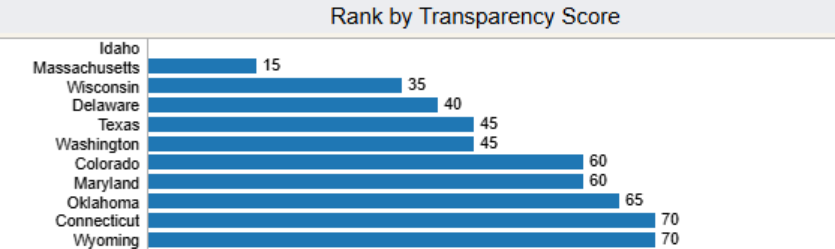
Figure 1: Transparency scores by the bottom ten states from U.S. Data Labs.
The scope of the State Auditor’s authority: the Massachusetts debate
A heated debate is currently raging over whether the Massachusetts State Auditor should have the authority to audit the Legislature, investigating legislative spending and contracts of taxpayer-funded institutions. In 2024, more than 2.3 million Massachusetts citizens voted “yes” to Question 1 on the state ballot, granting the auditor that authority.
Those in favor of the ballot question believe its passage will promote transparency, accountability and reduce the misuse of public funds. Those opposed believe that giving such authority to the auditor—a member of the executive branch—would violate the constitutional separation of powers and could lead to the weaponization of audits to interfere with internal voting and policy debates.
Just recently the House passed Bill 5469, which, among several anti-transparency provisions, includes a clause to restrict the audit scope to four specific categories: budgets, official audits, appropriated expenditures, and monetary supplements. Most, if not all of this information is already made public. The bill was passed on June 3 and now awaits a Senate vote and Governor Maura Healey’s signature to take effect. House Speaker Ron Mariano claims it will promote transparency, but rightfully, Massachusetts State Auditor Diana DiZoglio disagrees, stating that it is unconstitutional and against what citizens voted for in 2024.
There is currently an initiative that may appear on the November 2026 ballot to subject records held by the state Legislature and Governor’s Office to the public records law. As of now, Massachusetts is the only state where these records are exempt from the law, making it a lot harder for Massachusetts citizens to freely access information such as legislative voting records and meeting notes.
It is evident that Massachusetts presents a mixed picture on financial transparency. It outperforms peers in key areas related to transparent government operations, yet struggles with timely reporting and producing an accurate balance sheet. The Massachusetts Legislature is also one of the least transparent in the country. The debate over the scope of the auditor’s authority reflects the tension between the public’s opinion and a Legislature that wants to limit oversight, making the push for transparency a constantly evolving endeavor.
Nina Argel is a Roger Perry Government Transparency Intern with the Pioneer Institute. She is a rising junior and James Monroe Scholar at the College of William & Mary with a double major in Government and English.