On July 1, 2026, Xcel Energy opened a proceeding with the Colorado Public Utilities Commission (PUC) about its Clean Heat Plan compliance. The Clean Heat Plan requires that Colorado gas utilities reduce their greenhouse gas emissions by 41 percent compared to 2015 levels by 2035. The law also aims for 22 percent reductions by 2030 and, critically, four percent emissions reductions by the end of 2025.
Xcel won’t say so directly, but the company has already whiffed its 2025 target. That’s despite spending $65.4 million in 2025 for 24,821 metric tons of program-attributed emissions reductions.
It isn’t a surprise to Xcel that it’s missing the mark, given the company’s own consultants said in a 2024 filing that “achieving the 2025 goal is extremely unlikely.” The PUC approved the plan anyway, waiving the 2.5 percent cost cap on the grounds that doing so was in the public interest.
Table 12, on page 28 of Hearing Exhibit 103, Attachment 1, of Proceeding 26A-0263EG, shows the math clearly. The number to beat is 7,127,540 metric tons of CO2-equivalents (CO2e) emitted in 2015. If Xcel reduced emissions four percent below that baseline, the company would be expected to emit 6,842,438 metric tons in 2025.
In 2025, the company’s actual emissions were 7,333,175 metric tons, or 7.2 percent above the compliance level — higher than they were in 2015.
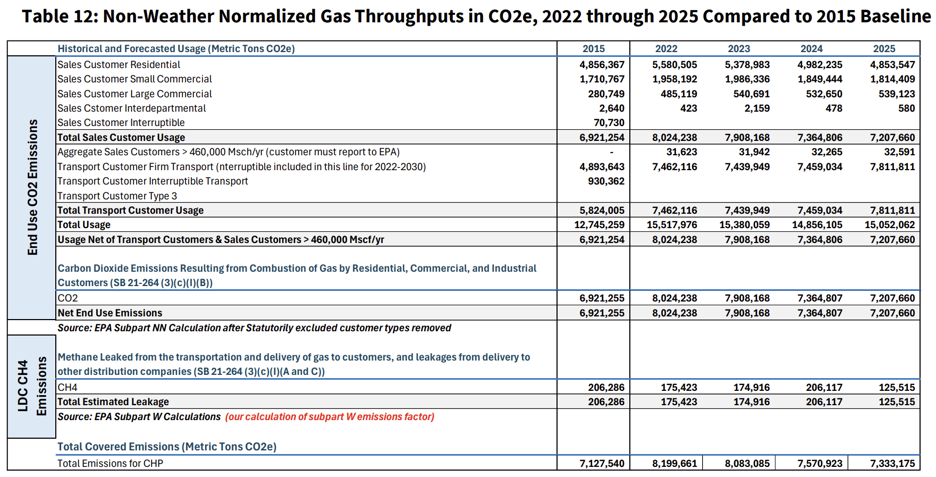
Emissions in 2025 fell 237,748 metric tons since 2024, when the Clean Heat Plan went into effect. However, Xcel attributes only 10.4 percent of that (24,821 metric tons) to Clean Heat programs like rebates for residential HVAC, insulation, weatherization, and other programs. On a first-year basis, that’s $2,635 per ton of CO2 averted by Clean Heat Plan programs.
A forward-looking portfolio analysis by the consultancy Energy and Environmental Economics (E3) (Exhibit 103, Attachment 2) modeled what it would cost to reach these emissions reduction targets. If Xcel stayed strictly under the Clean Heat Plan’s statutory 2.5% cost cap, at an annual program implementation cost of $41 million, the company would achieve only 3 percent of the 2030 emissions target.
Annual costs of $41 million are a bargain next to what it would cost to actually meet the emissions target, which would range “between $1.0 and $1.4 billion per year,” breaking the cost cap by a factor of 23: “This range is equivalent to 58% to 83% of the Company’s forecasted 2030 natural gas revenue requirement,” or well more than half of what Xcel collects from every gas customer in the state.
E3 also notes that “the scale of electrification required to meet the target in this scenario requires an unprecedented, nearly overnight transformation of the heating appliance market in Colorado.” It’s not even clear that high incentive spending would be sufficient to drive adoption to the levels needed to meet these emissions targets.
That’s regulatory euphemism for: this just isn’t going to happen.
Xcel prefers to split the difference, still breaking the cost cap to spend between $190 and $245 million annually, and achieve annual emissions reductions equivalent to 21% of the 2030 emissions target.
E3’s modeling priced out that the cost of HVAC electrification comes out to nearly $700 per ton of CO2 equivalents abated under current empirical operating data. More optimistic modeling for hybrid and all-electric heat pumps run slightly less than $400 per ton of CO2 and $500 per ton of CO2, respectively. Colorado’s own social cost of carbon statute prices the social cost of carbon at only $68 per short ton, or about $75 per metric ton, meaning that in any case, Xcel will have to spend far more than the state thinks each ton of CO2 is worth.
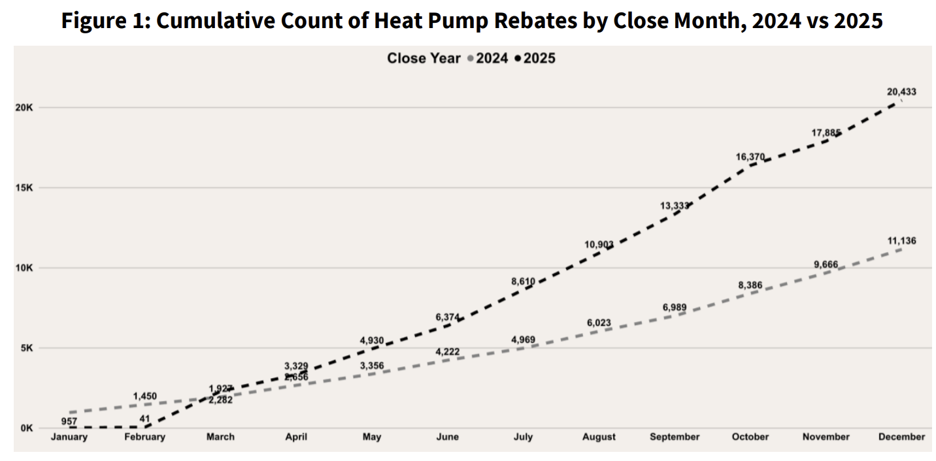
The Clean Heat Plan is designed to force households off of natural gas. Xcel notes that “heat pump adoption is of particular interest” to the company and the PUC, but heat pumps are an input, not a measurable emissions outcome. The company says it paid 12,186 heat pump rebates in 2025, more than double the prior year, and another 3,461 in the first quarter of 2026. (It isn’t clear why these figures differ from those in Figure 1, which shows a cumulative 20,433 rebates redeemed by December 2025, and 11,136 redeemed in 2024). Despite this, residential combustion emissions in 2025 sat within six-hundredths of a percent of their 2015 level.
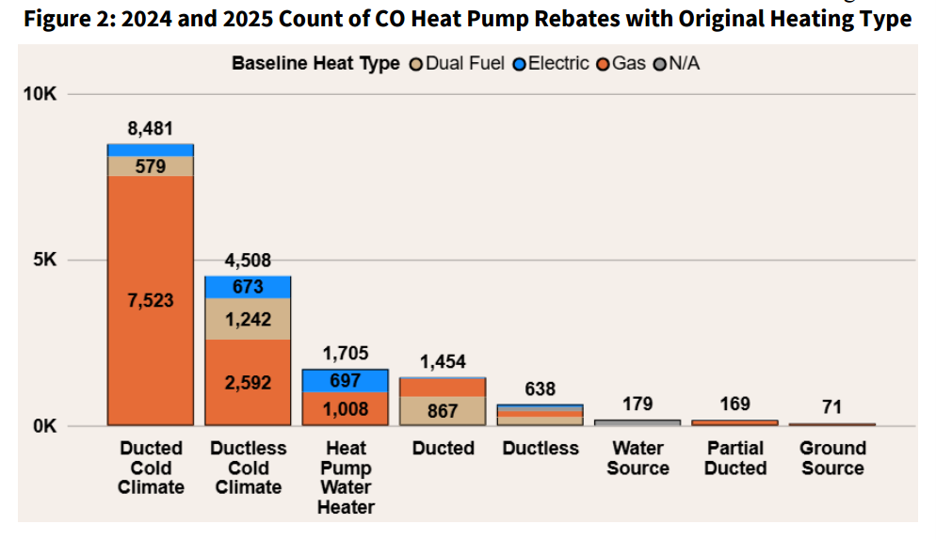
That’s in part because heat pumps installed in all-electric homes are an efficiency upgrade, potentially, but don’t remove emissions from Xcel’s natural gas system. Figure 2 shows at least 10 percent of the rebates issued in 2024 and 2025 were to homes already heated with electricity, and another 16 percent went to dual-fuel customers who kept their gas furnace as backup. The actual emissions reductions from dual-fuel systems depend greatly on how often the heat pump runs instead of gas. (Figure 2 sums to only 17,205 heat pump rebates across both 2024 and 2025, which adds more ambiguity to how many rebates have actually been issued).
Xcel is directing $11.6 million into income-qualified rebates in 2025, but it acknowledges that this market has “added sensitivity to the potential bill impacts of transitioning their heating source from natural gas to an electric heat pump.” If running a heat pump raises operating costs for low-income households, then it raises them for others, too. The price of gas being lower than the price of electricity doesn’t depend on income. For dual-fuel households that can switch between gas and electric heat-pump use, stakeholders have “raised concerns” that setpoint temperatures are too high; customers can dodge higher costs of running the heat pump by raising the switchover temperature.
On June 4, 2026, the PUC also denied most of Xcel’s request for $2.9 billion for its gas infrastructure program, on the basis that the state has policies to “encourage” electrification and “all-electric heating,” and Xcel had failed to account for electrification in its load forecast. That electrification is being pushed through the Clean Heat Plan, which isn’t succeeding in meeting its emissions reductions targets and, if it did, would cost more than a billion dollars each year to do. Either Xcel needs to invest and maintain its gas system, or the Clean Heat Plan is retiring gas demand fast enough to make that investment redundant — not both.