In most states, where a child goes to school is still largely based on where that child lives. Wealthy families buy homes in the “right” zip code to live in a desirable school district; those without that luxury take what they are assigned. It’s a system that has created unequal access to education over the years.
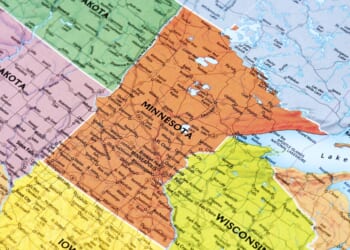
Open enrollment policies seek to remedy these residential assignment policies. Minnesota’s 1988 open enrollment law was the nation’s first, allowing students to attend public schools outside their zoned home district. It remains a central feature of Minnesota’s public education system and is used by tens of thousands of families each year.
Data from the Minnesota Department of Education show that open enrollment participation has increased by roughly 27 percent over the last decade. In the 2015 school year, 75,166 students enrolled outside their residential districts. By 2025, that number has grown to 95,214 students. With total K-12 public school enrollment at 843,287, just over 11 percent (or roughly 1 out of every nine students) are open-enrolled outside their home district. Nationally, Minnesota is among the largest open enrollment programs in the country, tied with Indiana for fourth.
Families choose other schools for a variety of reasons — to escape bullying, access specialized programs, different teaching approaches, smaller class sizes, or an athletics program their home district doesn’t offer. The competition is an opportunity for school districts to give families a reason to stay and to offer programs that families can’t easily find somewhere else.
So who’s getting who?
According to Minnesota Department of Education data, the Minnetonka school district received more students through open enrollment than any other district during the 2025-26 school year (4,743 students). The St. Paul school district was second, with 2,413 incoming students, followed by Rosemount-Apple Valley-Eagan (2,136 students) and Edina (2,032 students).
But as districts gain students, they also lose students. And vice versa.
The interactive tool below shows the movement for the 2025-26 school year. You can track how many students left each district for other districts, how many students each district gained, and where they came from and went.
Interactive Tool: Where are Students Coming From and Going To?
Data from the Minnesota Department of Education (2025-2026)
I also calculated each district’s net change — students gained minus students lost — in the spreadsheet below. The districts shaded green gained students overall through open enrollment. The red districts lost more students than they gained.
Spreadsheet: Students Lost and Gained by District (Net Change)
Minnetonka came in as the biggest net winner (+4,538 students). Minneapolis was the biggest net loser by a wide margin (-5,363 students). Minneapolis lost its largest groups of students to Edina (868 students) and Robbinsdale (824). Minnesota’s largest school district, the Anoka-Hennepin school district, lost 3,080 students to other districts while only gaining 1,680 students, for a net change of -1,400. Saint Paul school district also had a negative net change of 923 students.
Raw net change numbers, though, don’t tell the whole story on their own because they don’t account for district size. A district that gains 50 students out of an enrollment of 500 looks very different from one that gains 50 students out of 5,000.
That’s why I also calculated net change as a percentage of each district’s total enrollment. This gives a better sense of how much open enrollment changes a district’s student population.
For certain districts, the effect is substantial. In the Houston school district, 72 percent of enrolled students arrived from another district. In the small, rural Goodridge district, more than half (50.2 percent) of the students enrolled came from other districts.
You’ll also notice in the spreadsheet a couple of districts with percentages below 100 percent. Take the Ivanhoe district, which currently has 66 students. Eighty-one students who live in the district chose to attend school somewhere else. Only five students living outside the district chose Ivanhoe. For every student in an Ivanhoe classroom, there are more than one and a half students who live in the district but go to school elsewhere, which produces a net change over 100 percent. That number is high not because the district lost more students than it has, but because so few of its residentially assigned students actually enrolled.
No school is going to be the right fit for every child, and open enrollment gives families another option. While there are problems to work out (including transportation gaps), the answer shouldn’t be to make open enrollment harder to use. Instead, policy decisions should focus on the goal of the law in the first place: to give students access to a classroom that works best for them. Minnesota was the first state to make this a possibility within the public school system, but it can’t rest on its laurels.