Back in July, the Minnesota House reported:
DFL legislators from the Minnesota House and Senate unveiled the Minnesota Values Project Policy Agenda 2027. The agenda is the result of input from Minnesotans across the state and will serve as the guiding vision for lawmakers when they return to the Capitol in 2027.
The agenda is 16 pages of fresh spending commitments, some large, and all on top of a budget which is already in deficit.
But just how expensive would the DFL’s agenda be?
A number of the proposals are vague: “Rein in corporate consolidation in health care,” “We’ll support local farms and new farmers,” and “Every worker deserves to be listened to and safe on the job,” for example, could mean almost anything. Others do not impose a direct fiscal cost. Some, however, are less vague and would impose a direct cost.
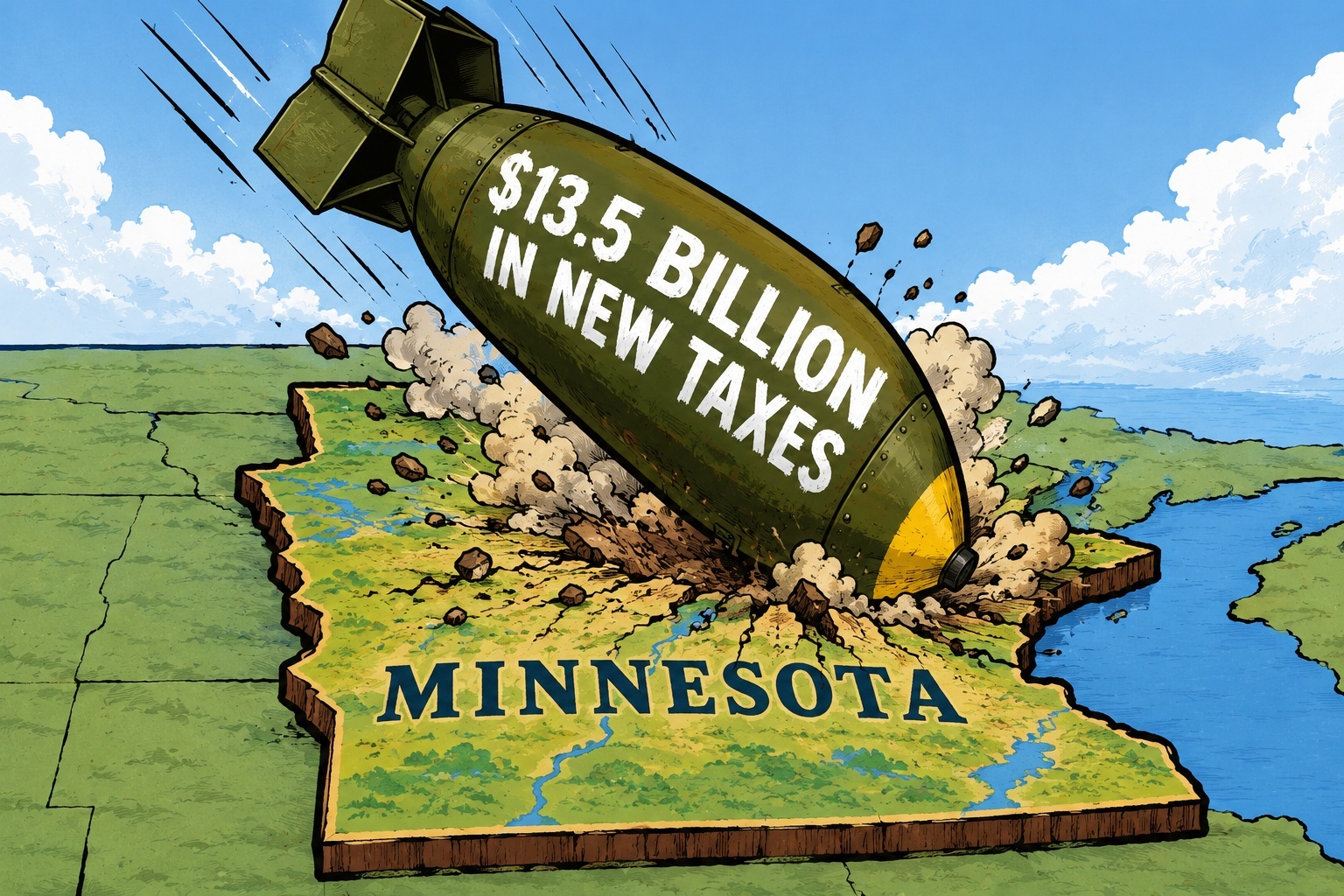
Here is our attempt to estimate just how expensive the DFL’s agenda would be. In all cases, we have adopted what we believe to be the most conservative assumptions possible. In total, we estimate that the DFL’s agenda would require $13.5 billion in new spending annually and, of course, a matching amount of extra tax revenue.
Healthcare – $2.8 billion
The DFL’s agenda promises to:
- Establish Universal Primary Care
How much would this cost?
According to the Census Bureau, Minnesota has 5.8 million residents. The Centers for Medicare & Medicaid Services estimates that National Health Expenditure totaled “$15,474 per person” in 2024. Together, these numbers give total health spending of $90.2 billion in Minnesota. The Health Care Cost Institute estimates that 4.0% of health spending goes to primary care which, applied to that $90.2 billion, gives an estimate of $3.6 billion annually.
We can approach the question another way. In December 2024, the Minnesota Department of Health (MDH) estimated health care spending in our state of $66.8 billion. In October that year, MDH estimated that “Over the course of the next ten years (2022 through 2031), MDH projects health care spending to grow 5.6% per year.” If so, then health care spending in Minnesota will have hit $83 billion in 2026. If we apply the 4% rate for primary care spending to that total, we get an estimate of $3.3 billion.
It is important to note, however, and will be again, that some of this new spending replaces current spending rather than adds to it. Currently there are no copays or any type of cost sharing in Medicaid, which means that primary care is already free for the 1.1 million Minnesotans on that program, or 18.9% of the state’s population. If we reduce our estimate of primary care spending of $3.3 billion by 18.9%, we arrive at a total of additional spending of $2.7 billion.
We can expect that reducing the cost of primary care would lead to an increase in the demand for it — indeed, that is one of the scheme’s selling points — so we can also expect the cost of providing it to rise. On the other hand, earlier treatment and better management of chronic diseases might reduce some avoidable emergency department visits and hospital admissions down the line; another of the scheme’s selling points. Which of these will dominate is unknown.
We conservatively estimate that universal primary care would require $2.7 billion in new spending annually.
The DFL’s agenda also promises to:
- Expand access to public health care options like Minnesota Care
This echoes a scheme from 2024 to “to open the program up to anyone,” as MPR News reported, which the Minnesota Department of Commerce estimated “would cost the state between $113-364 million annually” if it “let anyone buy into a plan identical to the existing MinnesotaCare coverage” and “between $86-187 million annually” if “three different “levels” of the plan that would be sold on MNsure” where “People earning over the current MinnesotaCare income limit would qualify for the “platinum level” plan.”
Going with the lowest of these estimates, we conservatively estimate that expanding access to Minnesota Care would require $86 million in new spending annually.
Together, these commitments add up to $3.4 billion in new healthcare spending annually.
Energy – $4.5 billion
The DFL’s agenda claims:
- We’re ready to invest in weatherization and clean heat for both homes and small businesses…
According to the Census Bureau, there are 2,616,906 housing units in Minnesota. The Center for Energy and Environment estimates that “The median upfront cost per dwelling of weatherization and electrification is $29,000 to $33,000.” If we commit to weatherize and electrify half of Minnesota’s housing units at $31,000, we are looking at a total cost of $40.6 billion. If we spread that over ten years, that is $4.1 billion in new spending annually.
According to the Energy Information Administration, the average commercial building is 16,300 square feet. In Minnesota’s climate, retrofitting a baseline commercial structure of this size involves two distinct operational phases. First, commercial weatherization, which includes air sealing, blown-in insulation, and high-performance commercial spray foam. This can average $1.25 to $3.00 per square foot, or, at that low end, $20,375 for the average commercial building. The second step, clean heat conversion, involves transitioning away from natural gas to cold-climate Variable Refrigerant Flow systems or high-efficiency rooftop heat pump units (RTUs) rated to handle sub-zero temperatures. RTUs are among the most affordable options for mid-size retail and office buildings, typically ranging from $10,000 to $50,000. If we make the most conservative assumption of $10,000 and add that to the cost of commercial weatherization, that works out, at the low end, to $30,375 per commercial building. If we apply this to just half of Minnesota’s 160,773 estimated commercial properties, we get a total cost of $4.9 billion. If we spread that over ten years, that is $460 million in new spending annually.
Taken together, we conservatively estimate that this proposal would require $4.5 billion in new spending annually.
Childcare – $2.6 billion
The DFL’s agenda promises:
- Low or no-cost child care access for every Minnesota family, as universal and in as many towns in the state as we can make it.
Since the state government already spends an average of $500 million on existing childcare programs, my colleague Martha Njolomole estimates that this program would cost $2.6 billion in new spending annually.
Education – $2.6 billion
The DFL’s agenda promises to:
- Invest in quality, accessible Special Education
As the Minnesota House reported in April:
Minnesota special education spending has increased from $1.8 billion to $2.7 billion per year over the last five years.
Those skyrocketing costs led to a 2025 law creating a Blue Ribbon Commission to find $250 million in special education cuts or mandate an automatic $250 million deduction in special education cross subsidy aid.
As this is a biennial total, reversing these cuts would require $125 million in additional spending annually.
The DFL’s agenda also promises to:
- Stabilize the compensatory school funding formula
As my colleague Catrin Wigfall warned at the time, compensatory funding ran into trouble after the 2023 universal school meals law reduced the number of families filling out free and reduced-price meal applications. Under the revised funding formula, schools were projected to lose about $34 million in compensatory aid statewide. The Legislature provided an additional $10 million in one-time funding for FY 2027 to help offset those losses, which still leaves a $24 million deficit.
To fill this deficit would cost $34 million in additional spending annually.
The DFL’s agenda also promises to:
- Continue our investment in unemployment for seasonal school workers
This resurrects a scheme passed by the DFL’s 2023 trifecta which cost an estimated $45 million in 2023 and $57 million in 2024, according to the Minnesota Department of Education.
If we split the difference, we conservatively assume that this scheme would require $51 million in new spending annually.
The DFL’s agenda also promises to:
- Create a public health insurance pool for educators
This is the Educator Group Insurance Program. This is modeled on the state employee group insurance program — SEGIP — the state employee group insurance program that has covered legislators and state government workers for decades. Employees on “single” and “family” plans pay 5% or 15% of the total premiums, respectively, with the state covering the rest. The monthly premiums for Medical Coverage are currently $48.94 for a single plan and $333.92 for a family plan and for Dental Coverage are $14.50 for a single plan and $61.86 for a family plan. We can use these numbers to calculate the state’s share of the annual payment.
According to the Minnesota Department of Education, there are currently 74,584 “Licensed staff headcount” and 66,674 “Non-licensed staff headcount,” for a total staff of 141,258. If we assume that 50% of these staff sign up for family plans and 50% for single plans, we can estimate how much the state government would be paying towards this scheme annually.
It should be noted that much of this spending would replace spending currently undertaken by school districts and, to that extent, it might represent more of a shift of the tax burden, from local to state authorities, than a new burden. Even so, it will fall to the state government to cover this new cost, and it must find some way of doing so.
We estimate that this program will require $2.4 billion annually in new spending.
Together, these commitments add up to $2.6 billion in new education spending annually.
Overall – $13.5 billion
All this new spending would come on top of a state budget where spending is already above revenues, by around $1 billion annually. To assess the full fiscal cost of the DFL’s agenda, that amount must be added to the new spending proposals.
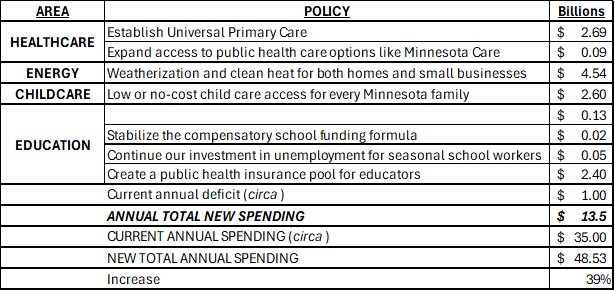
Altogether, Minnesota’s state government would, under the DFL agenda, be spending something like $13.5 billion more each year than it currently is, as Table 1 shows. This represents a 39% increase from the current levels of around $35 billion. The scale of this is staggering.
Table 1: Estimated annual cost of DFL’s Minnesota Values Project Policy Agenda 2027
Some of these policies may be desirable, like the expanded health insurance pool for educators. Some have support from Republicans, like spending on special education. But the state government is not like the federal government. It cannot borrow or print money to finance its spending. Every cent of that $13.5 billion will have to be extracted from Minnesota’s taxpayers, already some of the most heavily taxed in the United States, and an economy which is already growing more slowly than the national average, and by a state government which has allowed billions of dollars to be stolen in fraud. This will be a massive blow to affordability for Minnesotans.